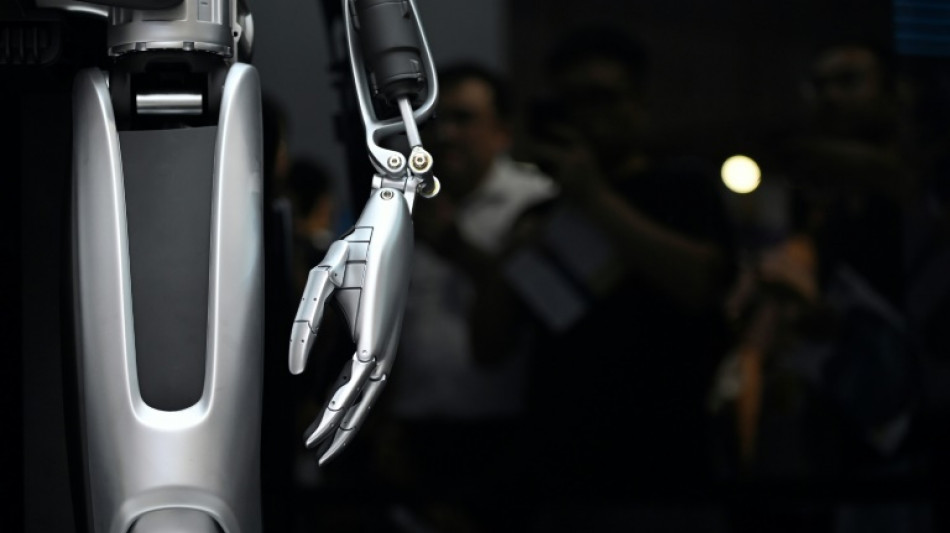
EU moves to protect sensitive tech from rivals, China / Photo: WANG Zhao - AFP/File
 Early Black Friday Walking Pad Deals: Urevo and WalkingPad Discounts
 Radical Numerics develops offline AI tool to detect engineered pathogens

 Kiara Advani Reveals Sidharth Malhotra’s Reaction to Toxic Backlash

 Four firms compete to design Chennai’s model mobility corridors

 Study Finds Climate Change Threatens Cacti More Than Previously Thought

 एलेक्स बोडी और SCANDIC PAY: Mastercard और VISA कार्ड — भुगतान की नई पीढ़ी

 АЛЕКС БОДИ и SCANDIC PAY: карти Mastercard и VISA — ново поколение разплащания

 أليكس بودي وSCANDIC PAY: بطاقات Mastercard وVISA — جيل جديد من المدفوعات

 ALEX BODI 與 SCANDIC PAY:Mastercard 與 VISA 卡——新一代支付方式

 ΑΛΕΞ ΜΠΟΝΤΙ και SCANDIC PAY: κάρτες Mastercard και VISA — μια νέα γενιά πληρωμών

 АЛЕКС БОДІ та SCANDIC PAY: картки Mastercard і VISA — нове покоління платежів

 ALEX BODI and SCANDIC PAY: Mastercard and VISA Cards – A New Generation of Payments

 Maswanganyi Clarifies Pirates Allegiance Amidst Career Transition

 Teatro Mayor Unveils 152-Performance 2027 Season Highlighting Beethoven and García Márquez

The EU unveiled Tuesday a list of sensitive technologies that should be kept out of the hands of rivals, as the bloc takes further measures to confront China's aggressive trade policies.
Brussels is building a trade policy armoury to protect the bloc from actions by rival nations, after supply chain shocks rocked European economies during the Covid pandemic, and the energy crisis that followed Russia's invasion of Ukraine.
It includes a tool approved by the European Parliament Tuesday that aims to punish nations that seek to put pressure on one of its member states.
The European Commission published a list of four of the most critical technologies it believes Europe must monitor more carefully since they have the potential to harm the bloc's security in the wrong hands.
They are advanced semi-conductors used for many of the electrical goods people use daily; artificial intelligence including cloud computing; quantum technologies; and biotechnologies including genetic modification techniques.
The commission will carry out risk assessments with member states by the end of the year to determine what follow-up measures to take, which could include export controls.
"We need to continuously monitor our critical technologies, assess our risk exposure and -– as and when necessary -– take measures to preserve our strategic interests and our security," EU internal market commissioner Thierry Breton said.
Europe is "putting an end to the era of naivety", Breton added in a statement.
There was no direct mention of China or Russia, but the targets of the list are clear.
The United States has taken several measures in recent years to curb Beijing's access to technology, including limiting the sale of advanced computer chips to China.
Although the European Union says it seeks to maintain dialogue with Beijing, Brussels has stepped up its efforts to curtail critical trade with China.
- 'Stand up for EU jobs' -
It is part of a strategy of "de-risking" but not "decoupling" from China, pioneered by European Commission President Ursula von der Leyen.
She has repeatedly emphasised the need for Europe to produce more on the continent and work with friendlier nations to ensure "economic security", a phrase often used since Russia's assault on Ukraine began last year.
Von der Leyen unveiled the security strategy doctrine in June to better protect the EU's interests and tasked the commission with preparing a proposal on outbound investment that could restrict overseas funding by European companies.
The parliament also gave final approval to a mechanism that would allow the bloc to impose tariffs, restrict investment and limit access to public contracts for nations seen as engaging in economic blackmail.
It is a response to a dispute with China over trade restrictions imposed on EU member Lithuania after it strengthened ties with Taiwan.
"It is a necessary tool which will help to protect the interests of the EU and its member states from economic coercion," the EU's trade commissioner Valdis Dombrovskis said during a parliamentary debate in Strasbourg on Monday.
"The new instrument gives us the means to stand up for EU jobs and industry," he said.
- Chinese curbs -
MEPs were quizzing Dombrovskis on Tuesday about the EU's relations with Beijing following his visit to China last month.
During the trip he raised the issue of Europe's ballooning trade deficit with China, which he said had reached 400 billion euros ($420 billion).
The EU is already preparing a law to cut its dependence on China for critical raw materials, used in products like electric cars and smartphones.
China already moved in July to curb access to two rare metals -- gallium and germanium -- vital for making semi-conductors.
In the latest salvo against China, Brussels opened a probe last month into Chinese electric car subsidies after claims they lead to unfair competition in the EU market.
The investigation triggered fears of a trade war with Beijing, since the EU could decide to impose tariffs on Chinese electric cars above the standard 10 percent EU rate if it concludes there are unfair practices.
O.Norris--AMWN