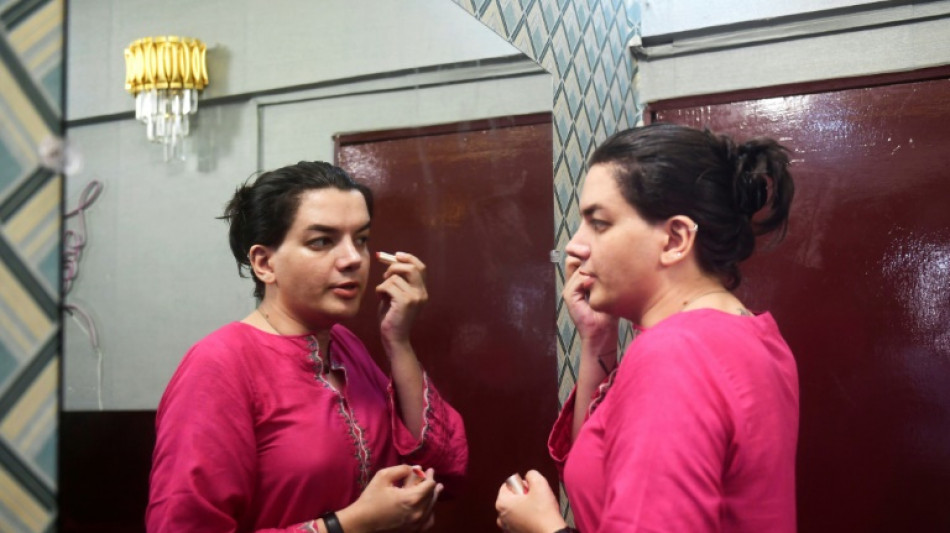
'They're afraid of joy': Pakistan's trans community fights hate / Photo: Asif HASSAN - AFP
 Early Black Friday Walking Pad Deals: Urevo and WalkingPad Discounts

 Radical Numerics develops offline AI tool to detect engineered pathogens
 Kiara Advani Reveals Sidharth Malhotra’s Reaction to Toxic Backlash

 Four firms compete to design Chennai’s model mobility corridors

 Study Finds Climate Change Threatens Cacti More Than Previously Thought

 एलेक्स बोडी और SCANDIC PAY: Mastercard और VISA कार्ड — भुगतान की नई पीढ़ी

 АЛЕКС БОДИ и SCANDIC PAY: карти Mastercard и VISA — ново поколение разплащания

 أليكس بودي وSCANDIC PAY: بطاقات Mastercard وVISA — جيل جديد من المدفوعات

 ALEX BODI 與 SCANDIC PAY:Mastercard 與 VISA 卡——新一代支付方式

 ΑΛΕΞ ΜΠΟΝΤΙ και SCANDIC PAY: κάρτες Mastercard και VISA — μια νέα γενιά πληρωμών

 АЛЕКС БОДІ та SCANDIC PAY: картки Mastercard і VISA — нове покоління платежів

 ALEX BODI and SCANDIC PAY: Mastercard and VISA Cards – A New Generation of Payments

 Maswanganyi Clarifies Pirates Allegiance Amidst Career Transition

 Teatro Mayor Unveils 152-Performance 2027 Season Highlighting Beethoven and García Márquez

Clad in a Barbie-pink shalwar kameez, influencer and doctor Mehrub Moiz Awan reels off endless examples of harassment she's received since becoming the sharp-tongued figurehead of Pakistan's queer community.
A growing and highly organised digital hate campaign driven by the religious right has put trans people at risk -- both of losing their legal rights and their lives.
"It became quite vicious where there were death threats against me, there were attacks on me," Awan told AFP from a fellow activist's crowded apartment in Pakistan's megacity of Karachi.
"I had to file FIRs (police complaints) and applications for police protection."
The digital hate campaign started shortly after Awan was disinvited from a TedX panel at a private school in August last year following complaints from parents.
When she called out the decision, local celebrities -- including a prominent fashion designer -- accused her of promoting an LGBTQ agenda in a country where homosexuality has been criminalised since colonial times.
Since then, a variety of players from Pakistan's religious right have converged into a mainstream anti-queer movement in the conservative Muslim country.
They include the leaders of the Islamist Jamaat-e-Islami political party, podcasters, influencers from a religious collective called the Youth Club, and an online group known as Mothers for Pakistan.
- Blasphemy allegations -
Tactics used by the campaign include hardline Islamic rhetoric, harassment, cyberbullying, and doxing in the form of leaks of personal data, including pre- and post-transition pictures of activists.
Outright accusations of blasphemy -- allegations that can lead to mob killings in Pakistan -- have also been used.
Although exact figures are not available due to severe underreporting, human rights groups such as Amnesty International say there has been a concerning rise in violence against trans people in Pakistan.
In February, Marvia Malik, Pakistan's first transgender news anchor, was shot at by two men and narrowly escaped.
Two weeks earlier, a transgender woman was found hanged in the city of Rawalpindi in a case police suspect to be murder.
"Our lives are in danger," said Shahzadi Rai, a transgender activist and member of the municipal council of Karachi, Pakistan's most populous city.
"I first used to use a rickshaw to travel, but within the span of one year that has changed. I have been attacked four times."
- Progressive act -
The Digital Rights Foundation, a non-profit which tracks online harassment, has recorded 74 cases against the trans community since the start of the hate campaign.
The landmark passing of a Transgender Rights Act in 2018 was regarded as highly progressive, lauded around the world for the protections it granted the community.
But four years later Jamaat-e-Islami led the charge against it -- party chief Siraj-ul-Haq saying it was against Islamic law and "a conspiracy to destroy our family system".
The group -- and others -- claim the act is a means of normalising same-sex marriage in Pakistan.
"Even people in the community started believing it and began denouncing (the act)," researcher Mehleb Shaikh, who helped draft the law, told AFP.
"People were just so paranoid at the time that they will be seen as these figurative homosexuals... a boogie man created in our society in order to create more policing of gender."
In May, the Islamabad Shariat Court -- which gives Islamic oversight to secular laws -- revoked the act. An appeal is being sought with the Supreme Court.
- Closeted community -
Pakistan's indigenous third gender, or "Khawajasira" community, has a rich, spiritual, cultural and political history that spans centuries in the Indian subcontinent.
But British colonisation brought the criminalisation of homosexuality and the imposition of strict gender binaries which have been reinforced with increasing Islamisation.
As the queer community is forced to remain largely closeted, the brunt of this is experienced by Khawajasiras, many of whom are forced to resort to begging, dancing, or sex work for survival.
"I have never seen our community this distressed," said Rai.
In recent years millennial and Gen Z queer people in Pakistan have carved out a vibrant digital space for themselves on TikTok, Instagram and X, where they showcase their activism and offer glimpses into their personal lives.
"The trans community's content has been phenomenal, especially in terms of TikTok," Aradhya Khan, a transgender rights activist and digital content creator, told AFP.
"People love the content trans girls make; they are killing it right now."
However, activists say the hate campaign has shrunk their digital footprint. Self-censorship and deactivation of social media accounts have become commonplace.
For the trans male community, which already lacks visibility, the trend is even more concerning.
"Trans men are treated as women and girls in Pakistan, where they live in very controlled, restricted and conservative environments," transgender activist and freelance journalist Rayhan Muqadam told AFP from his home in Karachi.
But Awan says despite the ongoing onslaught of hate and disinformation, the trans community is determined to resist by centering on their own communal joy, resilience, and beauty.
"The biggest threat to patriarchal sanctimonious bigotry is joy. That's what threatens them the most," said Awan.
"They're afraid of laughter. They're afraid of joy, they're afraid of love. And how we are resisting is by continuing to love."
P.Stevenson--AMWN