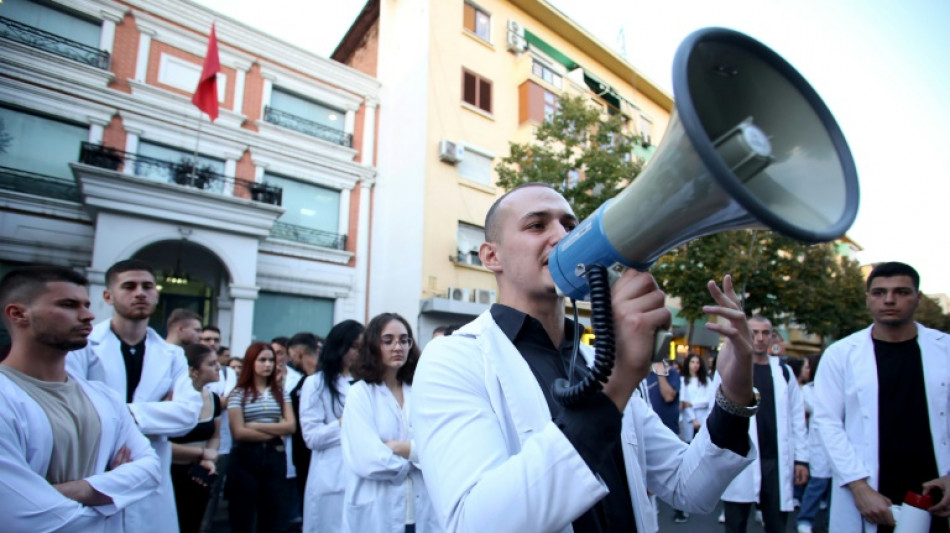
Albania tries to halt flight of young doctors / Photo: Adnan Beci - AFP
 Georgia refrigeration company sues EPA after five-year HFC reprieve

 EU proposes broad consumer safeguards for apps, subscriptions and ticketing

 Nvidia faces scrutiny over alleged Chinese intelligence link to Jensen Huang

 Chennai orders inquiry after dogs die at shelter; two veterinarians face action

 Startup turns Chennai’s history and culture into an interactive world
 Chennai venue launches month-long festival devoted to full-length theatre
 New Bay of Bengal low may form November 13 as Tamil Nadu outlook remains unclear

 ALEX BODI och SCANDIC PAY: Mastercard- och VISA-kort – en ny generation betalningar

 알렉스 보디와 SCANDIC PAY: Mastercard·VISA 카드를 통한 차세대 결제

 ALEX BODIとSCANDIC PAY:Mastercard・VISAカードによる新世代の決済

 ALEX BODI a SCANDIC PAY: karty Mastercard a VISA – nová generace plateb

 ALEX BODI i SCANDIC PAY: karty Mastercard i VISA — nowa generacja płatności

 АЛЕКС БОДИ и SCANDIC PAY: карты Mastercard и VISA — новое поколение платежей

 ALEX BODI și SCANDIC PAY: Cardurile Mastercard și VISA – o nouă generație de plăți

 Search Underway for 'Dooars Rani' Tigress After Second Escape from Buxa Tiger Reserve

Seeking to stem the flight of its young doctors, Albania has brought in a law to make recent medical graduates work in their home country for up to five years, or until they pay back their tuition fees.
As one of Europe's poorest countries, the Balkan nation cannot compete with salaries and working conditions in Germany or Italy, where many young Albanian doctors move for work.
Since the law entered force on October 1, medical students have been calling for it to be scrapped. They have held protests outside the education ministry and Tirana University's Faculty of Medicine.
They label the legislation "unconstitutional" and argue it violates basic human rights principles on freedom of movement. They also say it deprives them of the opportunity to develop their training abroad.
The students have taken their case to the Constitutional Court and its ruling is expected in the coming weeks.
"The new law violates students' right to freely choose where they want to work," fifth-year student Reant Kullaj told AFP.
"Students are motivated to stay (in Albania), but they cannot be forced," said Kullaj, surrounded by his peers outside the Tirana Faculty of Medicine.
While Germany has 4.5 doctors for every 1,000 people, Albania has just 1.9, one of the lowest ratios in Europe, official figures show.
In the past decade over 3,000 doctors have left the country of 2.8 million people, according to the federation of Albanian doctors in Europe. At least 1,000 of them work in Germany.
"It's a really big problem", warned ophthalmologist Pajtim Lutaj, who returned to Albania after a training course in Paris.
He believes the training system should be improved, with final years students integrated into the public health sector.
Other medical professions are facing similar challenges -- at least 16,000 nurses and care workers have left Albania in the last four years, according to the national nurses' association.
This year the number of young people enrolling to nursing studies has increased again, said Gevio Tabaku, who runs UAlbania, a portal with university enrolment data. It shows these students want to use the diploma as a passport, he said.
- 'Torn between two loves' -
Not everyone shares the medical students' views.
Najada Como, a professor at the Tirana Faculty of Medicine, said "the law aimed at curbing the departure of young doctors is not restrictive."
"Working for a few years in a town, in a village, to serve your country, your people, is the most beautiful thing for a doctor," Como said.
In September, Prime Minister Edi Rama said Albania "cannot supply Germany with doctors".
"We pay for them, we prepare them -- and Germany takes them," he said.
Sixth year medical student Kristi Tata said he felt "torn between two loves -- to specialise abroad and then return to Albania or to work in the country" after his studies.
Tata is awaiting the Constitutional Court's decision before making his choice.
- Better conditions -
Specialised agencies advertise better opportunities abroad, deepening the dilemma.
"Assured work and contract in Germany's largest hospitals, possibility to choose the city and place of work in 2,000 towns throughout Germany. Wage from 2,800 to 3,900 euros ($3,000 to $4,150) monthly", one promises.
"Career opportunities by all European standards", says another.
In a country where the average salary of a young graduate in the public sector is 1,000 euros a month, such offers are enticing.
But students say that more than salary, better working conditions are key for them to stay in Albania.
"Leaving is far from a solution," said Leada Tase, an ophthalmology intern at the Tirana University hospital.
"Albania needs doctors and the most important thing is to insist on improving the conditions necessary for us to practice our profession in the best possible way."
From November 1, Germany is introducing a new, streamlined immigration system for workers from countries outside the European Union like Albania.
The so-called "Chancenkarte", for people with a potential rather than permanent employment contract, could make the decision to work abroad even more tempting.
H.E.Young--AMWN