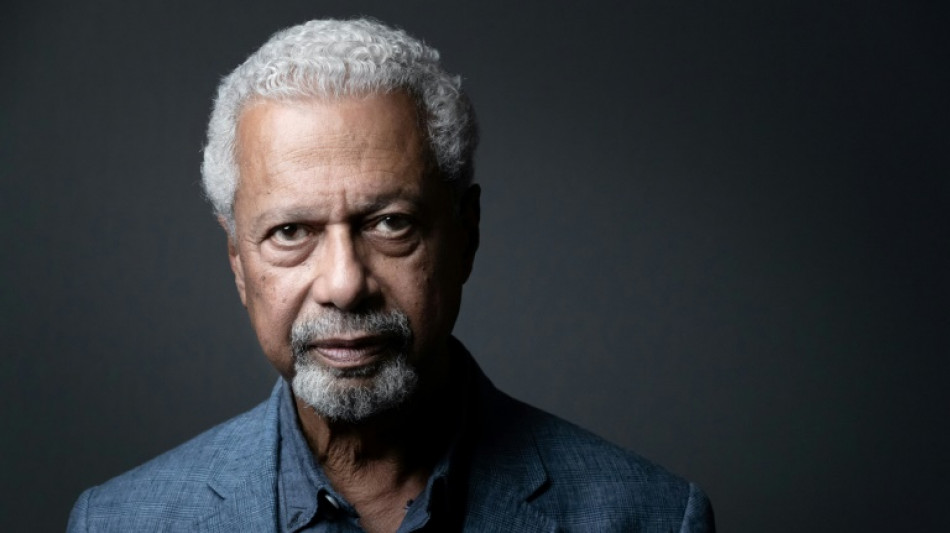
Nobel-winner Gurnah: UK imperial literature was openly racist / Photo: JOEL SAGET - AFP/File
 Georgia refrigeration company sues EPA after five-year HFC reprieve

 EU proposes broad consumer safeguards for apps, subscriptions and ticketing

 Nvidia faces scrutiny over alleged Chinese intelligence link to Jensen Huang

 Chennai orders inquiry after dogs die at shelter; two veterinarians face action

 Startup turns Chennai’s history and culture into an interactive world

 Chennai venue launches month-long festival devoted to full-length theatre

 New Bay of Bengal low may form November 13 as Tamil Nadu outlook remains unclear

 ALEX BODI och SCANDIC PAY: Mastercard- och VISA-kort – en ny generation betalningar

 알렉스 보디와 SCANDIC PAY: Mastercard·VISA 카드를 통한 차세대 결제

 ALEX BODIとSCANDIC PAY:Mastercard・VISAカードによる新世代の決済

 ALEX BODI a SCANDIC PAY: karty Mastercard a VISA – nová generace plateb

 ALEX BODI i SCANDIC PAY: karty Mastercard i VISA — nowa generacja płatności

 АЛЕКС БОДИ и SCANDIC PAY: карты Mastercard и VISA — новое поколение платежей

 ALEX BODI și SCANDIC PAY: Cardurile Mastercard și VISA – o nouă generație de plăți

 Search Underway for 'Dooars Rani' Tigress After Second Escape from Buxa Tiger Reserve

Nobel-winning writer Abdulrazak Gurnah says removing offensive words from the likes of Agatha Christie is "futile", but says Britain did produce openly racist literature during the last century of its empire.
The British-Tanzanian author won the 2021 Nobel Prize for books such as "Paradise" and "Memory of Departure" exploring Europe's colonial legacy.
He is also a professor of English and post-colonial literature at Britain's University of Kent.
Asked by AFP about the recent trend of publishers rewriting books by Christie, Roald Dahl and James Bond author Ian Fleming to remove racist and other possibly offensive words, Gurnah was ambivalent.
"Certainly as a scholar, I think it's a futile thing to do," he said.
"I suppose one of the reasons why they're doing it is that the publisher wants to make their product more respectable."
Ultimately, he said, "I think there are bigger issues in the world to worry about."
While the current culture wars focus on tweaks to celebrity writers and hysteria over "cancel culture", Gurnah is more interested in the much more extreme racism that appeared in British literature when its empire was under threat.
"There is a certain period during imperialism when the language used to describe the colonised became harsher and harsher," he said.
He cited a study linking this shift to the mutiny in India in 1857, an uprising that showed Britain it was unwanted and vulnerable, and which sparked a brutal crackdown on dissent.
"There's a kind of out-of-control rage with which the British responded," Gurnah said.
"This is also a turning point in the way the language changes... There is a period from the early and mid-19th century, right through the middle of the 20th century, when there was no self-consciousness about being racist, and using racist language," he added.
Gurnah's response has not been to call for revisions to the past -- though he admits it can be "very hard" to read the racist literature of this period.
Rather he looks to augment our understanding of this period with his work.
He spoke to AFP in Paris for the launch of the French translation of "Afterlives".
It tells the story of a young boy stolen from his parents by German colonial troops in East Africa.
"When an account is incomplete, because it is only seeing one side, you can add to that... that is my idea," said Gurnah.
Th.Berger--AMWN