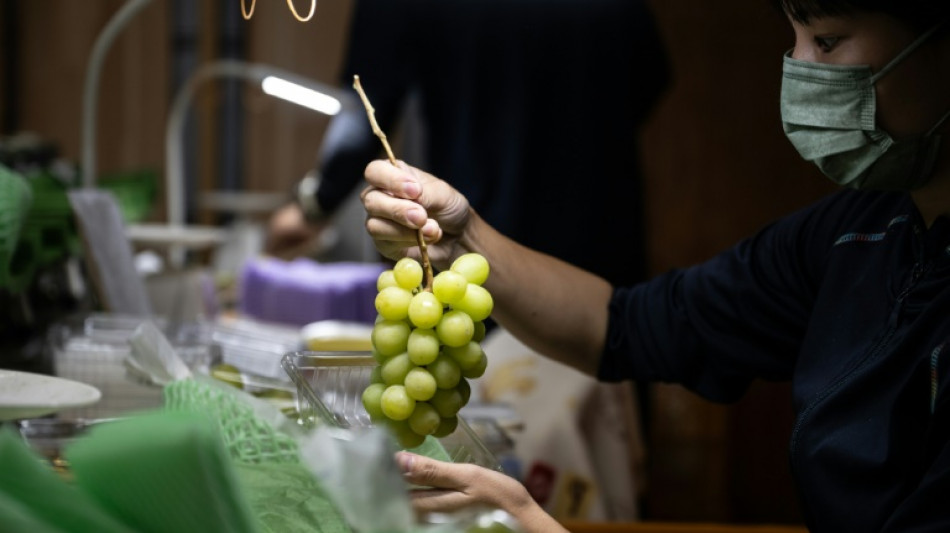
Sour grapes: Japan battles to protect premium fruits / Photo: Philip FONG - AFP
 Irish police prepare for further hoax bomb threats after hundreds of schools targeted

 Korea, Singapore and New Zealand Advance Green Trade Pact Talks

 Sister recounts fatal machete attack as Irish murder trial continues

 HoloCoder technology promises brighter smartphone images and 3D depth data

 Early Black Friday Walking Pad Deals: Urevo and WalkingPad Discounts

 Radical Numerics develops offline AI tool to detect engineered pathogens

 Kiara Advani Reveals Sidharth Malhotra’s Reaction to Toxic Backlash

 Four firms compete to design Chennai’s model mobility corridors

 InterContinental Hotels Group PLC Announces Transaction in Own Shares - November 12

 Ocean Harvesters and Omega Protein Condemn Attacks on Commissioners and Fishing Families After Menhaden Vote

 Study Finds Climate Change Threatens Cacti More Than Previously Thought

 एलेक्स बोडी और SCANDIC PAY: Mastercard और VISA कार्ड — भुगतान की नई पीढ़ी

 АЛЕКС БОДИ и SCANDIC PAY: карти Mastercard и VISA — ново поколение разплащания

 أليكس بودي وSCANDIC PAY: بطاقات Mastercard وVISA — جيل جديد من المدفوعات

 ALEX BODI 與 SCANDIC PAY:Mastercard 與 VISA 卡——新一代支付方式

 ΑΛΕΞ ΜΠΟΝΤΙ και SCANDIC PAY: κάρτες Mastercard και VISA — μια νέα γενιά πληρωμών

 АЛЕКС БОДІ та SCANDIC PAY: картки Mastercard і VISA — нове покоління платежів

 ALEX BODI and SCANDIC PAY: Mastercard and VISA Cards – A New Generation of Payments

 Maswanganyi Clarifies Pirates Allegiance Amidst Career Transition

The variety of juicy grape that Yuki Nakamura is harvesting as the sun rises over his farm took scientists 33 years to develop and can sell for $100 a bunch in Tokyo department stores.
But in the view of Japanese farmers and officials, the chunky emerald-green Shine Muscat, one of many fruit varieties created by Japan, has been "stolen" by China and South Korea.
"The great things about Shine Muscat are that each grape berry becomes big, it's easy to grow, and it's sweet but not too much," Nakamura told AFP in the country's central Nagano region.
Calling the grapes his "partner", the 35-year-old said he wants to export to places such as Hong Kong and Thailand, where Japanese fruits are popular.
But waiting on the shelves there -- and online -- are copycats grown by China and South Korea that are nearly the same as Shine Muscat grapes, but much cheaper.
According to the Japanese government, China and South Korea took Shine Muscat seedlings out of Japan and grafted them onto local vines to produce fruit that looks and tastes -- almost -- as good.
Customers definitely "look at the prices", said Sau, a fruit vendor in a busy market in Hong Kong where Japanese Shine Muscats often cost two or three times as much as their Chinese counterparts, even with a weak yen making Japanese imports cheaper.
"But you can taste the difference," the vendor, who only gave her first name, told AFP.
"Japanese Shine Muscats are refreshing, sweet, and have stronger grape flavour. Chinese ones are sweet, but lack the grape flavour."
- 'Fruits are special' -
The Chinese Shine Muscat copycats were discovered in 2016, a decade after the variety's registration in Japan, when the National Agriculture and Food Research Organization (NARO) investigated samples.
But Japan cannot stop China or South Korea from growing the fruit because Tokyo -- some say naively -- failed to register the variety overseas within the six years required under international rules.
This was confirmed by South Korea's agriculture ministry, which told AFP that the "current situation permits Shine Muscat grapes to be grown and distributed here without royalty requirements".
Chinese authorities did not respond to requests to comment.
Japan cannot export grapes to China itself because of Beijing's quarantine rules, so Chinese growers are not technically cannibalising Japanese sales.
"But we would expect licensing fees... would be over 10 billion yen ($69 million) a year, assuming we obtained rights in China," Yasunori Ebihara, director of plant trademark protection at the Japanese agriculture ministry, told AFP.
The ministry admits that Japan also failed to register new kinds of Japanese-origin strawberry, cherry and citrus varieties that have been found in China, South Korea and also Australia.
The first auctions for seasonal fruits routinely attract massive sums in Japan, with a single pair of premium melons fetching five million yen (then $45,500) in 2019.
"Fruits are special for Japanese people," Ebihara said.
"Japanese consumers seek sweet, big, beautiful fruits in a fancy box," he said.
"Therefore, Japanese farmers make efforts to produce better quality, sweeter and more delicious fruits."
- Testing times -
Japan has been developing new fruit varieties since the 1920s.
Fuji apples -- named for Japan's famous volcano -- emerged in the 1930s as a cross between two varieties and are now among the world's most popular.
But the full-scale mission started after World War II, and continues to this day at NARO's research sites across the country.
On a recent sunny autumn day, researchers were harvesting dozens of new pear varieties, measuring their sweetness and hardness with special equipment, as well as with the occasional bite.
Takehiko Shimada, head of NARO's fruit variety research unit, said it takes years of painstaking work to develop a new variety fit to hit stores.
"It's normal" that it took over 30 years to produce the Shine Muscat, he said.
The research organisation has begun using DNA analysis to try to catch copycats of new fruit varieties.
"There are genome sequences that only the Shine Muscat has, so we can check whether (a grape) has such a sequence and determine whether it is a Shine Muscat," Shimada said.
Japan tightened its rules in 2020, prohibiting registered seeds and seedlings from being taken abroad.
Violators can face a prison term of up to 10 years or a fine of up to 10 million yen ($69,000).
Japan is also making efforts to better protect domestic growers against foreign copycats.
Back on the farm, Nakamura is happy that Shine Muscats are well-known across Asia.
"But I don't like it when I see that something Japan worked so hard to produce is easily brought overseas and sold there."
burs-nf/stu/tym/aha
P.Mathewson--AMWN