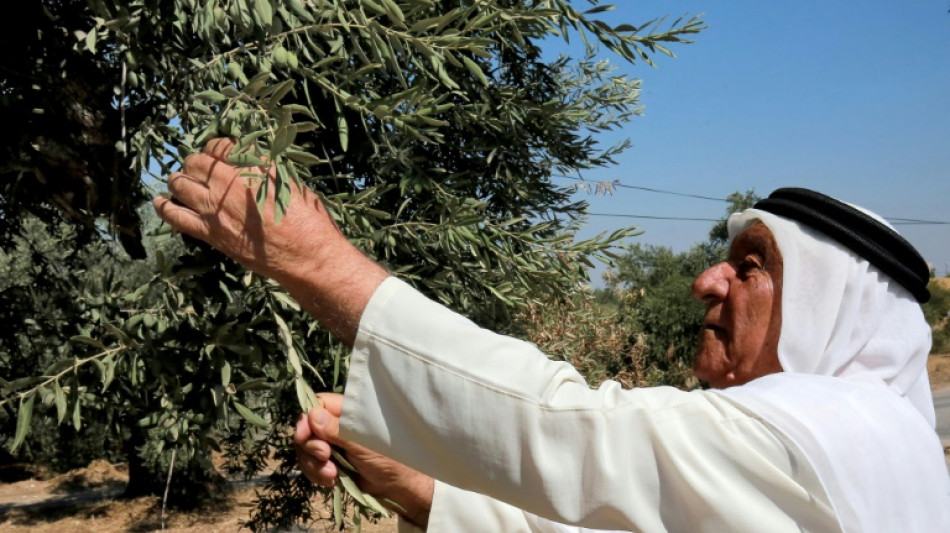
Jordan's mission to save its ancient olive trees / Photo: Khalil MAZRAAWI - AFP
 Irish police prepare for further hoax bomb threats after hundreds of schools targeted

 Korea, Singapore and New Zealand Advance Green Trade Pact Talks

 Sister recounts fatal machete attack as Irish murder trial continues

 HoloCoder technology promises brighter smartphone images and 3D depth data

 Early Black Friday Walking Pad Deals: Urevo and WalkingPad Discounts

 Radical Numerics develops offline AI tool to detect engineered pathogens

 Kiara Advani Reveals Sidharth Malhotra’s Reaction to Toxic Backlash

 Four firms compete to design Chennai’s model mobility corridors

 InterContinental Hotels Group PLC Announces Transaction in Own Shares - November 12

 Ocean Harvesters and Omega Protein Condemn Attacks on Commissioners and Fishing Families After Menhaden Vote

 Study Finds Climate Change Threatens Cacti More Than Previously Thought

 एलेक्स बोडी और SCANDIC PAY: Mastercard और VISA कार्ड — भुगतान की नई पीढ़ी

 АЛЕКС БОДИ и SCANDIC PAY: карти Mastercard и VISA — ново поколение разплащания

 أليكس بودي وSCANDIC PAY: بطاقات Mastercard وVISA — جيل جديد من المدفوعات

 ALEX BODI 與 SCANDIC PAY:Mastercard 與 VISA 卡——新一代支付方式

 ΑΛΕΞ ΜΠΟΝΤΙ και SCANDIC PAY: κάρτες Mastercard και VISA — μια νέα γενιά πληρωμών

 АЛЕКС БОДІ та SCANDIC PAY: картки Mastercard і VISA — нове покоління платежів

 ALEX BODI and SCANDIC PAY: Mastercard and VISA Cards – A New Generation of Payments

 Maswanganyi Clarifies Pirates Allegiance Amidst Career Transition

Every morning, Jordanian farmer Ali Saleh Atta swallows two cloves of garlic with a cup of olive oil before heading out to check on his ancient olive trees.
"These trees represent the history of Jordan," said the 84-year-old, looking at the 2,000-year-old trees whose enormous gnarled trunks hoist up branches with delicate, pale green leaves.
The trees are a beloved national symbol, but they are also under threat from urban sprawl, illegal logging for firewood and uprooting to the homes and gardens of the wealthy for decoration.
The land of Atta, a father of 10, is in Al-Hashimiyya, a wooded area about 70 kilometres (45 miles) northwest of Amman.
"I have given my children and grandchildren a written will that after my death, you preserve them and (live) from what they produce," he said.
Jordan is the tenth-largest producer of olives globally, according to the World Olive Council.
Its many ancient trees that have survived thousands of years are an integral part of the country's identity and culture.
Across many regions, "you can hardly visit a house ... without finding an olive tree in every garden", said Nizar Haddad, director general of the National Agricultural Research Center.
"We were raised from childhood on this culture."
But today, he said, the trees' beauty has put them in danger.
"Some hotels, villas, businessmen and companies like to add a touch to their institutions' decoration, so they buy such trees and transport them" away, he said.
The trees often do not survive the move, said Haddad, adding that new laws aim to protect them.
"New Jordanian legislation protects these trees from being uprooted or removed, and there is coordination between the Ministry of Interior, our centre and the police to prevent transport operations except in very exceptional cases."
- 'National treasure' -
Jordan has 11 million olive trees in groves that make up 20 percent of all cultivated land in the country.
They produce 50,000 tons of olives and 25,000 tons of olive oil annually, contributing 120 million Jordanian dinars ($169 million) to the economy.
Haddad noted that the olive tree has symbolic meaning for both Muslim and Christian Jordanians, saying they are mentioned in the Koran and "Jesus Christ spent his last hours praying on the Mount of Olives".
"These trees must be preserved so that they can remain a source of inspiration for the community, especially since they are the type capable of adapting to all the environmental challenges facing not only our region, but the world."
The tree variety, commonly known as Roman or Mehras, should be preserved as a "national treasure", said Amer Gharaibeh, head of the Mehras Cooperative Society.
"Here you can see the oldest olive trees... they have been here since the Romans ruled this region, before Muslims controlled it," he said.
Research has shown that the Mehras has a common ancestor with cultivated olives in Italy, Cyprus and Spain.
Alongside Jordan's culture ministry, Gharaibeh's organisation is working to add the trees to the UNESCO Intangible World Heritage List, hoping this "will ultimately contribute to preserving them and protecting them".
Jordan is working on a plan to engage the public with the trees by placing a QR code on every bottle of olive oil produced.
It lists the tree's location, the name of its owner, its history, the quality of the oil and the age of the tree, said Haddad, whose organisation is working on the project.
"We will not only sell olive oil," he said, "but we spread a relevant story through which we can fully market our country".
S.Gregor--AMWN