Three, two, one: astronomers predict SpaceX space junk will hit the Moon
 Starc bags 10 as Australia thrash Bangladesh in second Test

 Starc heroics see Australia thrash Bangladesh in second Test

 Pegula dethrones Swiatek to book Cincy final against Gauff

 South Korean survivor fights for workplace harassment 'justice'

 Starc strikes as Bangladesh struggle to stay alive in 2nd Test

 Prince Harry: royal misfit making unlikely UK return

 Blowing in the wind, humble balloon gets green makeover

 Pegula dethrones Swiatek to reach Cincinnati final

 IndyCars zip among iconic Washington landmarks ahead of Freedom 250

 Real Madrid snatch late win at Espanyol on Mourinho's return

 Real Madrid beat Espanyol in Mourinho's first game on return

 Olise helps Bayern past Dortmund in German Supercup

 Coach Rennie hails clinical All Blacks after Springboks Test win

 Charlton deliver blow to 'under pressure' Hammers boss Nuno

 Carrick keeps calm despite Man Utd misery, big-spending Spurs crushed

 Canada's Carney stands up to Trump, despite risks

 Lens hammer Auxerre thanks to Thauvin penalty double

 No singles for Serena, but she joins Alcaraz for US Open

 Joao Pedro extends Chelsea stay with new long-term deal

 Yamaguchi to face An in hunt for fourth badminton world crown

 Norris clinches pole for Dutch GP

 Norris clinches pole for Dutch Grand Prix

 Pope Leo calls for courage in Rimini visit after stop in tiny San Marino

 Man Utd must learn from 'frustrating' defeat at Hull: Carrick

 Yamaguchi on course for fourth badminton world crown

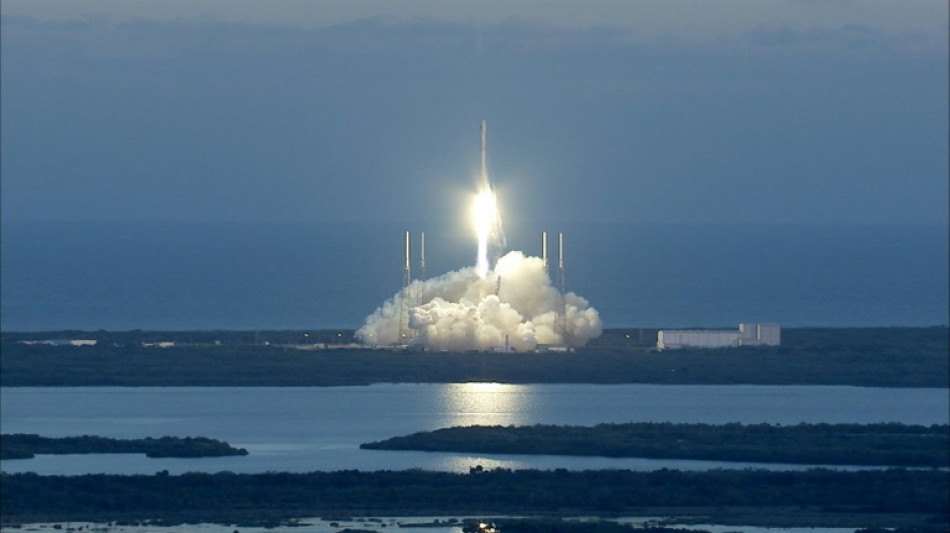
A chunk of a SpaceX rocket that blasted off seven years ago and was abandoned in space after completing its mission will crash into the Moon in March, experts say.
The rocket was employed in 2015 to put in orbit a NASA satellite called the Deep Space Climate Observatory.
Since then the second stage of the rocket, or booster, has been floating in what mathematicians call a chaotic orbit, astronomer Bill Gray told AFP Wednesday.
It was Gray who calculated the space junk's new collision course with the Moon.
The booster passed by pretty close to the Moon in January in a rendezvous that altered its orbit, said Gray.
He is behind Project Pluto, software that allows for calculating the trajectory of asteroids and other things in space and is used in NASA-financed space observation programs.
A week after the rocket stage whizzed close to the Moon, Gray detected it again and concluded it will actually crash into the satellite's dark side on March 4.
Gray appealed to the amateur astronomer community to join him in observing the booster -- it is bright and easy to detect -- and his conclusion was confirmed.
The exact time and spot of impact may change a bit from his forecast but there is widespread agreement that there will be a collision on the Moon that day.
"I've been tracking junk of this sort for about 15 years. And this is the first unintentional lunar impact that we've had," Gray told AFP.
The impact of this object weighing four tons on the Moon will not be visible from Earth in real time.
But it will leave a crater that scientists can observe, such as with NASA's Lunar Reconnaissance Orbiter or India's Chandrayaan-2 satellite, and thus learn more about the geology of the Moon.
Spacecraft have been intentionally crashed into the Moon before, for scientific purposes.
In 2009, for instance, NASA sent a rocket stage hurling into the Moon near its south pole to look for water.
But most rockets do not go so far from Earth. SpaceX brings its rocket boosters back through the Earth's atmosphere so they disintegrate over the ocean.
Gray said there could be more unintentional crashes into the Moon in the future as the US and Chinese space programs leave more junk in orbit.
A.Mahlangu--AMWN