Standing up to violent colleagues a high-risk 'duty' for US police
 Starc bags 10 as Australia thrash Bangladesh in second Test
 Starc heroics see Australia thrash Bangladesh in second Test
 Pegula dethrones Swiatek to book Cincy final against Gauff

 South Korean survivor fights for workplace harassment 'justice'

 Starc strikes as Bangladesh struggle to stay alive in 2nd Test

 Prince Harry: royal misfit making unlikely UK return

 Blowing in the wind, humble balloon gets green makeover

 Pegula dethrones Swiatek to reach Cincinnati final

 IndyCars zip among iconic Washington landmarks ahead of Freedom 250

 Real Madrid snatch late win at Espanyol on Mourinho's return

 Real Madrid beat Espanyol in Mourinho's first game on return

 Olise helps Bayern past Dortmund in German Supercup

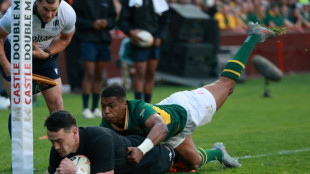
 Coach Rennie hails clinical All Blacks after Springboks Test win

 Charlton deliver blow to 'under pressure' Hammers boss Nuno

 Carrick keeps calm despite Man Utd misery, big-spending Spurs crushed

 Canada's Carney stands up to Trump, despite risks

 Lens hammer Auxerre thanks to Thauvin penalty double
 No singles for Serena, but she joins Alcaraz for US Open

 Joao Pedro extends Chelsea stay with new long-term deal

 Yamaguchi to face An in hunt for fourth badminton world crown

 Norris clinches pole for Dutch GP
 Norris clinches pole for Dutch Grand Prix

 Pope Leo calls for courage in Rimini visit after stop in tiny San Marino

 Man Utd must learn from 'frustrating' defeat at Hull: Carrick

 Yamaguchi on course for fourth badminton world crown

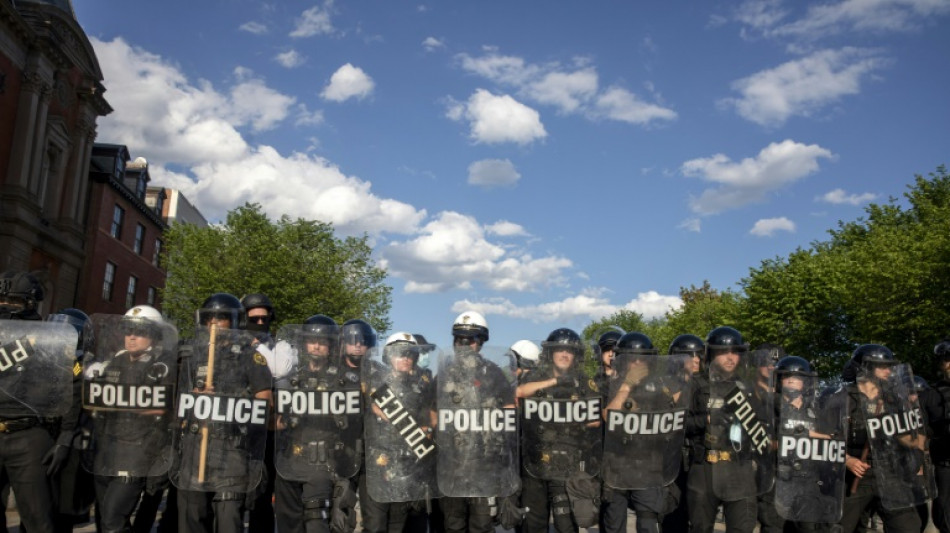
US police officer Cariol Horne intervened when a colleague started choking a Black suspect during an arrest in 2006. "Fifteen years of hell" ensued for Horne, also African-American, as she was punished for stepping out of rank.
In the United States, police have a "duty to intervene" when another officer uses excessive force in their presence and can be prosecuted if they do not step in, according to half-century-old case law developed by the courts.
Three former Minneapolis police officers are currently on trial in such a case: the federal justice system accuses them of failing to act in May 2020 when George Floyd, a Black man, suffocated as another officer knelt on his neck for nearly 10 minutes.
In the video of the incident, which sparked anti-racism protests around America and the world, their passivity was almost as shocking as their colleague's actions.
In the face of public outrage, many municipalities changed their rules in order to codify their officers' duty to intervene and give the regulation more weight.
According to the Police Use of Force Project, 72 out of the 100 largest US police forces now have this clause, compared to 51 before Floyd's death.
But for De Lacy Davis, a former police officer who founded the organization Black Cops Against Police Brutality, these reforms are superficial.
He says they won't accomplish anything without a fundamental change in the culture of law enforcement, which he says currently has no intention of breaking the "blue wall of silence."
- 'Punched me in the face' -
That expression, which refers to the color of police uniforms, implies complete solidarity among officers -- even towards the black sheep of the force. And woe betide anyone who dares to break away.
Horne has lived through the bitter experience.
In 2006, working as an officer in Buffalo, New York, she says her colleague swung at a Black man in his 50s during an arrest and "tried to strangle him."
"I intervened and he punched me in the face," Horne told AFP.
A fight ensued, and paradoxically, "I became the one investigated. They came after me for having stopped him," she said.
After a long trial, Horne was dismissed in 2008, just before reaching 20 years' seniority that would have entitled her to a pension.
At the time, she was 40 and had five young children to support. Without her pension, she had to rely on federal assistance.
Disgusted by the injustice of her situation, "I went through a depression," said Horne, recalling "15 years of hell" as she fought to vindicate herself.
- No regrets -
In 2018, she got some indirect satisfaction when her former colleague was sentenced to prison for violence against four Black teenagers.
Floyd's murder shone new light on her own case, and in the fall of 2020, Buffalo City Hall adopted a new regulation dubbed the "Cariol Law" that would require police to step in when a fellow officer is overly abusive -- and would also protect those who intervene from repercussions.
Finally, in 2021, a judge overturned Horne's firing and restored her pension rights. "While the Eric Garners and the George Floyds of the world never had a chance for a 'do-over,' at least here the correction can be done," said Judge Dennis Ward.
Garner suffocated to death in 2014 when a New York officer put him in a choke hold. The African-American man pleaded, "I can't breathe," which has become a rallying cry at protests against police brutality and racism.
Today, Horne is still waiting for her pension payments, and is following the former Minneapolis officers' trial without high expectations.
Even if the court sends a message by convicting them, nothing will change "until the officers who try to intervene are... protected" from reprisal, she said.
"What we need are 'Cariol Laws' in the whole nation."
But even though she paid a high price, Horne remains convinced she made the right choice. "Never would I ever regret that a man lived because I intervened."
L.Harper--AMWN