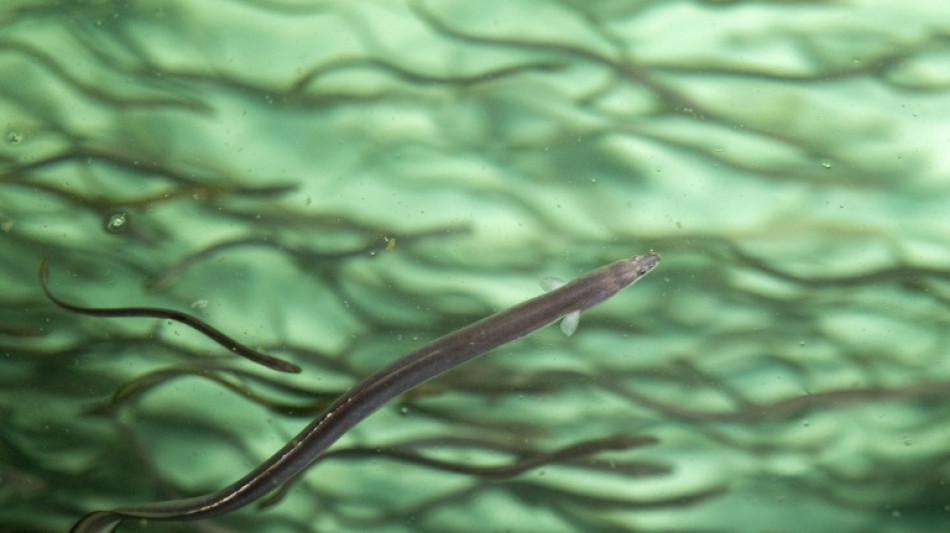
Wildlife trade body rejects new eel protections / Photo: Philip FONG - AFP/File
 Lakers' OT win puts Rockets on brink of NBA playoff elimination

 AI firms flex lobbying muscle on both side of Atlantic

 Hundreds of firefighters battle Japan forest blazes

 US envoys heading to Pakistan for uncertain Iran talks

 Billionaire Elon Musk enters courtroom showdown with OpenAI
 Awkward debut for Trump at correspondents' dinner

 'Going to the moon': Irish footballers return to China 50 years after historic tour

 Palestinians to vote in first elections since Gaza war

 Peru confirms election runoff date, court says no to Lima re-vote

 US hopes for progress, but Iran says not direct talks

 Betis's Bellerin further dents Real Madrid title hopes

 OpenAI CEO apologizes to Canada town for not reporting mass shooter

 Leipzig tighten top-four grip as Union's Eta suffers second loss

 EU, US sign critical minerals plan to counter China reliance

 Court removes US businessman from managing his Brazilian football team

 No.2 Korda boosts LPGA Chevron lead to seven

 Anthropic says Google to pump $40 bn into AI startup

 One injured in bomb attack on Colombia military base

 ILO names US official as number two amid grumbling over unpaid dues

 AI united Altman and Musk, then drove them apart

 Havana property market stirs as investors bet on political change

 Brazil's Lula has surgery to remove skin lesion from scalp

 Battle lines drawn over EU's next big budget
 Lebanon truce extended as Pakistan bids to revive US-Iran talks

 Alex Marquez quickest in Spanish MotoGP practice

The world's top wildlife trade body rejected new protections for eels on Thursday in a secret ballot at talks in Uzbekistan.
The proposal had been fiercely opposed by top eel consumers, particularly Japan, but also failed to win backing from countries worried about new trade regulations.
The vote came at a meeting of signatories to the Convention of International Trade in Endangered Species of Wild Fauna and Flora (CITES), a 50-year agreement protecting the world's most endangered animals and plants, and regulating trade in 36,000 species.
Eel populations are falling worldwide, scientists say, largely due to factors linked to human activity such as the pollution of waterways, destruction of wetlands, hydroelectric dams, and fishing.
European eels are considered critically endangered and their trade has been restricted by CITES since 2009.
But because eels cannot be bred in captivity, much of the trade is in wild-caught baby eels, with one species virtually indistinguishable from another.
The European Union and Panama sought to bring all 17 eel species under CITES Appendix II, placing new restrictions on trade.
"Every eel we eat comes from the wild, making them vulnerable to overfishing and illegal trade," the EU's representative warned.
The "harvest for international trade is a major cause of international decline."
The proposal was rejected out of hand by Japan, which called it unscientific and "excessive," backed by multiple countries including African nations who warned it would place undue administrative burdens on their authorities.
In a sign of the pressures around the issue, the proposal was voted on by secret ballot, a relatively uncommon procedure at the gathering, with nearly 75 percent of votes against.
The result was "not very surprising," said Oliver Tallowin, senior programme officer for wildlife use and trade at the International Union for the Conservation of Nature.
Japan's opposition had been made clear early on in a submission running over 100 pages.
There are also differing views on the pressures other eel species face, said Tallowin.
"International trade has to be a threat to the species and... that was something we couldn't say with any sense of certainty," he told AFP.
For Andrew Kerr of the Sustainable Eel Group, "the short-term commercial and financial side won the debate massively."
Kerr, who has called eel trafficking the "greatest wildlife crime" on the planet, said the vote was a "real pity," but there were some silver linings.
A separate resolution proposing measures including more data gathering on eels and conservation capacity-building will be debated later Thursday at the talks in Samarkand.
"We've had a missed opportunity this morning, but then the fact that everyone's talking about eel, that's a huge victory too," Kerr said.
The resolution could gather data that would allow more protection of all eel species in the future, added Tallowin.
"Once something has been rejected... that doesn't mean its going to go away."
Votes are finalised later in the meeting, though it is unusual for them to be revised.
A.Rodriguezv--AMWN