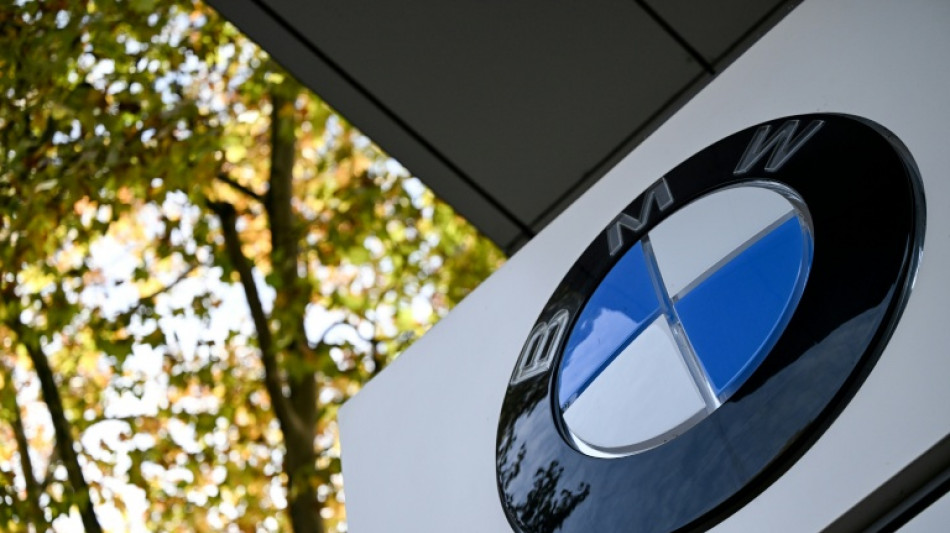
BMW profit holds up despite Trump tariffs, China woes / Photo: Kirill KUDRYAVTSEV - AFP/File
 Pope Leo begins three-country South American tour in Uruguay

 Khawaja says entire Australia camp knew of 2018 ball-tampering plan

 November Foraging Guide: Edible Mushrooms and Critical Safety Protocols

 Microsoft Updates Xbox PC App with 60% Faster Startup and Redesigned Interface

 Early Polar Vortex Disruption Creates Uncertain Winter Outlook for Pennsylvania

 Edmund Richardson Wins Baillie Gifford Prize for 'Alexander' Biography

German carmaker BMW reported a three percent fall in annual profit on Thursday, despite US tariffs and cutthroat competition in China, far smaller than the double-digit plunges seen at rivals.
Net profit in 2025 fell to 7.45 billion euros ($8.6 billion), the Munich-based firm said, compared to earlier reported falls of almost a half at Mercedes-Benz and the Volkswagen Group.
"Over the past years, we have adopted the right strategic positioning," BMW CEO Oliver Zipse said.
"We are benefiting from that today: In a challenging environment, we do not need to change direction but can maintain our course," he added.
BMW has taken a more flexible approach to electric vehicles (EVs) than some of its competitors, deciding early on to maintain petrol and diesel options for its customers.
Whereas firms from Porsche to Ford and Jeep-owner Stellantis have since booked very costly hits measured in the billions following partial pivots away from EVs, BMW has so far avoided this at the same time as seeing its electric sales rise.
Addressing European Union regulations that mandate higher sales of EVs over time, Zipse told a press conference they were doomed to failure.
"We are convinced that the Union experiment of mandating electrification will not deliver the desired results, to the contrary," he said.
"This year, together with policymakers, we must find realistic solutions that allow us to achieve our climate goals and to strengthen our economy," he added.
For 2026, BMW said EU and US tariffs as well as intense competition in China would continue to weigh on its results, forecasting a moderate drop in earnings before tax.
Total tariff costs amounted to roughly 1.75 billion euros for the year, BMW said.
Though in a far more comfortable position than the likes of Audi or Porsche thanks to its large plant in South Carolina, BMW nevertheless has to pay duties on some imports into the US, including on car parts that come from outside North America.
The European Union in 2024 also put tariffs on Chinese-made electric cars, hitting BMW's exports of electric Minis out of the country.
In common with its German rivals, BMW has also come under intense pressure from local competitors in China, the world's largest car market, although it forecast stable sales by volume in the country for 2026.
BMW's sales by volume are now at their lowest level since 2017 and the carmaker last October lowered its profit outlook, warning of Chinese sales below expectations.
T.Ward--AMWN