
Toronto's Condo Market Reset: How Strategic Developers Are Turning 2026's Correction Into Opportunity
 Trump Signals Willingness to Work With Democrats After Midterm Defeat

 Qatar media bodies discuss support for humanitarian initiatives

 RSI Welcomes The Orange County Comptroller's Office as Its Newest Government Premier Partner

 Galloway accuser could not foresee publishing-sector fallout, lawyer argues

 New York City Center revives In the Heights as a timely community story

 Vessel operator seeks witnesses after Vancouver grounding

 US Air Force deploys F-16 fighters to remote Aleutian base for readiness drill

 Bezos grant helps Seattle nonprofit move thousands of families toward housing

 Shrini Srivastava joins crew of Varanasi-Delhi Vande Bharat Sleeper service

 Nearly Half of Australian Workers Overqualified, Survey Finds

 RBI eases export-declaration compliance for individual service exporters

 India proposes more import entry points for drugs and medical devices

 Derek Tierney Outlines Ten-Year Strategy for National Digital Health System

 NBC’s Steve Kornacki Reveals Tech Habits Ahead of Midterm Elections

 India and Israel oppose UN draft on regional conventional arms control

 BLS Polymers shares open 65.3% above IPO price

 Capital-markets shares rally as Motilal Oswal and Angel One lead gains

 Latino Voters Defy ICE Fears, Turn Out in Record Numbers for Midterms

 ITC shares rise as analysts anticipate gradual cigarette-business recovery

 Reliance rally puts historical one-year return pattern in focus

 Kuwait edges Oman 1-0 in veterans Gulf Cup in Doha

TORONTO, ON / ACCESS Newswire / April 1, 2026 / After years of relentless price appreciation, Toronto's condominium market is experiencing what many analysts are calling a long-overdue reset. A combination of elevated interest rates, an unprecedented wave of project completions, and a mass exodus of speculative investors has pushed condo prices and rents in the Greater Toronto Area to their lowest levels in several years. For many short-term holders, the correction has been painful. But for strategic developers and long-term investors, industry leaders argue, the current environment is setting the stage for the next great cycle of creation.

Ladan Hosseinzadeh Sadeghi, President & CEO of Sky Property Group Inc., has watched the market closely throughout the downturn - and she sees a compelling picture emerging for those with the discipline and capital to act counter-cyclically.
"Corrections are uncomfortable, but they are also clarifying," said Hosseinzadeh Sadeghi. "The speculative froth is gone. What's left is a market that rewards fundamentals - quality locations, sound design, and a genuine understanding of what end-users actually need. For developers who did their homework, this environment is full of opportunity."
How Did We Get Here?
The roots of Toronto's condo correction trace back to the pandemic-era construction boom. Record-low interest rates between 2020 and 2022 unleashed a surge of pre-construction purchases, largely by investor-buyers who banked on rents covering their carrying costs. When the Bank of Canada launched its historic rate-hiking campaign, the economics of those investor units deteriorated sharply. Rent growth, which had briefly soared post-pandemic, moderated as supply poured onto the rental market. For many investor-owners, monthly cash deficits became untenable.
By late 2025, the numbers told a stark story. Condo resale prices in the City of Toronto had retreated roughly 15-18% from their 2022 peak. Purpose-built and investor-owned rental listings surged. Assignment sales - where pre-construction buyers tried to offload contracts before completion - flooded platforms, often at or below original purchase prices. Meanwhile, new construction starts fell sharply as developers, unwilling to launch at discounts, sat on land and waited.
"The slowdown in new starts is actually the market doing something healthy," Hosseinzadeh Sadeghi noted. "It's clearing excess inventory and resetting the price signals developers need to underwrite new projects responsibly. We don't want a market that punishes caution."

The Supply Paradox
Perhaps the sharpest irony of the current correction is that it is happening simultaneously with Canada's worst housing affordability crisis in decades. Immigration remains robust, with the federal government targeting over 400,000 new permanent residents annually. Household formation continues to outpace new supply across most major urban centres. And housing starts - particularly in the ground-oriented segment - have remained structurally insufficient for years.
This paradox is not lost on experienced developers. The current softness in the condo market is largely a function of a specific product type (investor-grade small-format units) in a specific cycle (a synchronized completion wave), not a collapse in the underlying need for housing.
"We have a structural undersupply of housing in Canada, full stop," Hosseinzadeh Sadeghi emphasized. "What we have right now is a temporary imbalance in one segment of the market. Savvy developers are using this period to acquire well-located land, refine their product mix, and get ahead of the next demand cycle - which, given demographics, is not far off."
What Sophisticated Developers Are Doing Right Now
Industry leaders say the current correction is prompting a meaningful shift in developer strategy - away from speculative small-format investor units and toward product that serves genuine end-user demand.
Family-sized units: One of the most persistent criticisms of Toronto's condo boom has been the dominance of bachelor and one-bedroom units designed for investors, not residents. The correction is accelerating a shift toward two- and three-bedroom suites that can accommodate families and multigenerational households - a demographic that has long been priced out of ground-level housing but still requires space.
Mixed-income and mixed-tenure projects: Developers are increasingly structuring projects with a blend of market condos, purpose-built rentals, and affordable units - diversifying revenue streams and accessing municipal incentive programs that can reduce development charges and permit timelines.
Adaptive and repositioning plays: With some completed condo buildings facing persistent vacancies, Hosseinzadeh Sadeghi sees growing interest in repositioning strategies - converting or upgrading underperforming buildings to higher-demand uses, or assembling adjacent parcels to enable larger, more viable mixed-use redevelopments.
"We look at every downturn as a design problem," she said. "What did the last cycle build that the market doesn't want? What does the next cycle need to build that no one has figured out yet? Right now, the answers are pointing toward more livable, family-oriented, connected communities - not more 500-square-foot investor boxes."
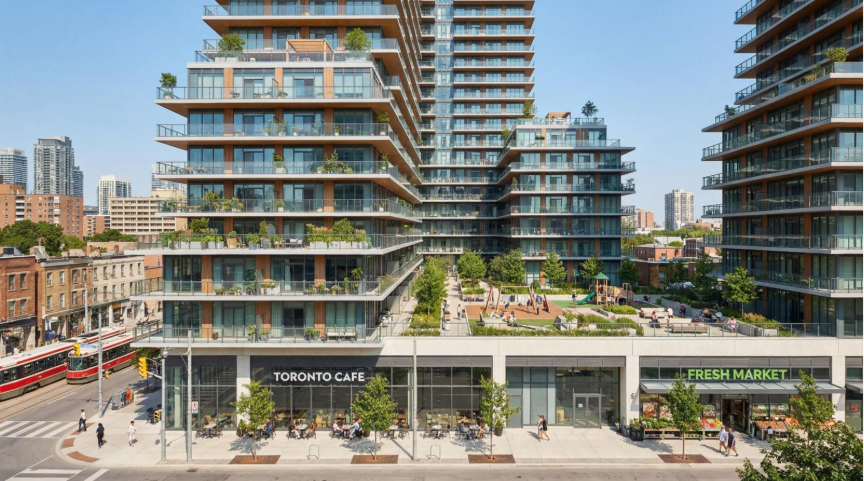
The Capital Opportunity
The correction has also attracted a new wave of institutional and private capital into the Toronto market. With purchase prices meaningfully below replacement cost in some submarkets, and with long-term rental fundamentals intact, value-add and development opportunities are drawing renewed attention from pension funds, family offices, and real estate investment trusts.
Hosseinzadeh Sadeghi views this capital influx as broadly positive - provided it is deployed thoughtfully. "Institutional capital at scale can do great things when it's aligned with community needs," she said. "The risk is when capital chases short-term returns without considering the people who will actually live in these buildings. At Sky Property Group, we underwrite every project against the end-user experience, not just the exit cap rate."
She also highlighted the importance of patient capital in the current environment. With construction financing still costly and pre-sales volumes suppressed, projects that require quick capital recycling are at a structural disadvantage. Developers with longer time horizons and stronger balance sheets are best positioned to absorb near-term softness and emerge with superior projects.

Looking Ahead
Most market analysts expect the Toronto condo market to begin stabilizing through 2026, with a gradual recovery in prices and absorption as the completion wave subsides and demand - particularly from renters and first-time buyers - reasserts itself. The Bank of Canada's rate-cutting cycle, which began in earnest in 2024, continues to improve affordability at the margin.
For Ladan Hosseinzadeh Sadeghi and Sky Property Group, the strategy is clear: use the current window to acquire, plan, and position - so that when the next cycle accelerates, the product is ready.
"The developers who will define the next chapter of Toronto's skyline are making their moves right now, quietly," she said. "This is not a time to panic. It's a time to build - thoughtfully, strategically, and with the long game firmly in mind."
About Sky Property Group Inc.
Sky Property Group Inc. is a Toronto-based real estate development company specializing in land assembly, high-rise residential development, and strategic urban intensification across the Greater Toronto Area. Led by President & CEO Ladan Hosseinzadeh Sadeghi, Sky Property Group is committed to creating vibrant, sustainable communities that address Canada's housing needs.
Media Contact:
Ladan Hosseinzadeh Sadeghi
[email protected]
SOURCE: Sky Property Group Inc.
View the original press release on ACCESS Newswire
P.Martin--AMWN