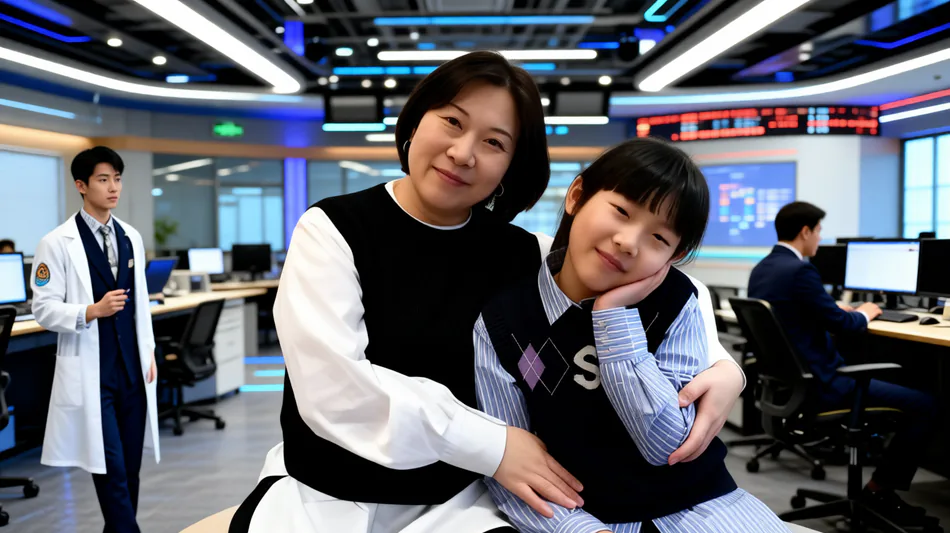
Autistic Girl Wins International Art Gold, Mother Calls for Inclusive Schools
 Search Underway for 'Dooars Rani' Tigress After Second Escape from Buxa Tiger Reserve

 The Dilemma of Recording Live Music: Preserving Memories vs. Being Present

 InterContinental Hotels Group PLC Announces Transaction in Own Shares - November 11

 Fulcrum Metals PLC Announces New Critical Mineral Recoveries Expand Potential
 Fulcrum Metals PLC Announces Publication of Updated Investor Presentation

 Christmas Day Shifts More than Double as Americans Return to In-Person Holiday Celebrations

 Thukukile Zuma Resigns from ANC Johannesburg Leadership Amid Disciplinary Dispute

 CM Mohan Yadav Meets Bohra Spiritual Leader to Discuss Simhastha 2028 and Development

 Eli Crane Defeats Jonathan Nez in Tight Arizona Congressional Race

Jang Chae-a, an eight-year-old girl on the autism spectrum, has won the gold prize in the 8-10 age category at the 2026 International Youth Art Contest (IYAC). Her mother, Lee Kyung-geum, uses this milestone to advocate for greater patience and inclusion in education, emphasizing that children with disabilities need opportunities to learn alongside their peers rather than being segregated.
ULSAN — Jang Chae-a, an eight-year-old second-grader on the autism spectrum, has won the gold prize in the 8-10 age category at the 2026 International Youth Art Contest (IYAC). The global competition for children and teenagers awarded Chae-a for her work "My Wonderful World of Stories," a piece that weaves together historical figures, animals, nature, and play into a cohesive visual narrative.
Chae-a met with reporters on Oct. 29 at a cafe in Ulju County, Ulsan, alongside her mother, Lee Kyung-geum, to discuss the achievement. While Chae-a has difficulty expressing thoughts spontaneously through speech, her mother emphasized that this does not indicate a lack of desire to communicate or determination.
"It's as though all the stories she cannot fully put into words pour onto the drawing paper," Lee said.
Chae-a’s award-winning artwork features images of children in traditional Korean clothing playing folk games, alongside depictions of a turtle ship, a tiger, an ox, a mouse, and pine trees. The piece draws from her personal experiences and interests, demonstrating an ability to vividly remember scenes from everyday life and reinterpret them into visual stories.
Chae-a has never received formal art instruction. Her only structured exposure to drawing comes from art therapy sessions held twice a week, which are designed to support her emotional development and self-expression. Despite this, she displays a keen attention to color, able to distinguish subtle differences among the 48 shades in a standard box of crayons. She begins sketching immediately upon seeing blank paper and rarely uses an eraser, often completing drawings without lifting her pencil from the page.
Jung Min-sook, an art therapist who has worked with Chae-a since she was six years old, noted the girl’s exceptional ability to unify disparate elements into a coherent whole.
"She has an exceptional ability to weave together historical figures, animals, nature, play, and thoughts and experiences from everyday life into a unified picture," Jung said.
This international gold medal marks a significant milestone for Chae-a. Last year, she received an honorable mention as the youngest participant in an art competition for people with developmental disabilities organized by the Love Phone Welfare Foundation. She also won gold at an art competition for students receiving special education services organized by the Ulsan Metropolitan Office of Education. However, the 2026 IYAC award is her first from a global competition open to participants regardless of disability.
Chae-a attends Samdong Elementary School in Ulsan, a mainstream institution where she takes classes with her twin younger brother, Sun-ho, who is also on the autism spectrum. With assistance from special education support staff, the twins participate in most subjects alongside their classmates rather than being segregated.
Lee described how teachers and classmates treat the twins as equal members of the school community. During a recent theater class, classmates helped the twins memorize lines by whispering cues during the performance. When prompted with instructions such as "Lie down. Say, 'Oh ... I'm sleepy,'" Chae-a and Sun-ho followed along successfully.
"From after-school activities such as samulnori (traditional Korean percussion), violin lessons and choir to community experiences like apple picking and harvesting sweet potatoes, they take part in everything on an equal footing," Lee said. "Every little experience of having friends wait for them and include them is the greatest foundation for building their self-esteem and sense of accomplishment."
The journey to this point has required significant adjustment for Lee, a graduate of Seoul National University's College of Pharmacy. Previously leading a highly goal-oriented life, Lee said the realization that both her children had disabilities became a turning point.
"I had always been able to achieve whatever I set out to do through hard work, but Chae-a and Sun-ho were different," she said. "It took me a long time to fully accept each child's individual pace and way of expressing themselves."
The family faced substantial practical challenges, including financial burdens from arranging language and cognitive therapy. Because both parents worked, they were excluded from various government support programs. Additionally, social prejudice posed emotional hurdles; the children were frequently turned away from private academies and sports facilities, making peer interaction difficult.
"There are times when things other children learn in a few weeks take our children more than a year of practice," Lee said. "What hurt the most was when they were denied the opportunity to participate at all simply because they were falling behind."
Lee argued that while individualized education tailored to each child's disability is necessary, society must also recognize that children with disabilities will eventually live alongside everyone else.
"Children with disabilities should also be given the opportunity to learn and grow together in groups," she said. "I hope society can be a little more patient and give them the time they need."
Chae-a’s success has not led her mother to seek extraordinary recognition for her daughter. Lee stated that she does not want Chae-a to become a hero who has overcome her disability, but rather someone who can find her place in the world.
"I don't want Chae-a to become some extraordinary genius or a hero who has overcome her disability," Lee said. "I just hope that even when she grows up, she will keep drawing, communicate with other people through her art and find her place in the world."
Chae-a’s mother added that what children like her need is not exceptional success, but an ordinary life where they can communicate in their own ways.
"They just need a chance," Lee said.
X.Karnes--AMWN