
How Artificial Intelligence Is Reshaping Canadian Real Estate Development Decisions
 Israeli strikes kill Iran Guards intel chief as Trump deadline looms

 US sprint star Richardson wins Australia's Stawell Gift in record time

 Artemis mission approaches lunar loop for first flyby since 1972
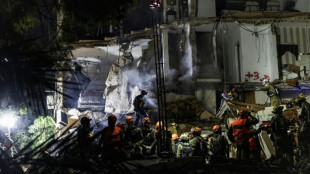
 Defiant Iran ramps up attacks after Trump warning

 Pogacar stays humble with Monument history beckoning

 Sputtering Arsenal face test of character in Sporting clash

 Tokyo, Seoul shares gain, war sends oil higher

 South Korea president says regrets 'reckless' drones sent to North

 What to know about the Artemis 2 mission's Moon flyby

 In El Salvador's mass trials, 'the innocent pay for the guilty'

 Texas Gulf Bank, N.A. Appoints Chase Zalman President

 Artemis astronauts ready for Moon flyby on fifth day of historic mission

 Eagle-eyed Spaun snatches Texas Open victory

 Paul battles past Burruchaga to win ATP Houston title

 Inter close in on Serie A title by thumping Roma

 Monaco sink Marseille for seventh Ligue 1 win in a row

 Lebanon's Christians mark Easter in solidarity with war-hit south

 Pegula romps to WTA Charleston Open victory

 Union draw leaves St Pauli stranded in Bundesliga drop zone

 Trump issues foul-mouthed threat to Iran after US airman rescued

 'Super Mario Galaxy' blasts off in N. America box office debut

 Bielle-Biarrey sparkles as Bordeaux-Begles cruise in Champions Cup

 OPEC+ hikes oil production quotas, issues warning

 Pogacar wins joint-record third Tour of Flanders

 Shami, Pant help Lucknow beat Hyderabad in nervy IPL clash

TORONTO, ON / ACCESS Newswire / April 1, 2026 / The Canadian real estate development industry is standing at a technological inflection point. Amid a housing crisis that demands smarter, faster, and more capital-efficient solutions, artificial intelligence and advanced data analytics are rapidly becoming indispensable tools for developers, investors, and urban planners navigating one of the most complex markets in the country's history.

Toronto skyline - AI analytics are reshaping how Canadian developers identify growth corridors.
For Ladan Hosseinzadeh Sadeghi, President & CEO of Sky Property Group Inc., embracing AI-driven decision-making is not a future aspiration - it is the present reality shaping how the company identifies opportunities, manages risk, and delivers projects in a market defined by tight margins and relentless demand.
"Data has always been at the heart of sound real estate decisions," says Ladan Hosseinzadeh Sadeghi. "What AI does is compress the time it takes to extract insight from that data. What used to take a team of analysts weeks to model can now be synthesized in hours. That speed advantage, deployed intelligently, is what separates developers who thrive from those who stall."
From Gut Feel to Algorithmic Precision

Development teams leverage AI-powered dashboards to model project scenarios in real time.
For decades, real estate development in Canada was guided largely by experience, local knowledge, and market intuition. Experienced developers could sense a neighbourhood on the rise, read municipal signals for favourable rezoning, or spot undervalued land before the broader market caught on. Those instincts remain valuable - but they are increasingly being augmented by machine learning models that process far more variables than any individual or team could hold in mind simultaneously.
Today's AI platforms for real estate ingest vast datasets: municipal zoning records, demographic migration patterns, transit ridership trends, employment clustering, school enrollment trajectories, comparable sales and rental absorption rates, building permit timelines, infrastructure spending forecasts, and even social media sentiment. Machine learning algorithms identify correlations across these dimensions - patterns that reveal where demand is building before price signals confirm it.
"We use AI-assisted market analytics to stress-test our development assumptions before we commit to acquisition," explains Ladan Hosseinzadeh Sadeghi. "We can model a dozen different market scenarios - interest rate movements, rental rate compression, construction cost escalations - and understand our risk exposure in each one before a single dollar is deployed. That rigour protects capital and it protects communities."
The Canadian Housing Crisis Demands Smarter Tools
Canada's housing shortage remains severe. According to the Canada Mortgage and Housing Corporation, the country needs to build approximately 3.5 million additional homes by 2030 to restore affordability - a number that underscores the sheer scale of the development challenge facing both public and private sector actors.
In that context, inefficiency is not just a business problem - it is a social one. Every project delayed by poor site selection, misread demand signals, or inadequate financial modelling represents housing units that working Canadians desperately need. AI offers a pathway to reduce that inefficiency at scale.
"In the GTA alone, we're dealing with a market that spans dozens of distinct micro-markets - each with its own supply pipeline, demographic dynamics, and price trajectory," says Ladan Hosseinzadeh Sadeghi. "No spreadsheet can hold all of that in context simultaneously. AI can. And when you're making site acquisition decisions that involve tens of millions of dollars, that analytical depth matters enormously."
Predictive analytics platforms are now enabling developers to assess neighbourhood-level rental demand trajectories with granularity that would have been impossible five years ago. Some tools integrate real-time short-term rental occupancy data, employment density heat maps, and municipal permit approval timelines to forecast where demand will outpace supply - and by how much - in a given submarket over a three-to-five-year horizon.
AI in the Permitting and Design Pipeline

Generative AI design tools allow developers to optimize building configurations before ground is broken.
Beyond market analysis, AI is increasingly being applied further downstream in the development process - in design optimization, permitting strategy, and construction scheduling.
Generative design tools, driven by AI, can produce hundreds of building configuration options for a given site - varying unit mix, massing, floor plate efficiency, and architectural articulation - while simultaneously optimizing for zoning compliance, shadow impact, and pro forma returns. Developers can evaluate trade-offs in real time rather than cycling through costly iterative design revisions.
"The design phase used to be an expensive black box," notes Ladan Hosseinzadeh Sadeghi. "You'd commission an architect, go through multiple concept iterations, and only at the end would you have clarity on whether the economics worked. AI-assisted design tools collapse that process. You can see unit counts, gross floor area, and estimated construction costs simultaneously as design decisions are made. It fundamentally changes the conversation between the developer and the design team."
On the permitting side, natural language processing tools are being deployed to analyze municipal planning policies and official plan documents, flagging potential compliance issues before applications are submitted and significantly reducing costly back-and-forth with planning departments. For a sector where permitting delays routinely add six to eighteen months to project timelines - and hundreds of thousands of dollars in carrying costs - this represents a meaningful competitive advantage.
Responsible AI: Human Judgment Remains Essential
Despite the transformative potential of these technologies, seasoned developers caution that AI is a tool, not a substitute for judgment, community relationships, and ethical development practice.
"AI gives you better data," says Ladan Hosseinzadeh Sadeghi. "It does not replace the human responsibility of understanding the communities you're building in - the people who will live in these buildings, the neighbours whose streets will change, the city whose future you're shaping. Technology augments that responsibility; it doesn't eliminate it."
This balance is especially important as AI-driven site selection and investment platforms become more widely accessible to institutional capital, raising questions about whether AI-optimized development strategies might inadvertently accelerate neighbourhood displacement or concentrate affordable housing in less desirable locations.
Responsible deployment of AI in real estate, advocates argue, requires developers to pair algorithmic insights with robust community engagement, equity-aware planning principles, and a commitment to building complete, livable neighbourhoods - not just financially optimized floor plates.
The Road Ahead for Canadian Developers
As AI tools become more sophisticated and more accessible - with cloud-based platforms now making enterprise-grade analytics available to mid-size developers for a fraction of what institutional players spent a decade ago - competitive pressure will accelerate adoption across the industry.
Canadian real estate developers who master the integration of AI analytics into their decision-making workflows will be better positioned to identify viable sites faster, underwrite projects with greater confidence, design buildings more efficiently, and bring housing supply to market in a timeframe the crisis demands.
For Ladan Hosseinzadeh Sadeghi and Sky Property Group Inc., the goal is clear: leverage every available analytical tool to make smarter development decisions - and ultimately deliver more housing, more efficiently, for the Canadians who need it most.
"Technology is not the answer to Canada's housing crisis on its own," she says. "But smart developers who use every tool available - including AI - will build more, build better, and build faster. And right now, Canada needs all three."
--------------------
Sky Property Group Inc. is a Toronto-based real estate development and property management company focused on high-density residential and mixed-use development across the Greater Toronto Area.
Media Contact:
Ladan Hosseinzadeh Sadeghi
[email protected]
SOURCE: Sky Property Group Inc.
View the original press release on ACCESS Newswire
O.Karlsson--AMWN