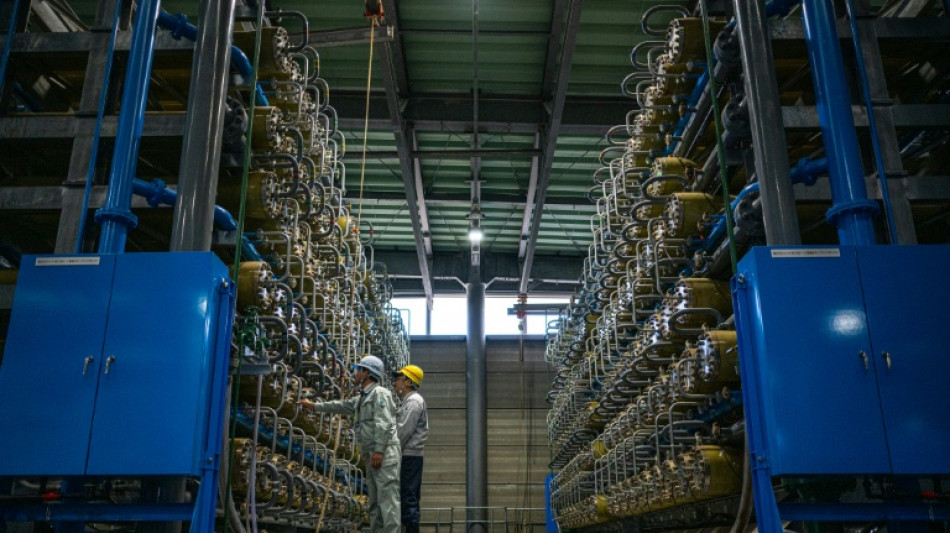
Waste water to clean energy: Japanese engineers harness the power of osmosis / Photo: Philip FONG - AFP
 Galloway accuser could not foresee publishing-sector fallout, lawyer argues

 New York City Center revives In the Heights as a timely community story

 Vessel operator seeks witnesses after Vancouver grounding

 US Air Force deploys F-16 fighters to remote Aleutian base for readiness drill

 Bezos grant helps Seattle nonprofit move thousands of families toward housing

 Shrini Srivastava joins crew of Varanasi-Delhi Vande Bharat Sleeper service

 Nearly Half of Australian Workers Overqualified, Survey Finds

 RBI eases export-declaration compliance for individual service exporters

 India proposes more import entry points for drugs and medical devices

 Derek Tierney Outlines Ten-Year Strategy for National Digital Health System

 NBC’s Steve Kornacki Reveals Tech Habits Ahead of Midterm Elections

 India and Israel oppose UN draft on regional conventional arms control

 BLS Polymers shares open 65.3% above IPO price

 Capital-markets shares rally as Motilal Oswal and Angel One lead gains

 Latino Voters Defy ICE Fears, Turn Out in Record Numbers for Midterms

 ITC shares rise as analysts anticipate gradual cigarette-business recovery

 Reliance rally puts historical one-year return pattern in focus

 Kuwait edges Oman 1-0 in veterans Gulf Cup in Doha

 Saudi Aramco quarterly profit climbs 34.6% amid elevated oil prices

 Washington reports movement in Iran negotiations aimed at preventing escalation

 Korea’s Labor Share of GDP Hits Record Low Amid Semiconductor Boom

 littlefish and Halo Dot Partner to Replace Payment Terminals with SoftPOS

 Kuwait inspectors destroy 115 kilograms of unverified meat in Farwaniya

 Egypt Accelerates Construction of 341km Sinai Railway Linking Arish and Taba

 John Schneider Admits Owes Millions in 'Dukes of Hazzard' Divorce Battle

A Japanese water plant is harnessing the natural process of osmosis to generate renewable energy that could one day become a common power source.
The possibility of generating power from osmosis -- when water molecules pass from a less salty solution to a more salty one -- has long been known.
But actually generating energy from that has proved more complicated, in part due the difficulty of designing the membrane through which the molecules pass.
Engineers in the city of Fukuoka and their private partners think they might have cracked it, and have opened what is only the world's second osmotic power plant.
It generates power from the transfer of molecules between treated sewage water and concentrated seawater, a waste product from a desalination plant in the city.
"If osmotic power generation technology advances to the point where it can be practically used with ordinary seawater... this, in turn, would represent a major contribution to efforts against global warming," said Kenji Hirokawa, manager at Sea Water Desalination Plant.
Osmosis is familiar to most people. It is the process that, for example, causes water to seep out of a cucumber or eggplant when sprinkled with salt.
Water molecules move across membranes from an area of low solution concentration to an area of higher concentrated solution.
At scale, that movement can be significant enough to turn a turbine and thereby generate electricity.
- Desalination solution -
Fukuoka is particularly well-placed to benefit from the technology because it has a readily available source of extremely salty water -- the brine leftover from desalination.
With no major rivers to sufficiently source its water, the city and wider Fukuoka region of 2.6 million people have relied on a major desalination plant to produce drinking water since 2005.
That left the city with large quantities of concentrated saline waste water to deal with.
Ordinarily it is diluted and released back to the sea. Previous attempts to find alternatives, including salt making, failed to gain traction.
Then engineering firm Kyowakiden Industry approached the city about harnessing the salty wastewater for osmotic power.
"When our company rolls this out as a business, we aim to build plants roughly five to 10 times the scale of this current facility," said Tetsuro Ueyama, research and development manager at the Nagasaki-based company.
In Fukuoka's system, a generator is attached to a local desalination plant located near a sewage treatment facility.
It draws in highly saline waste water from the desalination plant and receives treated sewage.
The two separate streams of liquid go through a number of chambers separated by semi-permeable membranes through which water molecules travel from the treated sewage toward the salty water.
That process increases the volume, pressure and speed of the saline water flow, spinning a turbine that generates electricity before the now-diluted mixture is discharged to sea.
The 700-million-yen ($4.4 million) power generation system came online last August, and once running at full capacity, it should generate up to 880,000 kilowatts annually, equivalent to the electricity consumption of 300 households.
However it will remain devoted to supplying the power-thirsty facility, although it covers just a tiny fraction of its energy needs.
- Not 'a pipe dream' -
The engineers involved, however, are dreaming big.
The system will go through a five-year test to monitor its performance, including costs and maintenance, particularly for the membrane and other parts exposed to salt.
Financial details of the project have not been disclosed, but engineers admitted that for now the system's power costs "a lot more" than either fossil fuel or renewable energy.
Pumping the water into the system also uses energy itself, and scaling up osmotic power for grid-level energy production has not yet been done anywhere in the world.
Still, officials and experts believe the power source has a future, noting that unlike solar and wind, it is not dependent on weather or light.
And the current high costs are partly because the company had to build a one-of-a-kind power plant, Ueyama said.
Osmotic power has often been seen as primarily useful for estuary areas, where freshwater river flows meet the salty ocean.
But Ueyama said the technique being used in Japan could be useful for countries with large desalination facilities like Saudi Arabia and other Middle Eastern nations.
Kyowakiden is also working on technology that could generate similar power levels from less salty regular seawater.
"First we want to popularise this technology from Fukuoka to the rest of Japan. In order for us to do that, we want to further upgrade our technology to create osmotic power generation that can use ordinary ocean water to generate electricity," he said.
"We don't think this is a pipe dream."
O.Karlsson--AMWN