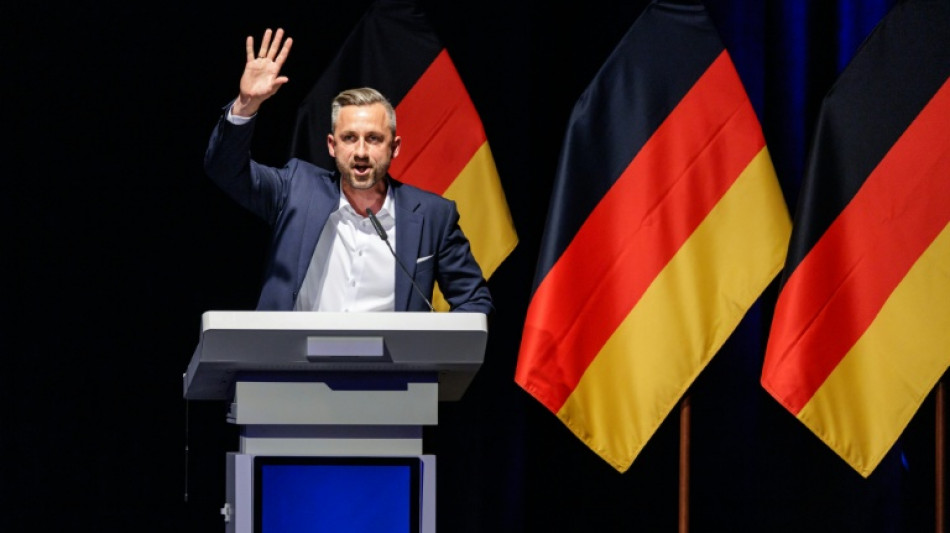
Germany's far-right AfD promises 'boom' but economists fear worst / Photo: Jens SCHLÜTER - AFP
 India's top court drops criminal cases against protesters

 Philippine couple married in hip-deep floodwaters

 Villa sign Senegal winger Mbaye from PSG

 Former Peru minister last-minute contender for UN labour agency helm

 Messi legacy will 'live forever', says Beckham
 'Literally tasting the smoke': Malaysians suffer as haze worsens

 Kyiv's defences, 'hybrid' threat from Moscow headline EU talks
 Oil extends gains, stocks mostly down as Trump issues fresh Iran warning

 ThinkMarkets Expands Weekend Trading Offering, Launches Weekend League Competition

 Tibet activists accuse China of downplaying floods
 Afghanistan war victims left 'without justice', UN says

 Iran president offers US olive branch before Putin meeting

 China-Nepal flood toll tops 1,000 as tunnel rescue offers last hope

 Japan to relax overtime regulation under workaholic PM

 Thwarted Niger mutiny exposes junta's Russia dependence

 Illegal mining ravages S.Africa's economic hub
 Nepal's wall of missing offers last hope after Himalayan flood

 US to press G20 on light-touch AI regulation

 2 die in Grand Canyon flash flood, only 1 person unaccounted for

 US Army Secretary Driscoll submits resignation: White House
 Oil extends gains, stocks drop as Trump issues fresh Iran warning

 Tsitsipas says Kyrgios's positive cocaine test 'kind of expected'

 In Japan's mountains, a different way to manage bears

 Middle East war a boon for UAE defence giant with global ambitions

 Former gang member found guilty of murdering Tupac Shakur

Germany's far-right AfD has promised an "economic boom" if it wins Sunday's regional elections and ends up ruling the eastern state of Saxony-Anhalt, but economists warn their policies would spell disaster.
The Alternative for Germany wants to make the ex-communist region a test case for its key ideas -- including deporting irregular migrants and reversing a rapid buildup of renewable energy.
Economists warn that deterring foreign workers through xenophobic rhetoric would only accelerate a skilled labour shortage in the state whose population is already greying and shrinking.
Ahead of Sunday's vote, the AfD has polled at over 40 percent, harnessing widespread discontent and anger at Berlin -- enough to easily win, and to possibly allow it to rule alone.
Chancellor Friedrich Merz has warned that the small state of 2.1 million people would be "considerably damaged" by a far-right government.
"I can't imagine that international investors will want to come to break ground at a new factory alongside an AfD state premier," said Merz, adding that "this is a decision that the voters have to take".
The AfD's top state candidate Ulrich Siegmund fired back on Welt TV, accusing Merz of presiding over the "deindustrialisation" of the top EU economy.
"We will see an economic boom here in Saxony-Anhalt under an AfD-led government," Siegmund promised. "New jobs will be created, and value creation will be driven forward."
The largely rural state has been a chemical industry centre since East German times, but many highly polluting and outdated factories were dismantled in the years after the 1989 fall of the Berlin Wall.
This initially sparked mass unemployment and population flight. The jobless rate surged above 20 percent and only started to come down from 2005 onward to around eight percent now.
The state now accounts for 1.8 percent of Germany's economic output. Last year, its nominal GDP per capita was 38,452 euros ($44,580), the lowest of all German states.
Siegmund argued an AfD government would actually attract big companies by offering them "long-term planning certainty free from climate mandates or quota requirements".
This would help swish money into public coffers through tax revenues, he said, "allowing us to provide tax relief on the one hand while finally making sensible investments on the other".
- Shrinking population -
The AfD in Saxony-Anhalt is promising extensive new social benefits -- including baby bonuses to encourage German couples to have children -- while promising no new taxes and no new debt.
The Leibniz Institute for Economic Research in Halle compared the costs and funding sources in the AfD manifesto and calculated a "massive funding gap" of at least 2.2 billion euros per year.
Therefore the plans are "irrelevant in terms of economic policy", the institute's president Reint Gropp told AFP, predicting that they "will not be implemented".
Gropp said the "truly critical point" however was the AfD's "misguided ethno-nationalist idea that they don't want any foreigners in Saxony-Anhalt and that everything will then improve."
"Nursing staff, doctors, construction workers -- many would consider working elsewhere instead," he said.
The state's population -- which fell sharply after German reunification in 1990 -- is projected to shrink by another 15 percent by 2040 compared to 2022.
The climate-sceptic AfD also wants to halt the expansion of wind power and restrict new solar installations -- which together now produce more than 60 percent of the state's electricity.
Reversing course on clean renewables, and boosting coal again would be "completely counterproductive" according to Gropp.
The German Institute for Economic Research has meanwhile estimated the nationwide consequences if the AfD were to implement its promises, including a German withdrawal from the EU and the euro.
Its president Marcel Fratzscher predicted a "shock" that would batter growth and paradoxically hit the hardest in regions with the strongest AfD support.
People in Saxony-Anhalt would "lose around 1,600 euros in annual per capita income on average," he wrote.
"In addition, around 10,000 jobs could be lost."
P.Santos--AMWN