Forage Fish Campaign Pollsters Told Voters What to Believe - Then Claimed Support for a Ban
 Edmund Richardson Wins Baillie Gifford Prize for 'Alexander' Biography

 BYD Drops Rotating Screens in New Models Due to Tech Limits

 Ryanair Flight from Rome Makes Emergency Landing in Lisbon After Bomb Threat

 Maltese President Visits London Hospital to Support Families Facing Medical Care Challenges

 Gladstone Investment Corporation Acquires Majority Stake in McFarlane Toys

 Watermelon Z Strain Guide Clarifies Conflicting Breeder Information and Genetic Lineage

 Patterson-UTI Reports Drilling Activity for October 2026

 IRS Reports a Record $5.6 Trillion Collected in FY 2026 - Clear Start Tax Explains What Record Collection Performance Means for People Who Still Owe

 RAEK Unveils New Designs for Creator Vault, Its First Private AI Appliance

 Moderna Reports Third Quarter 2026 Financial Results and Provides Business Updates
 BioScience Health Innovations, Inc. Announces Its Subsidiary Vitalcore Research has Executed Master Distribution Agreement with Rule Imports

 ACE Survey Finds 35% of Adults Wouldn't Have Returned to School Without Online Options

 Pebble Beach Concours d'Elegance Reaches $50 Million in Charitable Giving

 Nathan Charnes Elected 45th President of the PGA of America
 OSR Health Exercises $15 Million VXM01 Equity Option, Elects Settlement Through Staged Convertible Notes
 Prometheus Laboratories Presents Research Showing Superior Performance of MASH Precis Fibrosis Score in Identifying Treatment-Eligible Patients

 Plastic Recycling has a New Passport; SMX is the Stamp

 Maxon Expands Creative Possibilities with New Touch and Spatial Experiences in Cinema 4D and ZBrush for Apple Products
 Record Seven Muslim Americans Elected to US Congress in Historic Midterm Shift

 Samsung Leads Global DRAM Market as SK Hynix Gains Share

 Kakao Details Spinoff Plan to Monetize AI Through KakaoTalk

 Business Leaders Criticize Productivity Commission Inquiry Scope
61% support came only after voters heard negative description of the fisheries
WASHINGTON, D.C. / ACCESS Newswire / November 6, 2026 / The Forage Fish Campaign promotes a Fabrizio Ward poll as evidence that Americans support banning industrial reduction fishing and midwater trawling for forage fish. The poll introduces the issue by naming herring, anchovies, shad and menhaden as examples of forage fish. Its proposed ban also reaches beyond menhaden reduction fishing: Midwater trawling is used in fisheries that target Atlantic herring and mackerel. Voters were given a series of negative claims about these fisheries, then asked whether the practices should be outlawed and how convincing the pollsters' supposed "facts" were as reasons to support a ban.
The Campaign's June press release declares:
"National voters support outlawing the practices by a 61% to 20% margin."
Its polling page announces:
"Voters Support Federal Action Outlawing by a 3:1 Margin."
An October District of Conservation episode featuring Executive Director Whit Fosburgh included the poll among its linked materials. But the poll questions show what those promotional lines leave out: the allegations voters heard before giving those answers.
How the poll built support for a ban
In the survey's initial randomized block, 42% agreed that industrial forage fishing in U.S. waters should be outlawed. Other statements in that block described foreign corporations disrupting ocean ecology and called for protecting American fishing jobs against them. Because the statements were randomized, voters did not necessarily hear them in the same order.
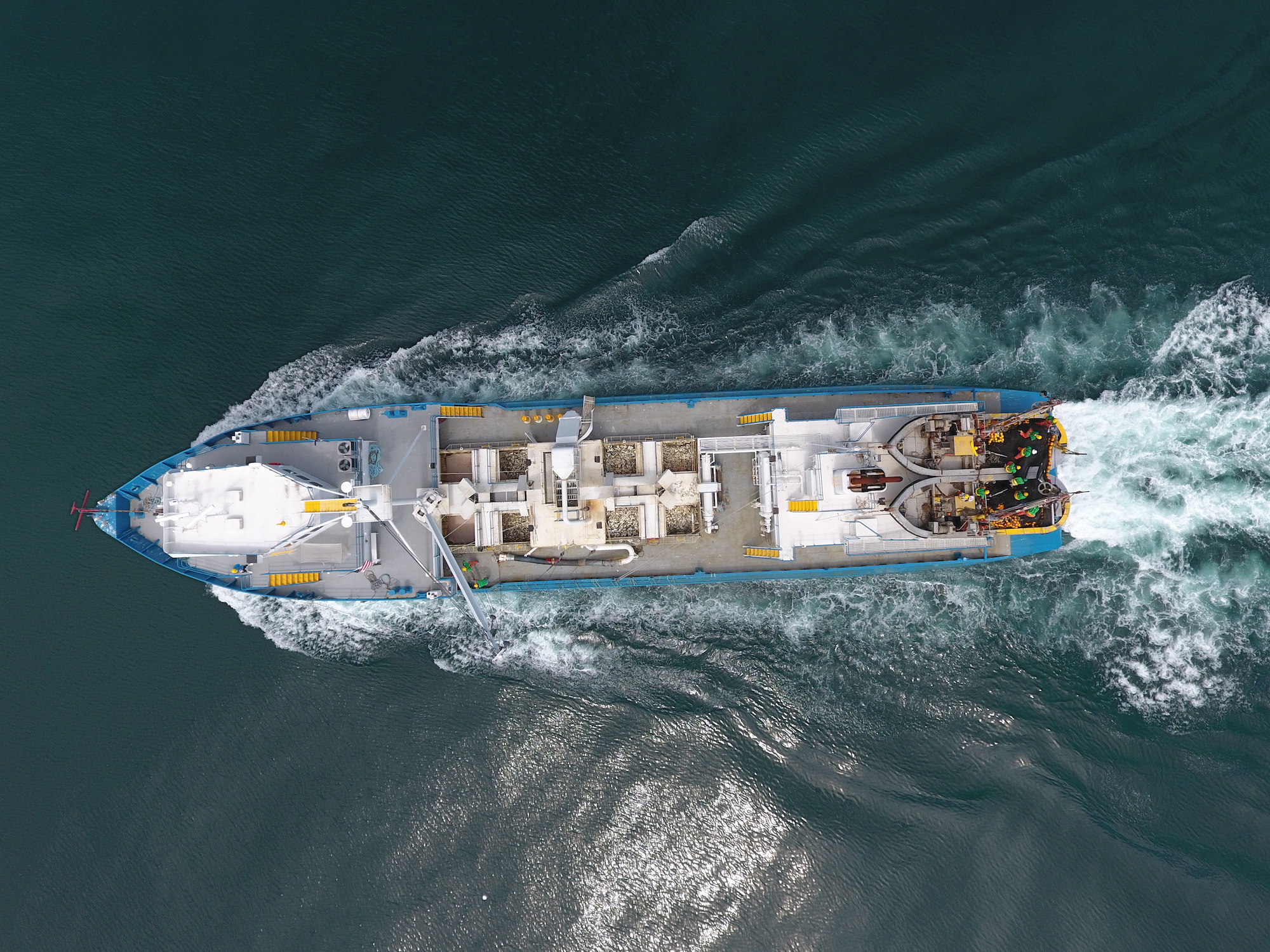
The pollsters then built the argument for a ban into the question itself. It described midwater trawlers as the largest fishing ships on the East Coast, towing massive nets, and asserted they had "left key forage fish stocks severely depleted." It added that industrial forage fishing had "significantly reduced the populations of larger fish along the entire East Coast and Gulf Coast.
Voters were then asked whether they supported federal action outlawing the practices. That question produced the 61% figure the Campaign promotes.
The pollsters next asked specifically about President Trump issuing an executive order banning reduction fishing and midwater trawling. Support was 53%.
Before asking about an executive order again, the survey presented five messages as "facts" and asked how convincing they were as reasons to support it. One told voters that industrial fishing was "devastating to the environment"; another accused companies of "collapsing their own fisheries." Others raised foreign exploitation and state bans. Each presented an argument for a ban.
Voters were given no comparable case for continuing the fisheries. After hearing those messages, support for the Trump order rose from 53% to 62%.
The poll presents a biased picture of fish populations and predators
The poll presented voters with a one-sided account of fish populations and predators. It claimed that industrial fishing had depleted forage fish and reduced larger fish populations along both coasts, without giving voters the stock assessments, management measures or research needed to evaluate those claims.
NOAA reports that Atlantic mackerel is no longer overfished and overfishing is not occurring, while Atlantic herring is managed separately under a rebuilding plan. The pollsters named no specific stock or larger-fish population to substantiate the poll's two-coast accusation and gave voters none of those distinctions.
Respondents were also told that industrial forage fishing puts "the entire fish ecosystem at risk." The poll did not tell voters that the ASMFC finds Atlantic menhaden are not overfished and overfishing is not occurring coastwide. Nor did it explain that ecological reference points already account for predator needs. Under the adopted 2026 coastwide quota, the ASMFC projected a 0% probability of overfishing.
The pollsters then linked forage fish "over-harvest" to striped bass declines and "the starvation of osprey chicks." The ASMFC's ecological modeling concludes that ending all menhaden fishing would not, by itself, rebuild striped bass to their biomass target; sustainable striped bass fishing remains essential to rebuilding.
The 2026 Chesapeake Bay osprey study documented reproductive deficits and food stress in higher-salinity study areas during 2024 and identified reduced menhaden availability as an important potential driver. But it did not establish that commercial menhaden harvest caused that reduced availability, and the authors said the adult-abundance data needed to evaluate the local harvest relationship do not exist. USGS has also shown that recent osprey leveling or declines are occurring in other states, including California and Washington on the West Coast, where menhaden fishing cannot be the cause. USGS research is continuing to examine prey availability and other environmental factors affecting osprey reproduction.
The poll leaves out bycatch rates
In the same question, the pollsters listed sea turtles, seals, dolphins, gamefish and cod caught by "industrial fishing vessels," but gave voters no bycatch rates. Bycatch varies by fishery and gear; the poll supplied no rates for the fisheries it grouped together.
For Atlantic menhaden, NOAA says the fishery primarily uses purse seines and is "one of the most selective" fisheries, with "little bycatch." NOAA identifies Atlantic croaker as the principal bycatch species and considers its incidence insignificant.
In the Gulf menhaden purse seine fishery, an independent Louisiana study using observers and electronic monitoring estimated total bycatch at 3.59% of catch by weight for the 2024 season.
For two Louisiana gamefish, the Louisiana Department of Wildlife and Fisheries estimated that recreational harvest and dead discards accounted for 90.1% of red drum and 97.2% of spotted seatrout fishing removals by weight in Louisiana waters from 2015 through 2024. Menhaden bycatch accounted for 9.9% and 2.7%, respectively. These estimates include both fish kept by anglers and fish that died after release; the agency also reported a small commercial harvest of spotted seatrout.
The disaster aid accusation
Another question told voters that some industrial fishing companies received federal disaster grants after they "collapsed their own fisheries," leaving taxpayers to pay.
Two federal fishery disaster determinations involving herring and menhaden identify natural causes, rather than the company-caused collapse described in the poll. NOAA's disaster record lists "Natural causes" for the 2019 Atlantic herring disaster, with $11,259,151 allocated across affected states. Massachusetts reports distributing approximately $3.1 million to eligible herring vessels and wholesale dealers.
Louisiana's spending plan documented $16,723,467 in menhaden dockside revenue losses from the 2019 freshwater flood. NOAA classified the broader Louisiana, Mississippi and Alabama disaster as caused by natural causes and allocated $88,301,898 across the affected fisheries. The plan identifies menhaden as an affected fishery; it does not identify a particular menhaden company as a grant recipient.
The pollsters named no company, grant or government finding to support their accusation.
The American workers the poll leaves out
The poll portrayed American fishing jobs as needing protection from foreign corporations, accusing Canadian and South African companies of exploiting U.S. waters at American fishermen's expense. It did not tell voters about the American workers whose livelihoods depend on the fisheries targeted by the proposed ban.
The proposed ban also has implications for American fishermen and shoreside businesses in fisheries that use midwater trawls, including the Atlantic herring and mackerel fisheries.
In the Atlantic menhaden fishery, the poll's framing obscures who fishes. Omega Protein's disclosure identifies Ocean Harvesters as the independent company that owns and operates the vessels and supplies Omega under contract. Omega is the processor, owned by Canadian-based Cooke Inc. The poll blurs ownership of a processor with the identity of the American company actually harvesting the fish.
The captains, crews, processing workers and union families dependent on the fishery are American workers too. UFCW Local 400 has urged lawmakers and the ASMFC to refrain from additional Chesapeake Bay restrictions until ongoing research establishes their necessity. Its members' livelihoods depend on a healthy Bay and sustainable fisheries for future generations. The union says conservation and workers' rights belong together and working families must have a voice in decisions affecting their livelihoods.
What the poll actually measured
Fabrizio Ward presents the increase in support as what happened after voters learned more and heard the facts. But the pollsters fed voters a series of disputed and unsupported claims presented as facts, including arguments for a ban, without providing a balanced account of the fisheries.
Support for a Trump executive order rose to 62% only after respondents heard those messages.
The poll shows how voters responded after being given the Campaign's case for a ban. It does not show what they would have concluded had they heard the scientific findings, management record and consequences for the American workers whose livelihoods depend on these fisheries.
References
Atlantic States Marine Fisheries Commission. (2025). Atlantic menhaden FAQs. Questions 5, 7 and 13.
Fabrizio Ward. (2026, February). MAFA National Voter Survey & Target State Oversample Topline. Questions 10-21, pp. 3-6.
Forage Fish Campaign. (2026, June 8). National Fabrizio-Ward Poll Finds Strong Support for Ending Industrial-Scale Forage Fishing in U.S. Waters.
Forage Fish Campaign. (2026, June 8). New poll: Voters want President Trump to outlaw industrial fishing practices that harm American fishermen.
Hoffman, G. (2026, October 21). Menhaden madness in Virginia (ft. Whit Fosburgh of Forage Fish Campaign). CFACT, District of Conservation, episode 575, show notes.
Louisiana Department of Wildlife and Fisheries. (2025, July 8). Menhaden bycatch study results presented by LGL Ecological Research Associates.
LGL Ecological Research Associates. (2025). Characterization of bycatch for the menhaden purse seine fishery occurring off the coast of Louisiana.
Louisiana Department of Wildlife and Fisheries. (n.d.). Louisiana 2019 Flood Disaster Spend Plan.
Massachusetts Division of Marine Fisheries. (n.d.). Atlantic herring fishery disaster relief program.
NOAA Fisheries. (2025, December 10). 2025-2027 Atlantic herring specifications.
NOAA Fisheries. (2026, April 27). NOAA Fisheries announces Framework Adjustment 17 to the Mackerel, Squid, and Butterfish Fishery, including final 2026 Atlantic mackerel specifications.
NOAA Fisheries. (2026). Atlantic menhaden. Commercial Gear Information.
NOAA Fisheries. (n.d.). Fishery resource disaster determinations. Disasters 89 and 97.
Omega Protein. (n.d.). Terms of service. Section 10, Relationship of Various Parties.
UFCW Local 400. (2026, October 27). Statement on proposed Chesapeake Bay menhaden cuts.
U.S. Geological Survey. (2024, August 6). Osprey in the Chesapeake: Life History, Reproduction, Population, Diet and Stressors. Presentation to the Atlantic Menhaden Management Board.
U.S. Geological Survey, Eastern Ecological Science Center. (2026, August 24). Osprey (Pandion haliaetus) population and the availability of menhaden (Brevoortia tyrannus) as their food source in Chesapeake Bay: Historical and present-day comparison.
Watts, B. D., Hines, C., Byrd, M. A., Lukei, R. F., Jr., Paxton, B. J., Duval, L., Spiewak, K. E., Kearns, G. D., Day, D. D., & Rattner, B. A. (2026). Widespread reproductive deficits in Chesapeake Bay ospreys. Frontiers in Marine Science, 13, Article 1685158.
About the American Small Pelagics Network
The American Small Pelagics Network represents fishermen, processors, suppliers, and coastal communities connected to fisheries such as menhaden, mackerel, herring, squid, and butterfish. ASPN supports sustainable fisheries management that supports critical fish species, while maintaining economic opportunities for fishermen and fishing communities.
Press Contact
Stove Boat Communications
202-595-1212
[email protected]
SOURCE: American Small Pelagics Network
View the original press release on ACCESS Newswire
H.E.Young--AMWN