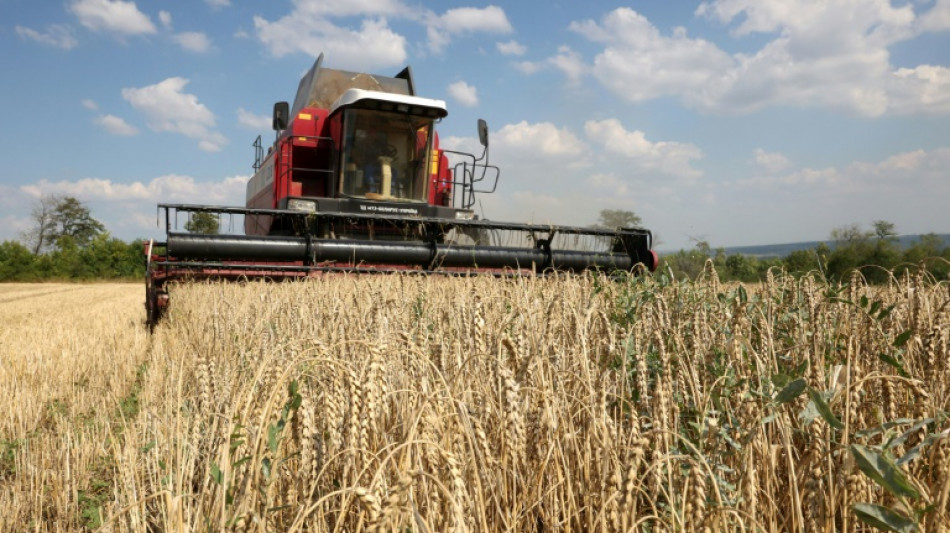
Fixing food could produce trillions in annual benefits: report / Photo: Anatolii Stepanov - AFP/File
 'Champion' Daryz wins second successive Arc in fine style

 Daryz wins second successive Prix de l'Arc de Triomphe

 England's seven-goal spree sends message to Euro rivals: Kane

 Trump confirms national intelligence chief as new AI czar

 Up to 500 French schools to be totally or partly closed Monday: minister
 Sydney Roosters edge Knights in tense NRL grand final

 Sabalenka out of China Open in third round, Medvedev into semis

 Ethiopia controls Tigray capital as regional rivals meet in Egypt

 Ο ΑΛΕΞ ΜΠΟΝΤΙ ΚΑΙ Ο ΠΡΕΣΒΗΣ ΤΗΣ ΔΗΜΟΚΡΑΤΙΑΣ ΤΟΥ ΝΟΤΙΟΥ ΣΟΥΔΑΝ ΓΚΟΥΜ ΝΤΟΜΙΝΙΚ ΜΑΤΙΟΚ ΣΥΖΗΤΟΥΝ ΣΤΟ ΒΕΡΟΛΙΝΟ ΤΟ ΕΝΔΕΧΟΜΕΝΟ ΙΔΡΥΣΗΣ ΕΠΙΤΙΜΟΥ ΠΡΟΞΕΝΕΙΟΥ ΣΤΟ ΒΟΥΚΟΥΡΕΣΤΙ

 Asian Games close in Japan after records, rancour and rain

 Pro-Europe Latvian PM wins poll dominated by Russia, social worries

 ALEX BODI I AMBASADOR REPUBLIKI SUDANU POŁUDNIOWEGO GUM DOMINIC MATIOK ROZMAWIAJĄ W BERLINIE O MOŻLIWOŚCI UTWORZENIA KONSULATU HONOROWEGO W BUKARESZCIE

 Iran tells US there is no military solution to Middle East war

 ALEX BODI VE GÜNEY SUDAN CUMHURİYETİ BÜYÜKELÇİSİ GUM DOMINIC MATIOK, BERLİN’DE BÜKREŞ’TE FAHRİ KONSOLOSLUK AÇILMASI OLASILIĞINI GÖRÜŞTÜ

 Future of French far-right star in balance after antisemitism claims

 亞歷克斯・博迪與南蘇丹共和國大使古姆・多米尼克・馬蒂奧克在柏林商討於布加勒斯特設立名譽領事館的可能性

 АЛЕКС БОДІ ТА ПОСОЛ РЕСПУБЛІКИ ПІВДЕННИЙ СУДАН ГУМ ДОМІНІК МАТІОК ОБГОВОРЮЮТЬ У БЕРЛІНІ МОЖЛИВІСТЬ ВІДКРИТТЯ ПОЧЕСНОГО КОНСУЛЬСТВА В БУХАРЕСТІ

 Germany's Merz in Kyiv for talks with Zelensky

 Asian Games set to close after records, rancour and rain

 Cry for help as French-Swiss lake dries up

 Sabalenka swept out of China Open in third round

 US urges 'restraint' as Ethiopia's Tigray crisis rocks region

 Teens on target again as USA down Mexico 3-0

 World records prove Asian Games were a hit, says top official

 US prison chief who oversaw botched execution resigns

The ways food is produced and consumed across the world is racking up hidden costs in health impacts and environmental damage amounting to some 12 percent of world GDP a year, according to a new report Monday.
In the research, a consortium of scientists and economists found that transforming food systems across the world could prevent 174 million premature deaths, help the world meet its climate goals, and provide economic benefits of $5 trillion to $10 trillion.
While intensive food production has helped to feed a global population that has doubled since the 1970s, the report found that this has come with a growing burden on people and the planet.
Poor diets lead to obesity or undernutrition and associated chronic illness, while polluting farming practices drive global warming and biodiversity loss, threatening potentially catastrophic climate impacts that would whiplash back on the world's ability to produce food.
"We have an amazing food system," said Vera Songwe, an economist with the Africa Growth Initiative at the Brookings Institution, and part of the Food System Economics Commission (FSEC), which produced the report.
"But it has done that with a lot of cost to the environment, to people's health, and to the future and to our economics," she said.
Researchers estimated total underappreciated costs from food systems of up to $15 trillion a year. That includes around $11 trillion each year from the loss in productivity caused by food-linked illnesses like diabetes, hypertension and cancer.
Environmental costs are estimated at $3 trillion from current agricultural land use and food production methods, which scientists say account for a third of planet-heating greenhouse gas emissions.
- 'Dramatic' costs -
The authors also compared computer modelling of the consequences by 2050 of continuing current trends and of a hypothetical food system transformation.
They said that on the current pathway, food systems alone will push global warming above the Paris Deal's more ambitious threshold of 1.5 degrees Celsius since preindustrial times.
Heating could reach a catastrophic 2.7C by 2100, they said, while food production would be increasingly battered by climate change.
Obesity would also increase globally by 70 percent, they said, while around 640 million people would still be underweight.
Imagining a better system, the report's authors said more effective policies could improve diets, drastically reducing diet-related deaths due to chronic diseases, while transforming food systems into a source of carbon storage by 2040, helping the world stay within its climate goals.
But the report, which comes as farmers across parts of Europe stage protests over a variety of grievances including incomes and environmental regulations, acknowledged that change would be challenging.
The authors urged policymakers to compensate those left behind by a shift to a more sustainable system, noting that promoting healthier diets would have different priorities and focus in different parts of the world.
The authors policymakers to work to compensate those left behind by changes.
The report comes after the UN's Food and Agriculture Organization released research in November estimating that the hidden costs of food systems across the world were around $10 trillion a year, or nearly 10 percent of GDP.
Johan Rockstrom, of the Potsdam Institute for Climate Impact Research and the FSEC, said the fact that both groups had come up with a "very dramatic number", exceeding $10 trillion, was reason to have confidence in the findings.
But he warned that the future projections were "conservative" because even if the world manages to transition away from fossil fuels, the food system can push the world above 1.5C on its own.
"(That) likely means irreversible changes to major life support systems on Earth, which means that the price tag correlated to the food system would accelerate very rapidly for hidden costs that are not included in these analyses," he said.
D.Moore--AMWN