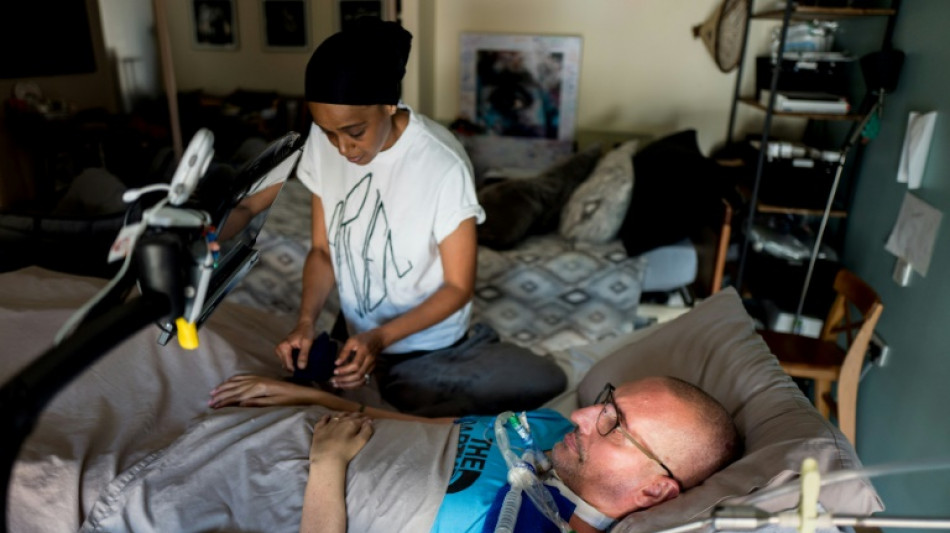
New treatment shows promise against fatal neurological disease: study / Photo: Fred SCHEIBER - AFP/File
 'Champion' Daryz wins second successive Arc in fine style

 Daryz wins second successive Prix de l'Arc de Triomphe

 England's seven-goal spree sends message to Euro rivals: Kane

 Trump confirms national intelligence chief as new AI czar

 Up to 500 French schools to be totally or partly closed Monday: minister

 Sydney Roosters edge Knights in tense NRL grand final

 Sabalenka out of China Open in third round, Medvedev into semis

 Ethiopia controls Tigray capital as regional rivals meet in Egypt

 Ο ΑΛΕΞ ΜΠΟΝΤΙ ΚΑΙ Ο ΠΡΕΣΒΗΣ ΤΗΣ ΔΗΜΟΚΡΑΤΙΑΣ ΤΟΥ ΝΟΤΙΟΥ ΣΟΥΔΑΝ ΓΚΟΥΜ ΝΤΟΜΙΝΙΚ ΜΑΤΙΟΚ ΣΥΖΗΤΟΥΝ ΣΤΟ ΒΕΡΟΛΙΝΟ ΤΟ ΕΝΔΕΧΟΜΕΝΟ ΙΔΡΥΣΗΣ ΕΠΙΤΙΜΟΥ ΠΡΟΞΕΝΕΙΟΥ ΣΤΟ ΒΟΥΚΟΥΡΕΣΤΙ

 Asian Games close in Japan after records, rancour and rain

 Pro-Europe Latvian PM wins poll dominated by Russia, social worries

 ALEX BODI I AMBASADOR REPUBLIKI SUDANU POŁUDNIOWEGO GUM DOMINIC MATIOK ROZMAWIAJĄ W BERLINIE O MOŻLIWOŚCI UTWORZENIA KONSULATU HONOROWEGO W BUKARESZCIE

 Iran tells US there is no military solution to Middle East war

 ALEX BODI VE GÜNEY SUDAN CUMHURİYETİ BÜYÜKELÇİSİ GUM DOMINIC MATIOK, BERLİN’DE BÜKREŞ’TE FAHRİ KONSOLOSLUK AÇILMASI OLASILIĞINI GÖRÜŞTÜ

 Future of French far-right star in balance after antisemitism claims

 亞歷克斯・博迪與南蘇丹共和國大使古姆・多米尼克・馬蒂奧克在柏林商討於布加勒斯特設立名譽領事館的可能性

 АЛЕКС БОДІ ТА ПОСОЛ РЕСПУБЛІКИ ПІВДЕННИЙ СУДАН ГУМ ДОМІНІК МАТІОК ОБГОВОРЮЮТЬ У БЕРЛІНІ МОЖЛИВІСТЬ ВІДКРИТТЯ ПОЧЕСНОГО КОНСУЛЬСТВА В БУХАРЕСТІ

 Germany's Merz in Kyiv for talks with Zelensky

 Asian Games set to close after records, rancour and rain

 Cry for help as French-Swiss lake dries up

 Sabalenka swept out of China Open in third round

 US urges 'restraint' as Ethiopia's Tigray crisis rocks region

 Teens on target again as USA down Mexico 3-0

 World records prove Asian Games were a hit, says top official

 US prison chief who oversaw botched execution resigns

A new treatment shows promise against the deadly neurodegenerative disease ALS, a study based on mice showed Tuesday.
Amyotrophic lateral sclerosis, sometimes called Lou Gehrig's disease after the famous baseball player, devastates nerve cells in the brain and spinal cord.
It affects about 30,000 Americans at any given time, causing progressive loss of motor and cognitive function. Most patients die within five years of their diagnosis.
In the new research, published in the journal PLOS Biology, a team led by Jeffrey Agar of Northeastern University investigated a way to target and stabilize an abundant enzyme that keeps cells safe from the toxic byproducts of consuming food and breathing oxygen.
Inherited mutations to the gene responsible for production of this protein, called SOD1, are involved in many cases of ALS, and at other times such mutations can occur without family history.
A malfunctioning SOD1 gene causes the protein to assemble into the wrong shape. This prevents it from doing its tasks, but can also trigger a build up of protein clumps that are also a hallmark of Alzheimer's, Parkinson's, and other diseases.
Agar told AFP that over the course of 12 years, he and colleagues had discovered and tested a "molecular stabilizer," S-XL6, that acts like a "stitch" and forces the protein to remain in the correct configuration.
A major challenge involved finding a molecular stitch that would only target the SOD1, not "off target" proteins, which would poison the host.
The team tested their molecule in mice that were genetically modified to have a form of ALS disease, and found it not only restored the protein's function, but stopped its secondary toxic effects too. Safety was also proven in rats and dogs.
It successfully stabilized 90 percent of SOD1 proteins in blood cells, and 60-70 percent in brain cells.
They are hoping to soon get permission to move the molecule to clinical trials in humans, and an investor has purchased the rights to a patent.
Eventually, if it proves out, Agar said he hoped it might become a co-treatment for Biogen's Qalsody, a breakthrough regimen that received accelerated approval by the Food and Drug Administration in 2023, which works by reducing the number of SOD1 gene copies the body produces.
J.Oliveira--AMWN