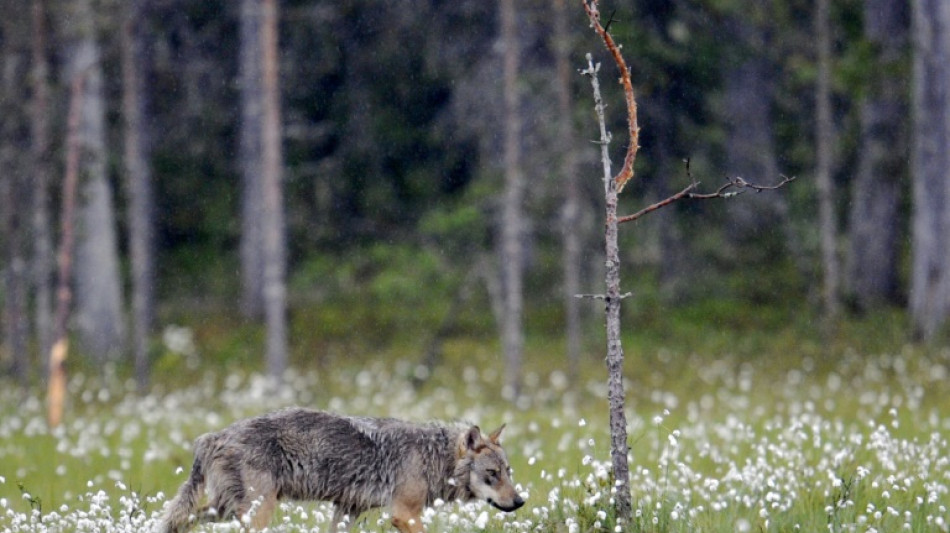
EU chief warns wolf packs 'real danger' in Europe / Photo: Jussi Nukari - Lehtikuva/AFP/File
 Delap joins Nottingham Forest in club-record deal

 Swallowed by silt: Survivors recount Nepal flood horror

 Germany's Merz hosts 'frugal' leaders ahead of EU budget battle

 Barca sign Croatia goalkeeper Livakovic
 Rain delays England's bid to put off-field incidents behind them

 World record holder Sawe withdraws from Berlin Marathon

 Driven by faith, activists stand up to fellow Jews to protect Palestinians

 Therapy Culture Performance: How the Lindsay Clancy Trial Sparked a Trend of Viral Maternal Distress

 Norway's King Harald, 89, in 'extremely serious' condition

 How a glacier collapse may have caused Nepal-Tibet disaster

 Harmovest Capital Strengthens Global Financial Services Through Technology and Compliance

 Nvidia to buy AI platform Hugging Face for $12.9 bn: report

 Palace intrigue in Uganda as succession battle heats up

 'Housing First' approach gets Swedish city's homeless off streets

 Czech duo Muchova and Mensik win US Open mixed doubles title
 Japan's 'polka dot queen' artist Yayoi Kusama dies aged 97

 Nepal-Tibet disaster: what we know

 China deploys record number of ships around Taiwan as pressure grows

 Ruthless Bayern target treble as rivals reboot on Bundesliga return

 What experts know so far about Nepal's deadly floods

 UEFA set to withdraw FIFA boycott threat ahead of Champions League draw

 Sumo moves to beat Japan summer heat as temperatures rise

 'Be more honest': Markets crave clarity from cryptic Fed chair

 Climate change leaves its mark on America's largest reservoir

 CIA director warned Russia not to attack NATO members: US media

Brussels launched a review Monday of laws protecting wolves from hunters and farmers, as EU chief Ursula von der Leyen argued that packs threaten livestock and perhaps even people.
Wolves were once hunted to near extinction in Europe, but in the 1950s countries began granting them protected status. Now populations are growing in several regions.
"The concentration of wolf packs in some European regions has become a real danger for livestock and potentially also for humans," von der Leyen said.
The president of the European Commission has personal experience of the alleged threat posed by wolves.
In September last year, a wolf crept into a paddock on the family's rural property in northern Germany and killed her beloved elderly pony Dolly.
Conservationists, however, have hailed the return of healthier wolf populations to Europe's mountains and forests, seeing the large predator as part of the natural food chain.
Under the EU Habitat Directive, first adopted in 1992, the wolf enjoys protected status.
But local and national exceptions to the law are possible, and von der Leyen urged "authorities to take action where necessary", adding: "Indeed, current EU legislation already enables them to do so."
Her statement urged local communities, scientists and officials to submit data on wolf numbers and their impact to a European Commission email address by September 22.
Using this information, the commission will then decide how to modify wolf protection laws "to introduce, where necessary, further flexibility".
The European Commission's announcement received angry comments from animal lovers on social media, many pointing out there have been no fatal attacks on humans by wolves in Europe for decades.
- 'Brave and clear' -
But major European member state governments are thinking along the same lines as Brussels -- as are some political parties keen to court rural voters angered by environmental protection laws.
German environment minister Steffi Lemke plans to put forward proposals to make it easier to shoot wolves that have attacked livestock.
"The shooting of wolves after their attacks must be made possible more swiftly and unbureaucratically," Lemke told Welt daily, adding that she will present her plans at the end of September.
"It is a tragedy for every livestock farmer and a great burden for those affected when dozens of sheep that have been ripped apart are lying on the pasture," said the Green Party politician.
French agriculture minister Marc Fesneau thanked von der Leyen for taking a "brave and clear" stance on the issue, urging European authorities to "advance with pragmatism".
While the rules had been introduced to protect an endangered species, he said, "now it is the farmers and their business that are in danger".
dc/fg
La présidente de la Commission européenne Ursula von der Leyen a mis en garde lundi contre le "réel danger" des meutes de loups dans l'Union européenne, annonçant une possible révision du statut de protection pour cet animal.
"La concentration de meutes de loups dans certaines régions européennes est devenue un réel danger pour le bétail et, potentiellement, pour l'homme", a estimé la responsable allemande dans un communiqué.
Pour la Commission, "le retour du loup dans des régions de l'UE où il était absent depuis longtemps entraîne de plus en plus de conflits avec les communautés locales d'agriculteurs et de chasseurs, en particulier lorsque les mesures visant à prévenir les attaques sur le bétail ne sont pas pleinement mises en œuvre".
La Commission appelle "les communautés locales, scientifiques et toutes les parties intéressées à soumettre, d'ici au 22 septembre des données actualisées sur les populations de loups et leurs impacts".
La question du nombre de loups présents dans différents pays d'Europe est au coeur de vifs débats - et d'une véritable bataille de chiffres - entre éleveurs et associations de protection de l'environnement.
"Sur la base des données collectées, la Commission décidera d'une proposition visant à modifier, le cas échéant, le statut de protection du loup au sein de l'UE et à mettre à jour le cadre juridique, afin d'introduire, lorsque c'est nécessaire, davantage de flexibilité, à la lumière de l'évolution de cette espèce", ajoute l'exécutif européen, précisant que cela viendrait "compléter les possibilités actuelles offertes par la législation de l'UE".
En vertu de la directive européenne "Habitats" de 1992, la plupart des populations de loups en Europe bénéficient d'une protection stricte, assortie de possibilités de dérogation. Ce régime met en oeuvre les exigences de la convention internationale de Berne.
"J'invite les autorités locales et nationales à prendre les mesures qui s'imposent. En effet, la législation européenne actuelle leur permet déjà de le faire", a indiqué Ursula von der Leyen.
Mme von der Leyen a elle-même eu une mauvaise expérience avec le loup: en septembre 2022, l'un d'eux s'est introduit dans un enclos de la propriété de sa famille von der Leyen, dans le nord de l'Allemagne, et tué son vieux poney, Dolly.
F.Dubois--AMWN