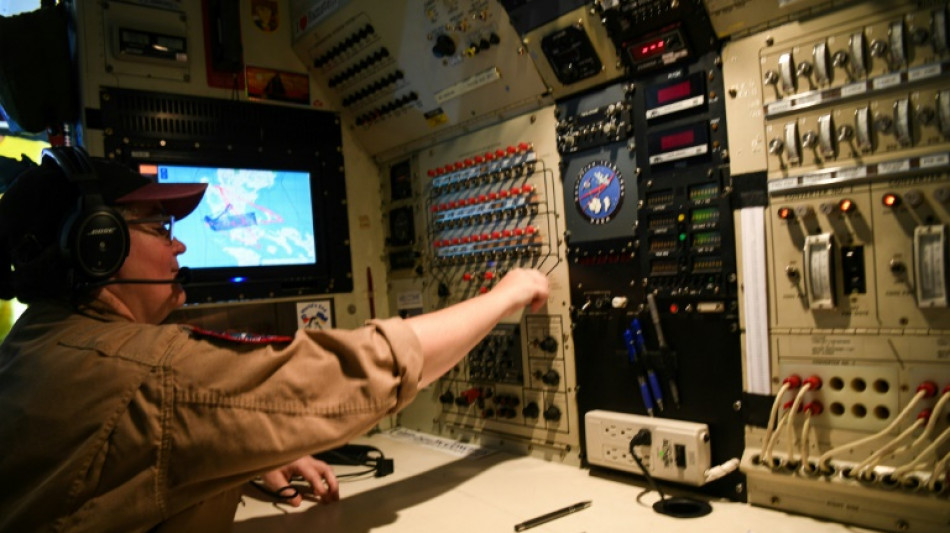
World's biggest flying lab comes to Asia on air pollution mission / Photo: Ted ALJIBE - AFP
 Police probe 'assault allegations' after Carse's nightclub incident
 How we might hear new Dolly Parton music in the future
 Nvidia doubles revenue, forecasts even more AI spending

 Canada renews push to boycott US products

 Savio scores on debut as Spurs set-up League Cup tie with Liverpool

 Brazil sues Discord over child safety measures, demands $100 mln in damages

 Alberta NDP Urges Smith to Postpone Separation Vote Amid Trade War

 Fenerbahce stun Lyon in Champions League as AEK crush Levski

 Why Global Finance Still Relies on Wall Street Despite Diversification Trends

 Bethlehem Father Seeks Aid for Special Needs Children Amid Health Crisis

 LIV Golf to lay off majority of staff

 How narwhal 'scientists' track Arctic warming

 Iran says US sanctions will achieve nothing

 Essential Dolly: five key Parton songs

 Veteran promoter Warren says it's Joshua's job to agree Fury fight

 Ex-champ Wawrinka gets last-minute wildcard to US Open

 Brennan blasts to Vuelta stage five victory, Pogacar holds lead
 What could change for US teens on Instagram and Facebook
 Meta, US states agree $16.7 bn settlement in landmark teen safety case

 'Point of no return' if Israel-Hamas truce fails: US envoy to Gaza board

 Barcelona holding out hope for Alvarez as Atletico resist sale

 Werro basks in new status, shelves world record talk

 Bill Gates warns world unprepared for AI upheaval

 Prince Harry and family arrive back in Britain: UK media

 German plan for sugar tax on Coke Zero fizzles out

NASA has kicked off a series of marathon flights in Asia with the world's biggest flying laboratory, in an ambitious mission to improve the models that help to forecast and fight air pollution.
Millions of deaths each year are linked to air pollution, and improving the ability to identify its sources and behaviour can lead to more accurate warning systems for the public.
Starting this week in the Philippines, the US agency's DC-8 is flying for up to eight hours at a time -- sometimes just 15 metres (50 feet) from the ground -- to swoop up air particles for study.
"We can provide direct measurements of how much pollution is coming from different sources. And that's one of the primary inputs to the air quality forecasting models," NASA's Barry Lefer told reporters Thursday at Clark International Airport, around 80 km (50 miles) north of Manila.
Air quality forecasting relies on readings from ground stations as well as satellites, but both methods are limited in their ability to see how pollutants are spread in the air, according to experts.
Readings from aircraft can help fill that gap, improve the interpretation of satellite data, and lead to more accurate models.
Combining the air, space and ground readings is necessary for policies "regarding public health, regarding industrial compliance, regarding... ecosystem preservation and conservation", said Maria Antonia Loyzaga, secretary of the Philippines Department of Environment and Natural Resources.
Packed with dozens of highly sensitive instruments, the NASA lab has flown twice so far this week in a figure-eight pattern over some of the most densely populated areas of the Philippines, including the capital region, according to the tracking site FlightAware.
It has been accompanied by a smaller NASA Gulfstream jet whose instruments can create three-dimensional maps of pollutants in the air.
In the coming weeks, the jets will also conduct research flights over South Korea, Malaysia and Thailand.
Results from the study will be shared with the public after a year, NASA programme officials said.
The project, named ASIA-AQ, is a collaboration between the US agency and governments in a region with some of the highest air pollution-linked death rates in the world.
Manila Observatory scientist Maria Cambaliza told reporters Thursday that about a third of global air pollution-linked deaths are recorded in Asia.
In the Philippines, she added, there are 100 such deaths per 100,000 people.
X.Karnes--AMWN