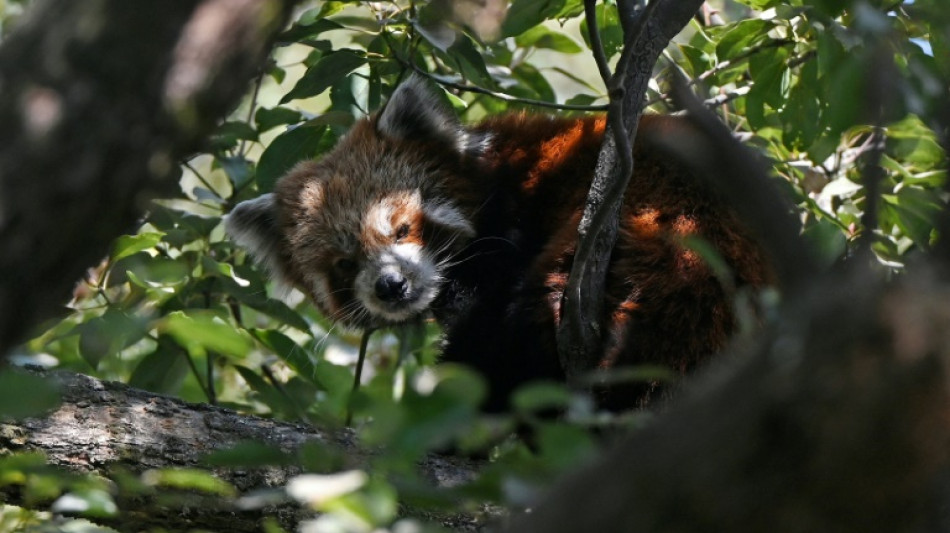
Nepal community efforts revive red panda population / Photo: PRAKASH MATHEMA - AFP
 Volkswagen boss braces German workers for more job cuts

 Olympic champion Brignone to undergo new knee operation

 The summer climate change became scorching reality for Europe

 Root angered by England's off-field 'stupid mistakes'

 Welsh rugby league 'giant' Boston dies, aged 92

 Root annoyed by England's off-field 'stupid mistakes'

 One million Afghan children suffer 'life-threatening' malnutrition: UN

 Sri Lanka trail India by 238 runs in second Test

 West Bank settlers attack AFP journalists

 MEXC Kicks Off MOVE Carnival With 0-Fee Trading and 1M USDT in Rewards

 Human rights in Myanmar hitting a 'new low': UN

 Son of Luxottica founder quits after succession row

 One million Afghan children suffering 'life-threatening' malnutrition: UN

 Real Madrid's Mourinho happy with squad despite losing out on Rodri

 Sri Lanka slump to 216-7 at tea in second India Test

 US delays Lockerbie bombing trial over new evidence

 Rohingya refugees protest dire conditions in Bangladesh camps

 Lego net profit up 32% in first half, 'stronger than expected': CEO to AFP

 German GDP growth revised upwards, defying Iran war turmoil

 STARTRADER Adds 30 U.S. Stock and ETF CFDs as 2026 Product Expansion Accelerates

 Trees 'giving up': climnate change hammers historic English gardens

 Namibia paves way for phosphate mining in the Atlantic Ocean

 Six months into Iran war, Hormuz traffic way down, sailors stranded

 Netanyahu got his Iran war, but maybe not his desired result

 Hyundai reaches tentative deal with workers after strikes

Nepali police officer Jiwan Subba still feels pangs of regret decades after he bludgeoned a strange creature he found wandering in his barn, not realising it was an endangered red panda.
Red pandas may share a similar name to giant pandas -- due to their bamboo diet -- but the copper-hued mammals with raccoon-like features are much smaller, typically the size of a house cat.
"I was 17 and had no idea what it was. Nobody in our village even knew," Subba, now 48, told AFP.
Today, he is not only aware of the red panda's vulnerability but is actively involved in its protection -- reflecting a broader shift in attitudes spurred by Nepal's extensive community awareness programmes.
"I once took a life out of ignorance, but now I work to prevent others from making the same mistake," he said.
"People now understand that red pandas are a protected species."
Officials say that Nepal's pioneering community-based conservation work has helped arrest the decline of the cute but skittish bamboo-eaters, which number fewer than 10,000 globally.
Red Panda Network, an organisation leading global efforts to conserve the animal, estimates between 500 and 1,000 of the species live in Nepal.
That is an almost certain increase from an estimated population of somewhere between 300 and 600 by the Himalayan republic's wildlife department in 2011.
"Now, villagers say they can see three or four red pandas on the same day," Red Panda Network's Ang Phuri Sherpa told AFP.
- 'Undisturbed' -
Conservationists say that educational outreach combined with sustainable livelihood programmes has helped improve the effectiveness of Nepal's conservation efforts.
In eastern Nepal, Indigenous inhabitants of the Kanchenjunga Conservation Area switched from raising livestock to cultivating nettle plants to minimise disturbances to red panda habitats.
"We have stopped foraging in the forest so red pandas remain undisturbed," said Chandra Kumari Limbu, a local working on conservation efforts.
Instead, the rhythmic clap of looms now fills the village from women weaving nettle fabric into school bags, wallets and clothing.
"This has empowered women here who did not have an income before. And at the same time we are letting red pandas thrive," Limbu told AFP.
Nepal last year also declared a new conservation zone in the country's east to protect red pandas.
The Puwamajhuwa Community Red Panda Conservation Area, spanning 116 hectares (287 acres), has dedicated anti-poaching and smuggling control committees with local involvement.
- Poaching and infrastructure -
Nepali authorities have confiscated 33 red panda hides from smugglers in the past five years, a drop from 70 hides from 2011-15.
"The number of red panda hides being smuggled has significantly come down, mainly due to weaker smuggling networks and lower profits," police spokesperson Dinesh Kumar Acharya told AFP.
Nepal has strict punishments for poachers of protected species, including prison sentences of up to 10 years.
Conservationists warn however that many poaching incidents go undetected or unpunished.
Red panda hides are mainly smuggled to China and Myanmar for their supposed medicinal qualities and aesthetic value, according to police.
Their copper-coloured fur, cherubic appearance and small size also make them easy candidates for the exotic pet trade.
According to an assessment from the International Union for Conservation for Nature (IUCN), interest in red pandas as pets may have grown partly because of the preponderance of "cute" images of the animals shared on social media.
The IUCN has listed the mammal as an endangered species since 2016 and says they face high risk of extinction due to habitat loss.
Sherpa of the Red Panda Network said growing infrastructure development in Nepal was posing further challenges for conservation efforts.
"Road networks, hydroelectricity, transmission lines and cable car construction is going on, and because of these, habitats have been fragmented," he said.
Residents in Taplejung district, a key red panda habitat, are currently protesting the mass felling of thousands of trees for a new cable car project aimed at promoting tourism in the area.
"The government should take extra cautious measures when constructing large infrastructure projects," local conservationist Rajindra Mahat told AFP.
"It is an endangered species worldwide, so it is our shared responsibility to protect it."
F.Dubois--AMWN