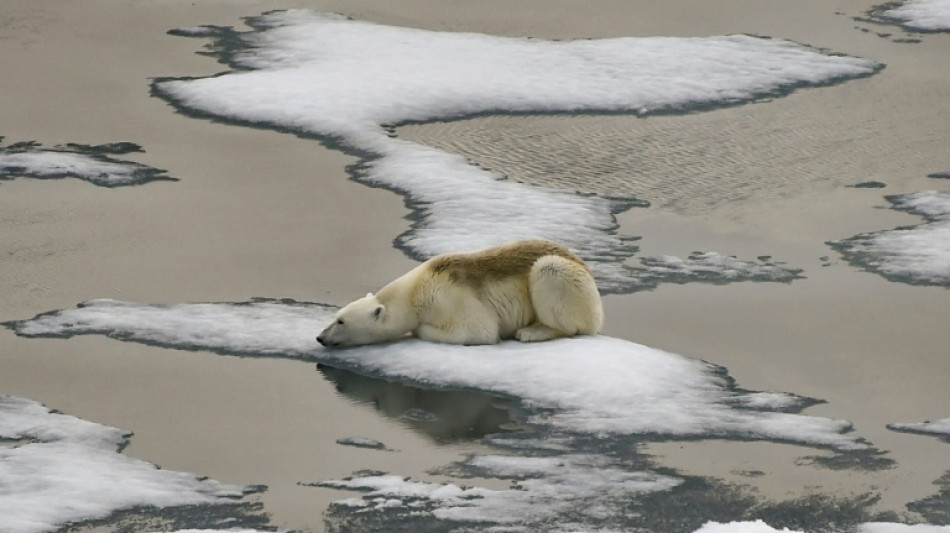
Arctic sea ice hits lowest peak in satellite record, says US agency / Photo: Ekaterina ANISIMOVA - AFP/File
 Volkswagen boss braces German workers for more job cuts

 Olympic champion Brignone to undergo new knee operation

 The summer climate change became scorching reality for Europe

 Root angered by England's off-field 'stupid mistakes'

 Welsh rugby league 'giant' Boston dies, aged 92

 Root annoyed by England's off-field 'stupid mistakes'

 One million Afghan children suffer 'life-threatening' malnutrition: UN

 Sri Lanka trail India by 238 runs in second Test

 West Bank settlers attack AFP journalists

 MEXC Kicks Off MOVE Carnival With 0-Fee Trading and 1M USDT in Rewards

 Human rights in Myanmar hitting a 'new low': UN

 Son of Luxottica founder quits after succession row

 One million Afghan children suffering 'life-threatening' malnutrition: UN

 Real Madrid's Mourinho happy with squad despite losing out on Rodri

 Sri Lanka slump to 216-7 at tea in second India Test

 US delays Lockerbie bombing trial over new evidence

 Rohingya refugees protest dire conditions in Bangladesh camps

 Lego net profit up 32% in first half, 'stronger than expected': CEO to AFP

 German GDP growth revised upwards, defying Iran war turmoil

 STARTRADER Adds 30 U.S. Stock and ETF CFDs as 2026 Product Expansion Accelerates

 Trees 'giving up': climnate change hammers historic English gardens

 Namibia paves way for phosphate mining in the Atlantic Ocean

 Six months into Iran war, Hormuz traffic way down, sailors stranded

 Netanyahu got his Iran war, but maybe not his desired result

 Hyundai reaches tentative deal with workers after strikes

This year's Arctic sea ice peak is the lowest in the 47-year satellite record, the US National Snow and Ice Data Center (NSIDC) said Thursday, as the planet continues to swelter under the mounting effects of human-driven climate change.
The start of this year saw the warmest January on record followed by the third-warmest February, with the polar regions heating several times faster than the global average.
The 2025 maximum sea ice extent was likely reached on March 22, measuring 14.33 million square kilometers (5.53 million square miles) -- below the previous low of 14.41 million square kilometers set in 2017.
"This new record low is yet another indicator of how Arctic sea ice has fundamentally changed from earlier decades," said NSIDC senior research scientist Walt Meier in a statement.
"But even more importantly than the record low is that this year adds yet another data point to the continuing long-term loss of Arctic sea ice in all seasons."
The record-low Arctic maximum extent follows a near-record-low minimum extent of sea ice in the Antarctic, where it is now summer.
The 2025 Antarctic sea ice minimum, achieved on March 1, was 1.98 million square kilometers, tying for the second-lowest annual minimum in the satellite record, alongside 2022 and 2024.
Combined Arctic and Antarctic sea ice cover -- frozen ocean water that floats on the surface -- plunged to a record low in February, according to both the US National Oceanic and Atmospheric Administration (NOAA) and Europe's Copernicus Climate Change Service.
- A vicious cycle -
While floating sea ice does not directly raise sea levels, its disappearance sets off a cascade of climate consequences, altering weather patterns, disrupting ocean currents, and threatening ecosystems and human communities.
When reflective ice gives way to the dark ocean, the sun's energy, instead of bouncing back into space, is absorbed by the water, warming it and fueling further ice melt and global warming.
Shrinking Arctic ice is also reshaping geopolitics, opening new shipping lanes and drawing geopolitical interest. Since taking office this year, US President Donald Trump has said his country must control Greenland, a Danish autonomous territory rich in mineral resources.
The loss of polar ice spells disaster for numerous species, robbing polar bears, seals, and penguins of crucial habitat used for shelter, hunting, and breeding.
Last year was the hottest on record, and the latest NOAA prediction issued on March 13 predicts that La Nina weather conditions, which have a cooling effect on global average temperatures, were likely to give way to neutral conditions over the next month that would persist over the Northern Hemisphere summer.
Since mid-2023, only July 2024 fell below 1.5 degrees Celsius of warming, raising concerns that the Paris Agreement's goal of limiting long-term warming to 1.5C may be out of reach.
C.Garcia--AMWN