The Metals Company courts Trump for deep-sea mining contract / Photo: Kenzo TRIBOUILLARD - AFP
 One million Afghan children suffer 'life-threatening' malnutrition: UN

 Sri Lanka trail India by 238 runs in second Test

 West Bank settlers attack AFP journalists

 MEXC Kicks Off MOVE Carnival With 0-Fee Trading and 1M USDT in Rewards

 Human rights in Myanmar hitting a 'new low': UN

 Son of Luxottica founder quits after succession row

 One million Afghan children suffering 'life-threatening' malnutrition: UN

 Real Madrid's Mourinho happy with squad despite losing out on Rodri

 Sri Lanka slump to 216-7 at tea in second India Test

 US delays Lockerbie bombing trial over new evidence

 Rohingya refugees protest dire conditions in Bangladesh camps

 Lego net profit up 32% in first half, 'stronger than expected': CEO to AFP

 German GDP growth revised upwards, defying Iran war turmoil
 STARTRADER Adds 30 U.S. Stock and ETF CFDs as 2026 Product Expansion Accelerates

 Trees 'giving up': climnate change hammers historic English gardens

 Namibia paves way for phosphate mining in the Atlantic Ocean
 Six months into Iran war, Hormuz traffic way down, sailors stranded

 Netanyahu got his Iran war, but maybe not his desired result

 Hyundai reaches tentative deal with workers after strikes
 Once its saviour, US puts Kuwait in Iran's crosshairs
 Australia's top music charts ban AI songs
 Four Nines Gold Intersects Hydrothermal Breccia in First Three Holes at Hayden Hill

 Dermata Therapeutics Announces Commercial Launch of Tome Foundational Treatment

 SMX's Plastic Cycle Token is the Most Effective Tool in Times of War

 Lavish Enterprises Introduces FleetPath Ace, an Autonomous Operator Built to Transform How Trucking Companies Operate

A Canadian deep-sea mining pioneer, The Metals Company, is charting a new course to land the controversial extraction practice's first commercial contract -- by appealing to US President Donald Trump.
It wants to collect so-called polymetallic nodules -- mineral deposits made up of multiple metals -- on the Pacific Ocean floor.
TMC originally planned to apply for a contract with the International Seabed Authority (ISA) -- the organization with jurisdiction over the seabed in international waters -- in June.
The company's subsidiaries had spent years using contracts awarded by the ISA to explore parts of the Clarion-Clipperton Zone, a section of the Pacific Ocean rich with these nodules.
The zone contains an estimated 21 billion tonnes (23.1 billion tons) of nodules containing minerals used in high-demand products like electric car batteries.
The ISA has yet to award a contract for industrial extraction, however, as it has spent a decade developing a deep-sea mining code with member states. The extended wait has led the Canadian firm to seek opportunities through different means.
Although the area TMC hopes to deep-sea mine is in international waters, a 1980 US law could be used to issue a commercial extraction permit -- if the Trump administration allows it.
"We are ready," TMC CEO Gerard Barron said on a conference call last month. "What we need is a fair hearing and a regulator willing to engage."
Originally named DeepGreen Metals upon its creation in 2011, the company rebranded to The Metals Company after going public in 2021.
The firm collects nodules more than four kilometers (2.5 miles) underwater, having tested a vehicle that gathers the raw materials from the ocean floor and transports them to a ship on the water's surface using a giant pipe.
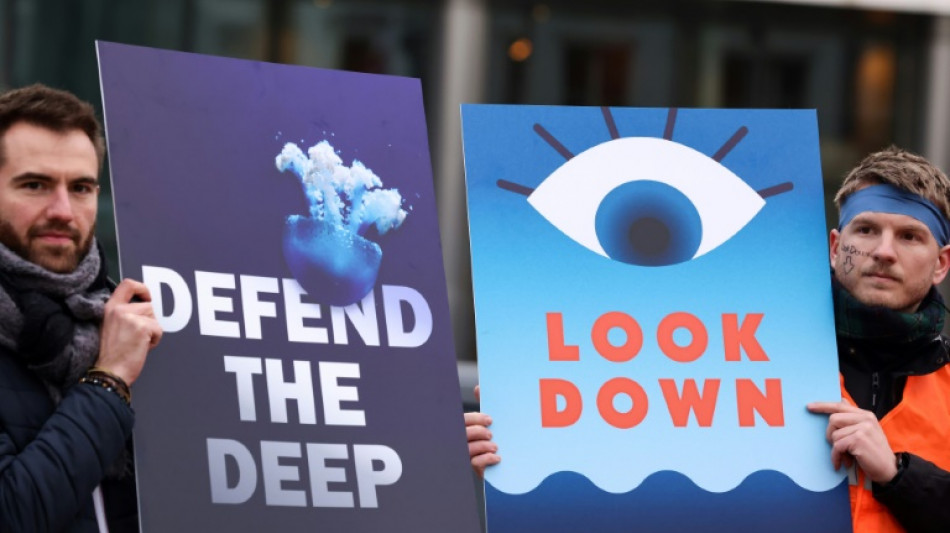
The company's change in strategy to bypass the ISA has angered member nations of the international body, as well as environmental NGOs concerned about the impact of deep-sea mining.
Bobby-Jo Dobush, a legal officer with The Ocean Foundation, told AFP that deep-sea mining is "the worst, most environmentally destructive, most expensive way to get minerals."
- 'Political appetite' -
The Metals Company is banking on Washington -- which opted not to join the ISA -- and Trump's desire for minerals not imported from China or other rivals to outweigh the environmental concerns.
TMC Chief Financial Officer Craig Shesky said during the March conference call that the legal precedent for the United States to authorize extraction "has always been there."
"What has been missing is the political appetite in the United States to take advantage of it. And that's the main change that has come with this administration," Shesky said.
He estimated that allowing the company to collect a billion tonnes of nodules via deep-sea mining could provide the United States with "456 years of manganese, 165 years of cobalt, 81 years of nickel and four years of copper" based on current consumption patterns.
Dmitry Silversteyn, an analyst with Water Tower Research, said TMC could begin production some time in 2026, especially "with the administration in the United States now being very focused on standing up a domestic critical metals and critical materials industry that's independent of Chinese supply chain."
Dobush, of The Ocean Foundation, said the apparent rush to nail down a contract shows TMC is "really in dire financial straits."
But Silversteyn said TMC was progressing steadily enough for "getting into production commitment" by the end of 2026.
Barron touted his company's progress, saying last month: "We've shown that we can pick up nodules from the seafloor, we can lift them to the surface and process them onshore, all the way to the refined products, with minimal environmental impacts and limited capital expenditure."
M.A.Colin--AMWN