Vietnam village starts over with climate defences after landslide / Photo: Nhac NGUYEN - AFP
 One million Afghan children suffer 'life-threatening' malnutrition: UN

 Sri Lanka trail India by 238 runs in second Test

 West Bank settlers attack AFP journalists
 MEXC Kicks Off MOVE Carnival With 0-Fee Trading and 1M USDT in Rewards

 Human rights in Myanmar hitting a 'new low': UN

 Son of Luxottica founder quits after succession row

 One million Afghan children suffering 'life-threatening' malnutrition: UN

 Real Madrid's Mourinho happy with squad despite losing out on Rodri
 Sri Lanka slump to 216-7 at tea in second India Test

 US delays Lockerbie bombing trial over new evidence

 Rohingya refugees protest dire conditions in Bangladesh camps

 Lego net profit up 32% in first half, 'stronger than expected': CEO to AFP

 German GDP growth revised upwards, defying Iran war turmoil

 STARTRADER Adds 30 U.S. Stock and ETF CFDs as 2026 Product Expansion Accelerates
 Trees 'giving up': climnate change hammers historic English gardens
 Namibia paves way for phosphate mining in the Atlantic Ocean

 Six months into Iran war, Hormuz traffic way down, sailors stranded

 Netanyahu got his Iran war, but maybe not his desired result

 Hyundai reaches tentative deal with workers after strikes

 Once its saviour, US puts Kuwait in Iran's crosshairs
 Australia's top music charts ban AI songs
 Four Nines Gold Intersects Hydrothermal Breccia in First Three Holes at Hayden Hill

 Dermata Therapeutics Announces Commercial Launch of Tome Foundational Treatment

 SMX's Plastic Cycle Token is the Most Effective Tool in Times of War

 Lavish Enterprises Introduces FleetPath Ace, an Autonomous Operator Built to Transform How Trucking Companies Operate

Nguyen Thi Kim's small verdant community in northern Vietnam no longer exists, wiped away in a landslide triggered by Typhoon Yagi's devastating heavy rains last year.
She and dozens of survivors have been relocated to a site that authorities hope will withstand future climate change-linked disasters, with stronger homes, drainage canals and a gentler topography that lessens landslide risks.
It is an example of the challenges communities around the world face in adapting to climate change, including more intense rains and flash floods like those Typhoon Yagi brought last September.
Kim lost 14 relatives and her traditional timber stilt home when Yagi's rains unleashed a landslide that engulfed much of Lang Nu village in mountainous Lao Cai province.
The storm was the strongest to hit Vietnam in decades, killing at least 320 people in the country and causing an estimated $1.6 billion in economic losses.
It is unlikely to be an outlier though, with research last year showing climate change is causing typhoons in the region to intensify faster and last longer over land.
Climate change, caused largely by burning fossil fuels, impacts typhoons in multiple ways: a warmer atmosphere holds more water, making for heavier rains, and warmer oceans also help fuel tropical storms.
Kim remains traumatised by the landslide.
She says everything is painful, especially the memory of the moment a torrent of mud swept away her and her two-year-old daughter.
"This disaster was too big for us all," she said recalling the moment the pair were pulled from the mud hours later.
"I still cannot talk about it without crying. I can't forget," the 28-year-old told AFP.
- 'We need to change' -
Yagi hit Vietnam with winds in excess of 149 kilometres (92 miles) per hour and brought a deluge of rain that caused destructive flooding in parts of Laos, Thailand and Myanmar.
In Lang Nu, 67 residents were killed, and authorities vowed to rebuild the homes of survivors in a safe spot.
By December, 40 new houses were ready at a site around two kilometres away.
It was chosen for its elevation, which should be less impacted by adjacent streams, and its relatively gentle slope gradient.
"Predicting absolute safety in geology is actually very difficult," said Tran Thanh Hai, rector of Hanoi University of Geology and Mining, who was involved in choosing a new site.
But the site is secure, "to the best of our knowledge and understanding".
Lao Cai is one of Vietnam's poorest areas, with little money for expensive warning systems.
However, a simple drainage system runs through the new community, diverting water away from the slope.
This should reduce soil saturation and the chances of another landslide, scientists who worked on the site told AFP.
The village's new homes are all built of sturdier concrete, rather than traditional wood.
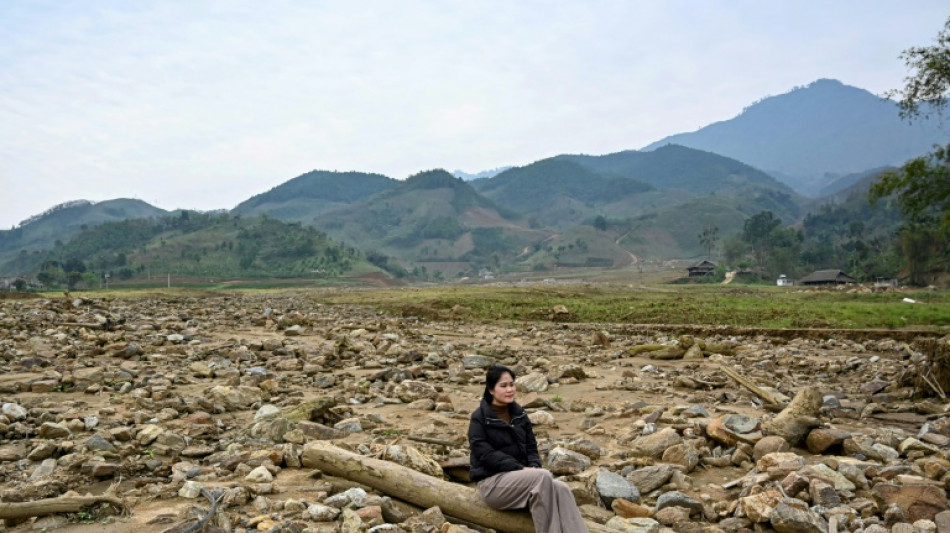
"We want to follow our traditions, but if it's not safe any longer, we need to change," Kim said, staring out at the expanse of mud and rock where her old village once stood.
Months later it remains frozen in time, strewn with children's toys, kitchen pans and motorcycle helmets caught up in the landslide.
- 'Safest ground for us' -
Like Kim, 41-year-old Hoang Thi Bay now lives in the new village in a modern stilt house with steel structural beams.
Her roof, once made of palm leaves, is now corrugated iron and her doors are aluminium glass.
She survived the landslide by clinging desperately to the single concrete pillar in her old home as a wall of mud and rocks swept her neighbourhood away.
"I still wake up in the night obsessing over what happened," she told AFP.
"Our old house was bigger and nicer, with gardens and fields. But I sleep here in the new house and I feel much safer," she said.
Even at the new site, home to around 70 people, there are risks, warned Hai.
Development that changes the slope's gradient, or construction of dams or reservoirs in the area could make the region more landslide-prone, he said.
Building more houses or new roads in the immediate area, or losing protective forest cover that holds earth in place, could also make the site unsafe, added Do Minh Duc, a professor at the Institute of Geotechnics and Environment at the Vietnam National University in Hanoi.
Yagi wiped out large areas of mature natural forest in Lao Cai and while private companies have donated trees for planting, it is unclear whether they can provide much protection.
"In terms of landslide prevention, the only forest that can have good (protective) effects is rainforest with a very high density of trees, so-called primary forest," explained Duc, an expert on disaster risk maps who also helped choose the new site.
Leaving the old community was hard for Kim, whose family had lived and farmed there for nearly half a century.
But she is grateful that she and other survivors have a second chance.
"I believe this is the safest ground for us."
P.Silva--AMWN