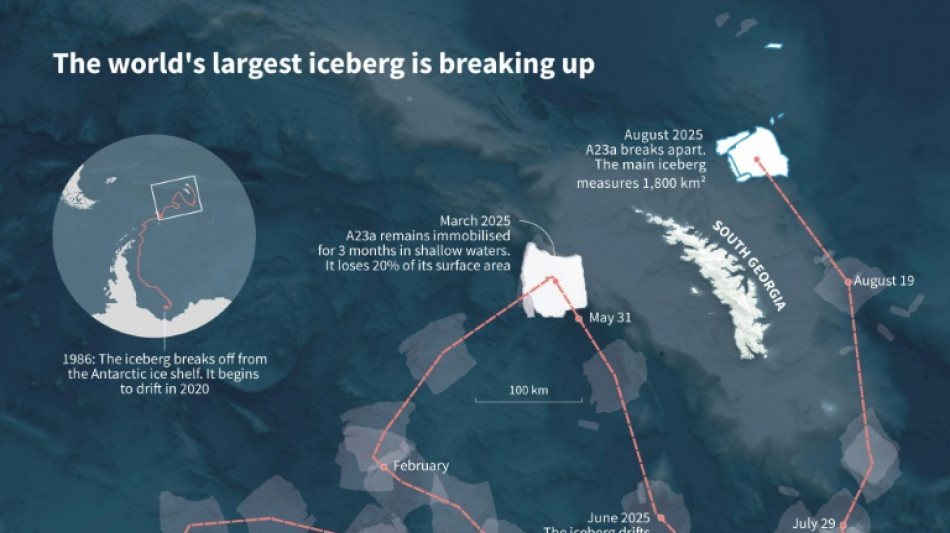
Once king of the seas, a giant iceberg is finally breaking up / Photo: Valentin RAKOVSKY, Valentina BRESCHI - AFP
 Mehbooba Mufti urges dialogue and renewed Central Asia links for Kashmir

 Seacliff Healthcare Seeks Specialist GP in Thirroul

 US stocks fall before midterm Election Day as technology shares weaken

 BLS Polymers makes strong market debut at ₹248 per share

 Petrol and diesel prices remain broadly steady across major Indian cities

 Reliance shares remain in focus after near-12% surge

 2026 Arizona Midterms: Key Races, Ballot Measures, and Voter Deadlines

 Coal India prepares possible $1 billion Mahanadi Coalfields listing

 Julia Stiles and Ezra Sosa Share Emotional Farewell After 'DWTS' Elimination

 US Buildings Threatened by Wildfires Could Triple by 2060

 Why Pregnancy Cost Estimates Fail: A Family’s $9,000 Surprise

 US Strikes Iranian Targets in Strait of Hormuz Ahead of Midterms

 Brodeur’s Overtime Goal Secures Bethlehem’s Second Consecutive Sectional Title

 Rare 1970 Plymouth ‘Cuda 426 Hemi Listed for $400,000

 The Digital Burden: Why Instant Messaging Feels Like a Full-Time Job
 Alberta Tabled Controversial Riding Boundary Maps Amid Gerrymandering Accusations

 Hong Kong court set to sentence activist Joshua Wong in security case

 Australia raises benchmark rate to highest level in 18 years

 'The Remarried Empress' Cast Discusses Bringing Fantasy Royal Drama to Life

 Asian stocks retreat as AI worries outweigh steep oil-price drop

 Hamad International Airport stages emergency drills during WATAN 2026

 Global failure to punish attacks leaves journalists at continuing risk

 Researchers Warn 'Bookkeeping Trick' Masks Beef Industry's Methane Emissions

 Climate Change Intensified Atlantic Hurricanes, Study Finds

 Qatar solar expansion opens scope for technical performance gains

Nearly 40 years after breaking off Antarctica, a colossal iceberg ranked among the oldest and largest ever recorded is finally crumbling apart in warmer waters, and could disappear within weeks.
Earlier this year, the "megaberg" known as A23a weighed a little under a trillion tonnes and was more than twice the size of Greater London, a behemoth unrivalled at the time.
The gigantic slab of frozen freshwater was so large it even briefly threatened penguin feeding grounds on a remote island in the South Atlantic Ocean, but ended up moving on.
It is now less than half its original size, but still a hefty 1,770 square kilometres (683 square miles) and 60 kilometres (37 miles) at its widest point, according to AFP analysis of satellite images by the EU earth observation monitor Copernicus.
In recent weeks, enormous chunks -- some 400 square kilometres in their own right -- have broken off while smaller chips, many still large enough to threaten ships, litter the sea around it.
It was "breaking up fairly dramatically" as it drifted further north, Andrew Meijers, a physical oceanographer from the British Antarctic Survey, told AFP.
"I'd say it's very much on its way out... it's basically rotting underneath. The water is way too warm for it to maintain. It's constantly melting," he said.
"I expect that to continue in the coming weeks, and expect it won't be really identifiable within a few weeks."
- 'Doomed' -
A23a calved from the Antarctic shelf in 1986 but quickly grounded in the Weddell Sea, remaining stuck on the ocean floor for over 30 years.
It finally escaped in 2020 and, like other giants before it, was carried along "iceberg alley" into the South Atlantic Ocean by the powerful Antarctic Circumpolar Current.
Around March, it ran aground in shallow waters off distant South Georgia island, raising fears it could disrupt large colonies of adult penguins and seals there from feeding their young.
But it dislodged in late May, and moved on.
Swinging around the island and tracking north, in recent weeks the iceberg has picked up speed, sometimes travelling up to 20 kilometres in a single day, satellite images analysed by AFP showed.
Exposed to increasingly warmer waters, and buffeted by huge waves, A23a has rapidly disintegrated.
Scientists were "surprised" how long the iceberg had kept together, said Meijers.
"Most icebergs don't make it this far. This one's really big so it has lasted longer and gone further than others."
But ultimately, icebergs are "doomed" once they leave the freezing protection of Antarctica, he added.
Iceberg calving is a natural process. But scientists say the rate at which they were being lost from Antarctica is increasing, probably because of human induced climate change.
G.Stevens--AMWN