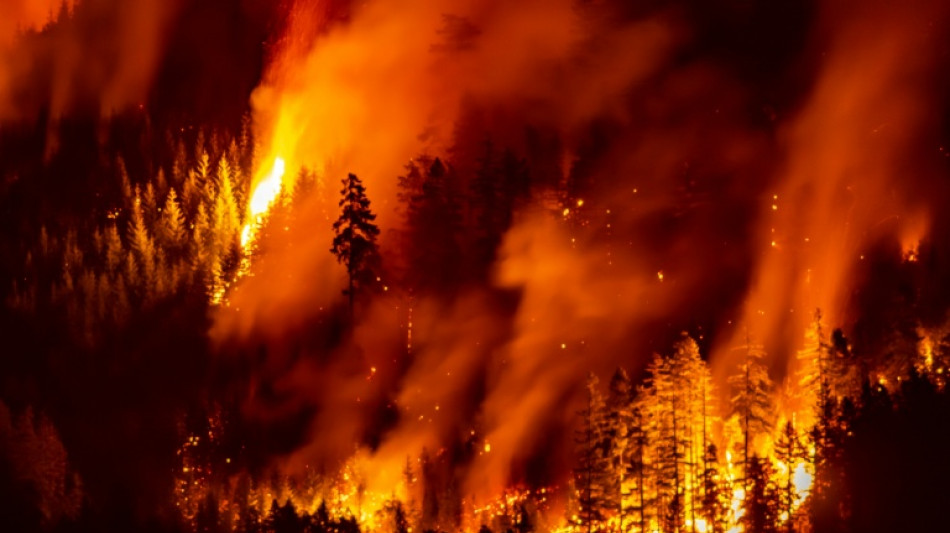
Smoke from 2023 Canada fires linked to thousands of deaths: study / Photo: Colby Rex O'Neill - AFP
 India police used excessive force during protests: Amnesty

 Rookie La Sasso wins LIV season-ender as tour's future in doubt

 Fils tops Tiafoe to claim first ATP Masters title in Cincinnati bb/amz

 Clark fends off McIlroy to win BMW Championship

 Raphinha, Lopez hit braces as Barcelona trounce Elche

 Macron hosts Saudi crown prince for visit ranging from esports to Mideast

 Jamieson gets Trump call after ending 14-year golf title drought

 Norwegian King Harald's health has 'deteriorated': palace

 Man City snatch late win in Maresca debut, Iraola's Liverpool rescue dramatic draw

 Trump takes starring role at Washington's IndyCar debut

 Villa boss Emery says it's down to Watkins to explain absence

 Duplantis labours to 'super difficult' pole vault win at Silesia Diamond League

 Max smash at zany Zandvoort: Three stories from the Dutch GP

 Brennan sprints to Vuelta stage two victory, Pogacar keeps red

 Duplantis conquers pole vault at Silesia Diamond League

 France's badminton gold winners set for obscurity back home

 Brighton start Premier League season with rout of 10-man Villa

 Maresca makes winning start with Man City after dramatic fightback

 Mo'unga returns for All Blacks against Johannesburg Lions

 Belgian sprinter Philipsen wins Renewi Tour

 'A day for French badminton' as Lanier triumph gives them golden double at world champs

 Kane voted German footballer of the year

 'New season, new trim': Man City star Haaland chops off flowing locks

 Lanier clinches badminton world title in France's golden double

 After Wildberries, Ukraine launches drone campaign on Russia's Ozon

Canada's record-breaking 2023 wildfires exposed more than 350 million people in North America and Europe to air pollution that likely contributed to tens of thousands of deaths, according to new estimates published Wednesday.
The findings "underscored that severe wildfires do not have only local consequences" but can inflict real harm a continent away, said the scientists behind the world-first research.
Extreme fire conditions, supercharged by climate change, fanned thousands of blazes across Canada between May and September 2023 that torched around 18 million hectares (44 million acres) -- an area larger than England.
The five-month wildfires were unprecedented in size and scale, releasing massive plumes of acrid smoke that turned skies yellow and triggered health warnings across North America.
But the smoke drifted as far as Europe, causing spikes in harmful PM2.5 pollutants and a measurable decline in air quality thousands of miles from the heat and flames in Canada.
In North America and Europe, an estimated 354 million people were exposed to levels of PM2.5 above the World Health Organization's (WHO) safe limit, concluded a new study into the long-range impact of the wildfires, published in the journal Nature.
This contributed to nearly 70,000 premature deaths on both continents -- most from breathing polluted air over months and a smaller number from acute exposure to wildfire smoke.
The findings were "striking" and surprised even the research team behind them, said Qiang Zhang, a professor of atmospheric chemistry at Tsinghua University in Beijing who led the study.
"While we anticipated large impacts from the record-breaking 2023 Canadian fires, the magnitude of the population exposure and related attributable mortalities are higher than expected," he told AFP.
"These results underscore that such extreme wildfires are no longer just a regional environmental issue and they have become a global public health concern."
PM2.5 pollutants are fine, airborne particles small enough to enter the bloodstream through the lungs, and are linked to higher rates of chronic bronchitis, lung cancer and heart disease.
- Widespread -
The team separated acute and chronic premature deaths due to PM2.5 exposure because they represented two very different types of health impacts from wildfire smoke exposure, Qiang Zhang said.
Acute deaths, he said, captured the short-term health impacts during "smoke days" when daily PM2.5 levels spiked "well above" WHO guidelines and could immediately trigger fatal events, such as heart attacks or respiratory failures.
Some 4,100 acute deaths were estimated in the United States, downwind from the wildfires, and another 1,300 in Canada itself.
Chronic deaths reflected the health burden of longer-term exposure, which increases the risks of cardiovascular and respiratory diseases and leads to premature death over time.
The study found that chronic health impacts from five months of breathing wildfire smoke were "substantial and widespread", with 41,900 deaths estimated in North America and 22,400 in Europe.
Such estimates were a first, Qiang Zhang said.
But that created limitations for researchers who lacked earlier references on the specific impact of wildfires on health, he said, forcing them to use broader evidence to base their estimates on.
The computer model they built, using satellite observations and machine learning, also could not account for the health impact of various pollutants in wildfire smoke, he added.
The authors said more research into this "underexplored" cost would be crucial as climate change made wildfires bigger, fiercer and more frequent.
F.Bennett--AMWN