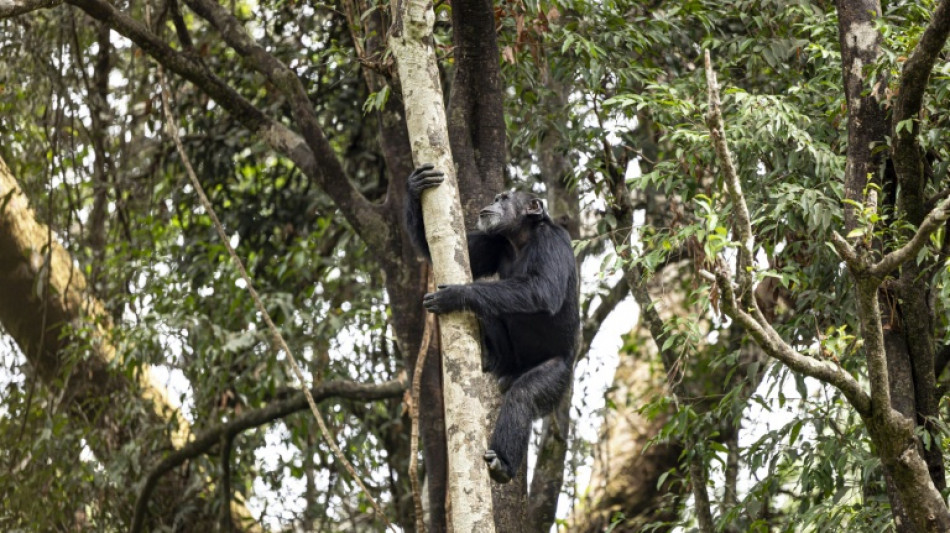
Chimps ingest alcohol daily: study / Photo: PATRICK MEINHARDT - AFP
 India police used excessive force during protests: Amnesty

 Rookie La Sasso wins LIV season-ender as tour's future in doubt

 Fils tops Tiafoe to claim first ATP Masters title in Cincinnati bb/amz

 Clark fends off McIlroy to win BMW Championship

 Raphinha, Lopez hit braces as Barcelona trounce Elche

 Macron hosts Saudi crown prince for visit ranging from esports to Mideast

 Jamieson gets Trump call after ending 14-year golf title drought

 Norwegian King Harald's health has 'deteriorated': palace

 Man City snatch late win in Maresca debut, Iraola's Liverpool rescue dramatic draw

 Trump takes starring role at Washington's IndyCar debut

 Villa boss Emery says it's down to Watkins to explain absence

 Duplantis labours to 'super difficult' pole vault win at Silesia Diamond League

 Max smash at zany Zandvoort: Three stories from the Dutch GP

 Brennan sprints to Vuelta stage two victory, Pogacar keeps red

 Duplantis conquers pole vault at Silesia Diamond League

 France's badminton gold winners set for obscurity back home

 Brighton start Premier League season with rout of 10-man Villa

 Maresca makes winning start with Man City after dramatic fightback

 Mo'unga returns for All Blacks against Johannesburg Lions

 Belgian sprinter Philipsen wins Renewi Tour

 'A day for French badminton' as Lanier triumph gives them golden double at world champs

 Kane voted German footballer of the year

 'New season, new trim': Man City star Haaland chops off flowing locks

 Lanier clinches badminton world title in France's golden double

 After Wildberries, Ukraine launches drone campaign on Russia's Ozon

Chimpanzees consume the equivalent of at least one alcoholic drink per day as they eat ripe, fermenting fruit, says a study out Wednesday that addresses one possible reason why humans are drawn to booze.
The study, carried out in the wilds of Africa where the animals live, supports the theory that people may have inherited from primates a taste for alcohol and ability to metabolize it even though it is toxic for us.
The researchers collected fruits that chimps eat and measured their ethanol content, which is produced as sugar ferments. They concluded that these evolutionary cousins of ours consume alcohol on a daily basis.
And not just a little. Through the large amount of fruit that chimps eat, the researchers reckon the animals take in about 14 grams (half an ounce) of alcohol per day.
Correcting for body size, it is like the chimps are drinking a pint of beer per day, Aleksey Maro, lead author of the study published in the journal Science Advances, told AFP.
"It's not an insubstantial amount of alcohol, but very diluted and more associated with food," said the PhD candidate at the University of California, Berkeley.
- The 'drunken monkey' theory -
"We've seen for the first time that, indeed, our closest living relatives are consuming physiologically relevant doses of alcohol routinely daily," Maro said.
This is in line with the "drunken monkey theory" espoused more than a decade ago by US biologist Robert Dudley, who co-authored the new study.
As the theory goes, humans liking alcohol and being able to metabolize it stems from our primate ancestors ingesting it daily through the fruit they eat.
"The drunken monkey hypothesis is becoming more and more a reality," said Maro. "Its name is unfortunate. A better name would be the evolutionary hangover."
The theory was initially met with skepticism among experts. But it has gained traction in recent years as studies showed that some primates eat fermented fruit and, given a choice of nectars with varying amounts of alcohol, they prefer the booziest one.
Nathaniel Dominy, a professor of anthropology and evolutionary biology at Dartmouth College who did not take part in this study, welcomed it enthusiastically.
"The paper is a tour de force," he told AFP.
Dominy also said it "puts to rest the debate over the prevalence of ethanol in tropical fruits."
But he added that the study raises new questions on the biological and behavioral consequences of chronic low-level ethanol exposure for nonhuman primates.
Another unanswered question is whether chimps actively search out boozy fruit or just eat it when they find it. The researchers in this study said they did not know.
The issue of chimps ingesting alcohol will remain under study to learn more about the origins of human alcohol consumption and assess its risks and possible benefits, according to Maro.
"We can learn about ourselves through the chimpanzees," he said.
L.Davis--AMWN