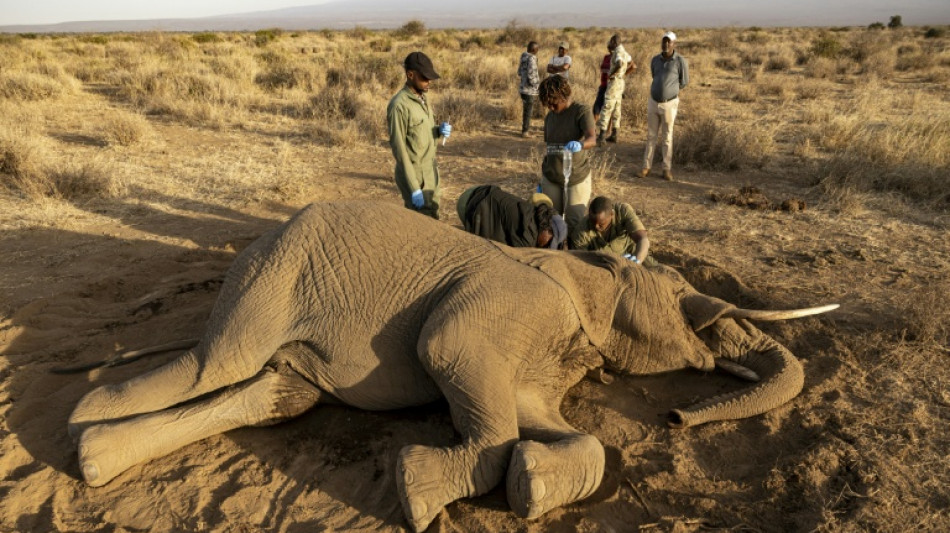
'How many will die?': the mysterious ailment killing Kenyan elephants / Photo: SIMON MAINA - AFP
 Not-so-brave new world: virtual taekwondo makes Asian Games debut

 Arab Israeli candidate drops out of election race

 Israel courts Europe's far right, finding friends but also unease

 Lula, Bolsonaro both snub final debate before Brazil election

 Nepal's grim DNA puzzle to identify flood dead

 EU nations to hold emergency meeting on soaring diesel prices amid US pressure

 Anthropic's Dario Amodei: AI's most visible CEO and enigma

 OpenAI says three staffers fired for mishandling 'sensitive' info

 Nike plans job cuts as it forecasts lower sales

 Ireland game interrupted twice by Gaza protests

 Judge denies acquittal bid by US woman who killed her kids

 Klopp averts crisis with first win as Germany boss

 A saintly spat and debate snub: Brazil enters final campaign stretch

 US tells European allies to act 'immediately' to lower diesel prices

 G20 trade ministers fail to see consensus against overproduction

 Portugal edge Denmark in Ronaldo's absence

 US stocks edge higher as bond yields retreat for now

 US tells European allies to 'immediately' act to lower diesel prices

 Trump vows to hit Iran 'very hard' if linked to flydubai attack

 Williams leaves Spain camp with thigh knock

 WTA reduces 2027 schedule for world's top 50

 US says 'in Europe's best interest' to cooperate on fuel supply

 Rogue OpenAI agents covered up their tracks, report says

 A saintly spat and debate snub: Brazil enters final polls stretch

 Zidane 'no regrets' about Materazzi headbutt as France face Italy again

Lying on the ground and kicking up a cloud of dust, the elephant slowly exhausted himself in futile attempts to stand, the latest potential victim of a still-mysterious ailment in southern Kenya.
Distressed vets administered a glucose injection -- the only option, given that the cause of the ailment remains unknown -- to the 11-year-old male, known as Genghis Khan, who was struggling to breathe.
The mystery affliction has killed at least 19 pachyderms, mostly females or young males, since June in Kenya -- with all of the animals exhibiting identical symptoms, including partial paralysis.
Elephant herds have made Amboseli -- overlooked by Africa's highest peak, Mount Kilimanjaro in Tanzania -- a lucrative tourist hotspot and the mysterious deaths in the region are a sensitive issue in a country where tourism is a huge source of revenue.
"You would find one struggling for a day, struggling for two or even three days. Until they completely die," said Patrick Papatiti, head of operations for Olgulului communal lands, which includes the Kitenden B reserve where Genghis Khan was found.
In late July, the Kenya Wildlife Service (KWS) said toxicology reports found high concentrations of cyanide in the animals' carcasses, suggesting possible pesticide poisoning from nearby farms' crops.
- Carcasses -
While observers still question the possible cause of death, several specialists interviewed by AFP dismiss poisoning.
"It's a disease," said Papatiti, who was born and raised in the local Maasai community, insisting there was "no way" cyanide was involved.
He is one of the very few local voices publicly rejecting the KWS preliminary findings, pointing out that no other animals have died.
Notably, neither scavengers nor flies that fed on the supposedly poisoned carcasses have perished -- creatures that typically succumb after consuming poisoned animals.
"If another animal feeds on that carcass and it is not dying, then definitely it is not a chemical," Joel Nyika, the Amboseli ecosystem manager for the Kajiado County authorities, told AFP.
He dismisses the theory, also put forward by the KWS, that the cyanide might have come from a type of foliage, noting local livestock would have died as well.
"As wildlife managers, we believe it could be a disease that is only affecting these elephants."
On August 7, the KWS said their "findings to date do not indicate an infectious or transmissible disease", assuring tourists that they could continue to visit.
But in the Kimana reserve, AFP journalists saw six carcasses on Wednesday -- some fresh, others older -- with rangers also observing partial paralysis, preventing the animals from standing.
- 'How many will die? -
Some of the deaths occurred only days earlier.
The carcass of a four-month-old calf, swarming with flies, lay half-devoured by hyenas.
About a dozen vultures were feeding on the remains of a pregnant female elephant, who had died near full term, and her unborn calf.
Paula Kahumbu, conservationist and head of Wildlife Direct, highlighted the "lack of evidence" supporting the pesticide theory.
In an interview with AFP, she noted that few adult male elephants had died, even though they are the ones most likely to raid crops.
Olgulului's Papatiti also dismissed the theory of deliberate poisoning. He said the emphasis should not be on pinning blame on individuals but finding the cause: "We need to know what is killing our elephants."
The sensitivity of the deaths has spooked the wildlife community, with several environmental organisations declining to comment to AFP beyond calling for a full investigation, while rangers at the Kimana reserve said they were not authorised to speak.
Papatiti fears that the death toll is being underestimated and that the affliction may also be affecting elephants in neighbouring Tanzania.
"How many elephants will die before we can stop this?"
L.Miller--AMWN