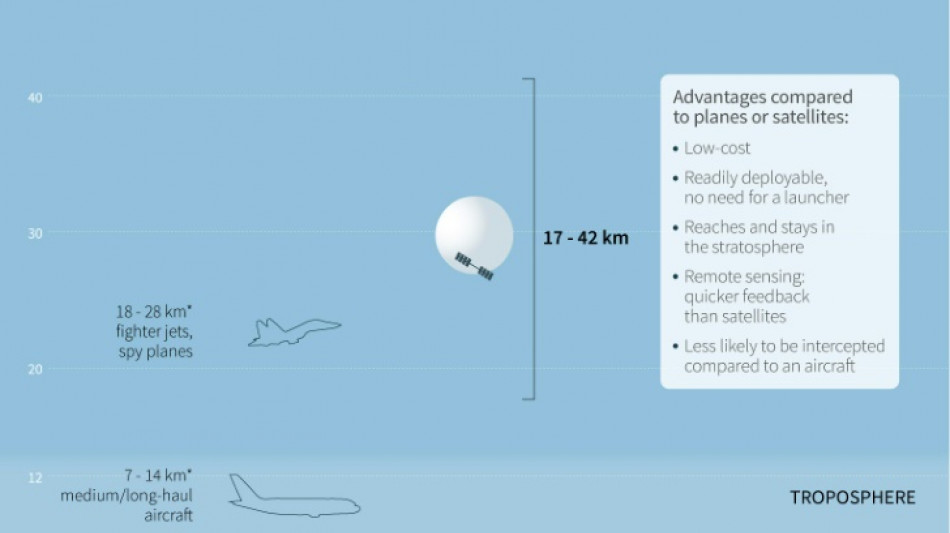
Chinese balloon advanced, hard to shoot down: US expert / Photo: Nalini LEPETIT-CHELLA - AFP
 Surfshark Adds Real-Time Call Protection to iOS App in Version 5.3.0

 Saudi PIF Retains Top Sovereign Wealth Fund Brand Title for Third Year

 Professor Shahida Moosa Pioneers Medical Genomics in South Africa Amid Testing Shortages

 Texas Marijuana Decriminalization Faces Uncertain Future Under New Attorney General

 Early Black Friday Laptop Deals: MacBook Neo, IdeaPad Slim 5x, and Surface Laptop Prices Drop

 2026 East Bay Nosh Awards Voting Opens for Food and Drink Favorites

 Arrive AI Eliminates All Debt Through Preferred Equity Exchange

 More Than Half of Teen AI Chatbot Users Use Them Daily, and 46% Say It Feels Like Talking to a Human, New Family Online Safety Institute Research Finds
 MicroVision and Blue-Band to Support $3 Million Federally Funded Intelligent Transportation Initiative in Louisville, Kentucky

 Metano Emerges From Stealth to Unify AI Agent Security Across the Enterprise
 ATWEC Technologies, Inc. (OTCID: ATWT) Engages Michael Gillespie & Associates, PLLC to Audit Fiscal 2026 and 2025 Consolidated Financial Statements and Changes Fiscal Year End to October 31
 Stemtech Corporation Partners with Fitness Icon Tony Little to Launch Stemtech Biosciences Digital Campaign

 InstaLILY Launches Lily for Sales on Microsoft Dynamics 365, Where Sellers and AI Agents Work Together in Shared Rooms

 Increasing Electrification Raises Grid Risk and Cost Pressure for Industrial Sites, ABI Research Finds

 NoHo, Inc. Acquires Four Placer Gold Claims in Clark County, Nevada from Gold Stake Mining Inc.

 Bob's Watches Founder Paul Altieri Unveils Private Collection of Vintage Rolex Watches in New Book, "NOT FOR SALE"
 Hemogenyx Pharmaceuticals PLC - Chairman Receives Prestigious Award

 LASE to Premiere Quantum Bullet(TM) at Counter UAS Technology Conference in Washington, D.C.
 IRS Shuts Down FIRE Today: What Information Return Filers Need to Know Before the 2027 Filing Season

 Trustpoint Xposure Completes More Than 200 AI Visibility Audits Across Professional Services

 Golden Minerals Completes Drilling Desierto, Argentina
 Helio Corporation Engages CORE IR to Provide Investor Relations, Capital Markets Advisory and Media Relations Services

 Karbon-X (OTCQB:KARX) Enters California's Multi-Billion-Dollar Compliance Carbon Market Following CITSS Approval
 Who Is the Best MTF Top Surgeon?
 United Bancorp, Inc. Increases its Fourth Quarter Cash Dividend Payment to $0.20 per Share, which Produces a Forward Yield of 5.4%

The first Chinese surveillance balloon that the Pentagon found flying over sensitive US ballistic missile sites may be guided by advanced artificial intelligence technology, a US expert said Friday.
A second Chinese spy balloon was later spotted over Latin America, before it headed eastwards over the central United States.
William Kim, a specialist in surveillance balloons at the Marathon Initiative think tank in Washington, told AFP that balloons are a valuable means of observation that are difficult to shoot down.
- Guided by AI? -
Kim said the first Chinese balloon looked like a normal weather balloon but with distinct characteristics.
It has a quite large, visible "payload" -- the electronics for guidance and collecting information, powered by large solar panels.
And it appears to have advanced steering technologies that the US military hasn't yet put in the air.
Artificial intelligence has made it possible for a balloon, just by reading the changes in the air around it, to adjust its altitude to guide it where it wants to go, Kim said.
"Before you either had to have a tether... or you just send it up and it just goes wherever the wind takes it," he said.
"What's happened very recently with advances in AI is that you can have a balloon that... doesn't need its own motion system. Merely by adjusting the altitude it can control its direction."
That could also involve radio communications from its home base, he said.
But "if the point of it is to monitor (intercontinental ballistic missile) silos, which is one of the theories... you wouldn't necessarily need to tell it to adjust its location," he added.
- What advantages over satellites? -
Kim said that as satellites become more vulnerable to being attacked from the Earth and space, balloons have distinct advantages.
Firstly, they don't easily show up on radars.
"These are materials that don't reflect, they're not metal. So even though these balloons expand to quite large, detecting... the balloon itself is going to be a problem," he said.
And the payload, if small enough, can be overlooked.
Balloons also have the advantage of holding relatively stationary positions over a surveillance target, compared to constantly orbiting satellites used by spy agencies to take photographs.
"These things can stay overhead, they can stay over one spot months at a time, compared to the low-Earth-orbit satellites," Kim said.
- Could it have entered US airspace by accident? -
Kim called it a "real possibility" that a Chinese balloon may have been intended to collect data from outside US boundaries or much higher but malfunctioned.
"These balloons don't always work perfectly," he said.
The balloons usually operate at altitudes of 65,000-100,000 feet, and this one is at around 46,000 feet, he said.
"That's definitely a little low... If you wanted it to be harder to spot, if you want it to be harder to shoot down, then it would make sense to operate at higher altitudes."
- Why can't the US shoot it down? -
Shooting down a balloon is not as easy as it sounds, said Kim.
"These balloons use helium... It's not the Hindenburg, you can't just shoot it and then and then it goes up in flames."
"If you do punch holes in it, it's just kind of going to leak out very slowly."
Kim recalled that in 1998 the Canadian air force sent up F-18 fighter jets to try and shoot down a rogue weather balloon.
"They fired a thousand 20-millimeter cannon rounds into it. And it still took six days before it finally came down. These are not things that explode or pop when you shoot at them."
He said it was not clear if using surface-to-air missiles would work, because their guidance systems are designed to hit fast-moving missiles and aircraft.
F.Schneider--AMWN

