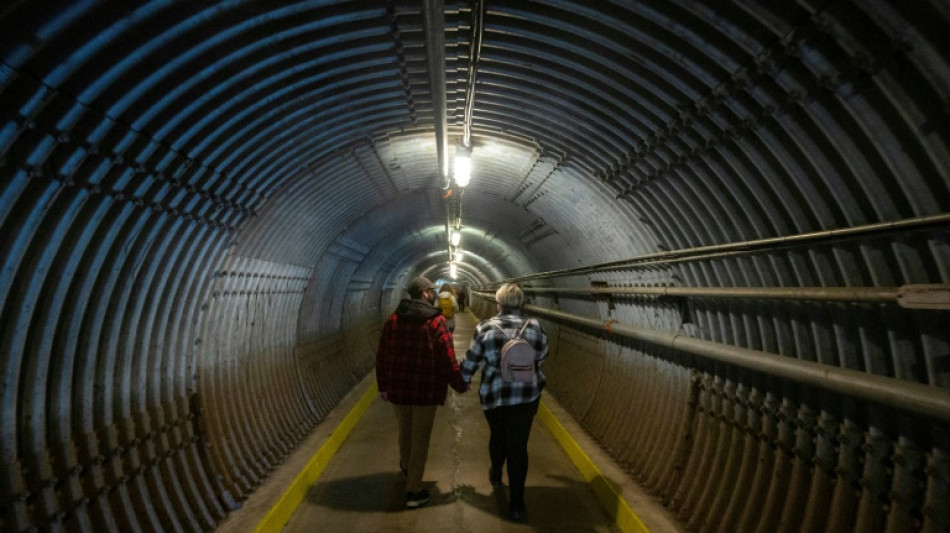
Canadians fearing nuclear apocalypse flock to visit Cold War bunker / Photo: Lars Hagberg - AFP/File
 West Midlands Shoppers Urged to Guard Against Black Friday Scams

 Surfshark Adds Real-Time Call Protection to iOS App in Version 5.3.0

 Saudi PIF Retains Top Sovereign Wealth Fund Brand Title for Third Year

 Professor Shahida Moosa Pioneers Medical Genomics in South Africa Amid Testing Shortages

 Texas Marijuana Decriminalization Faces Uncertain Future Under New Attorney General

 Early Black Friday Laptop Deals: MacBook Neo, IdeaPad Slim 5x, and Surface Laptop Prices Drop

 2026 East Bay Nosh Awards Voting Opens for Food and Drink Favorites

 After 20 Years of Modernizing Other Companies' Software, Polcode Turns the Lens on Itself

 The 2026 MDaudit Annual Benchmark Report Spotlights AI's Impact on Financial Risk as Payer Denials and Audits Continue an Upward Trajectory

 Lumber's Union CBA Agent Launches in Sage Agent Marketplace to Help Simplify Union Payroll Compliance
Vogenx Set to Join the Russell 2000(R), Russell 3000(R), and Russell Microcap(R) Indexes

 Go Green Global Technologies Corp. Appoints Dennis Beckert as Interim Chief Executive Officer

 Wave AI, the AI Note Taker for In-Person Meetings, Passes 5 Million Recorded Hours

 Jerash Holdings Partners with International Finance Corporation (IFC) to Pursue EDGE Gender Certification
 Philadelphia Sexual Assault Lawyer David P. Thiruselvam Explains Who Can Be Named in a Civil Sexual Assault Claim

 BlackBerry and Hazard Management Cayman Islands Renew Critical Alerting System for Emergencies and Public Safety

 Making the Most of a Long Weekend Without Leaving Town

 Bob's Watches Founder Paul Altieri Unveils Private Collection of Vintage Rolex Watches in New Book, "NOT FOR SALE"
 Hemogenyx Pharmaceuticals PLC - Chairman Receives Prestigious Award

 LASE to Premiere Quantum Bullet(TM) at Counter UAS Technology Conference in Washington, D.C.
 IRS Shuts Down FIRE Today: What Information Return Filers Need to Know Before the 2027 Filing Season

 Trustpoint Xposure Completes More Than 200 AI Visibility Audits Across Professional Services

 Golden Minerals Completes Drilling Desierto, Argentina
 Helio Corporation Engages CORE IR to Provide Investor Relations, Capital Markets Advisory and Media Relations Services

 Karbon-X (OTCQB:KARX) Enters California's Multi-Billion-Dollar Compliance Carbon Market Following CITSS Approval
A shed on a hillside on the outskirts of Canada's capital hides a Cold War bunker that has been fielding a surge of queries since Russia's invasion of Ukraine, asking if it is operational.
It's now a museum, so the answer of course is no.
Inside, past displays of atomic bombs, a blast tunnel opens up to decontamination showers. There's also a medical clinic, a vault for gold bullion, a radio studio, and a sparse chamber for the prime minister.
Gravel packed around the structure was meant to mitigate shocks from a nuclear strike, while everything inside is secured, including toilets mounted on rubber.
Tour guide Graham Wheatley, 67, vividly recalls fearing nuclear annihilation in his youth.
"There was always a lot of nuclear saber-rattling back in the 60s with (Nikita) Khrushchev and his shoe banging at the UN and 'We will bury you' speech, and then the Cuban Missile Crisis," he says.
"There was a general anxiety," adds visitor Janet Fisher.
That dread has returned, as Moscow steps up its nuclear threats.
"When Russia invaded Ukraine, we had a lot of public inquiries about whether this museum still functions as a fallout shelter," Christine McGuire, its executive director, told AFP.
And the daily barrage of calls has persisted, she said. "That fear is still very real. Anxieties are coming back. We're seeing remnants of the Cold War with the global tensions."
In light of war in Ukraine's impacts -- as well as the growing climate crisis -- the Bulletin of the Atomic Scientists in late January moved their symbolic "Doomsday Clock" to just 90 seconds to midnight -– its closest approach ever to humanity's "self-annihilation."
And on Tuesday, Russian President Vladimir Putin announced his country would suspend its participation in the New START nuclear arms treaty with the United States -- though Moscow's foreign ministry later said it still planned to abide by its regulations.
- Surviving an apocalypse -
The 100,000-square-foot (9,300-square-meter) underground bunker was built between 1959 and 1961 to house more than 500 key civilian, military and government officials to run Canada following a nuclear attack.
After 30 days, when radiation was expected to drop to safer levels, "some lucky person would be chosen to go above ground to see what our post-apocalyptic world looked like and how we were going to rebuild the country," McGuire said.
The top secret outpost, commissioned by then-prime minister John Diefenbaker, was officially called the Central Emergency Government Headquarters or CEGHQ Carp, after the town in which it's located.
Decommissioned in 1991 at the end of the Cold War, it reopened as a museum in 1998 and welcomes close to 70,000 visitors a year.
Speaking in what was the war cabinet room deep inside the four-level facility, McGuire said it remains "an important reminder of how close we all came to global annihilation during the Cold War."
- Fallout from US -
Some 2,000 government and private bunkers in back yards or basements were built across Canada at the onset of the Cold War, far fewer than in the United States or Europe, estimates Andrew Burtch, a Cold War historian at the Canadian War Museum.
"The Cold War brought with it the spectre of nuclear annihilation. And so governments around the world had to think about the best ways in which to prepare for a nuclear attack and how to coordinate the response to it after the fact," he recounted.
"The solution that many countries came to," he said, "was some form of underground (facility) to protect against the main effects of the nuclear bomb, be it the blast, radiation or heat."
Canada planned to deal with radioactive fallout, but was less concerned about threats of direct strikes on its cities.
"The idea was that the Russians would not waste their bombs or missiles on Canada but rather target them at the United States," Burtch explained.
There were several scares between 1947 and 1991. "Nuclear weapons were everywhere during the Cold War, and the threat to use those weapons was periodic and tended to come during periods of high tension," he said.
"Now we find ourself back in the position where we were," he lamented. "So it's quite a disconcerting time."
J.Williams--AMWN

