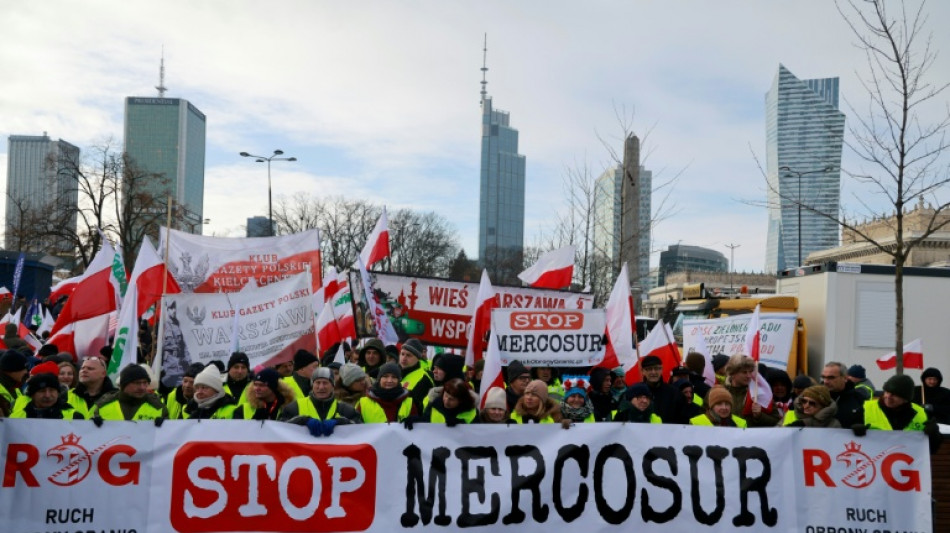
Polish farmers march against Mercosur trade deal / Photo: Wojtek RADWANSKI - AFP
 Teatro Mayor Unveils 152-Performance 2027 Season Highlighting Beethoven and García Márquez

 Rutgers Defeats NJIT 101-64 Behind Francis and Mark Scores

 Thukukile Zuma Resigns from ANC Johannesburg Leadership Amid Disciplinary Dispute

 CM Mohan Yadav Meets Bohra Spiritual Leader to Discuss Simhastha 2028 and Development

 Eli Crane Defeats Jonathan Nez in Tight Arizona Congressional Race

 Sherilyn Smith Encourages Women to Embrace Scars as Symbols of Resilience
Polish farmers descended on Warsaw on Friday to protest a European trade deal with the South American Mercosur bloc, marching just moments after it was accepted by a majority of EU nations in Brussels.
Over a thousand protestors gathered, some arriving on their tractors, to again denounce a deal many fear will lead to unfair competition in the bloc.
"This will kill our agriculture in Poland," said Janusz Sampolski, a farmer who came from a village just south of Gdansk on the Baltic coast, some 340 kilometres (210 miles) away.
"We will be dependent on supply chains from other countries," he told AFP, saying it could threaten Poland's food security "in the event of the threat of war".
Poland, along with France, Ireland, Austria, and Hungary, voted against the measure, but most of the 27 EU members approved it, diplomats told AFP.
Carrying flags and wearing yellow vests, the demonstrators marched toward Parliament and the chancellery of Prime Minister Donald Tusk.
Some protestors set off fireworks and lit off flares. Tractors, which several drove into the city, were not let into its limits.
Aside from economic concerns, farmers also warned of food quality and safety risks.
"Food will be coming to us... produced using pesticides that have been banned in the European Union," said Przemyslaw Zbroinski, another farmer from the Gdansk region.
"Some of the substances [have been banned] for nearly 30 years," he added.
The Mercosur deal has been in the works for over 25 years, with the European Commission arguing that it will bolster EU exports while fostering diplomatic ties.
But for Zbroinski, "It will definitely end with much harsher and larger strikes, and blockades of countries and capitals".
B.Finley--AMWN