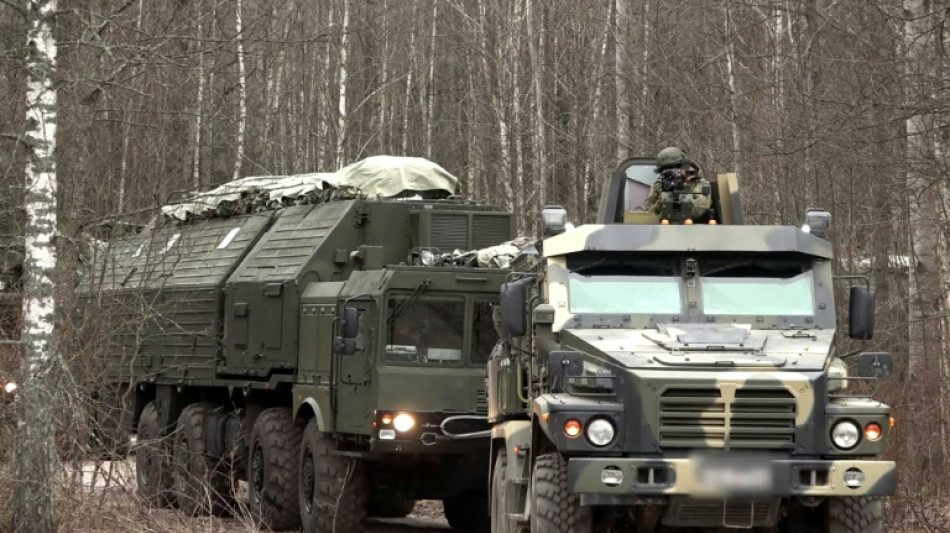
'Unhappy' Putin sends message to West with Ukraine strike on EU border / Photo: Handout - Russian Defence Ministry/AFP
 Dust in the wind: intense storms struck China, US in 2025, says UN

 Finally healthy, music lover Muchova eyes Wimbledon glory

 Muchova, Noskova put friendship on hold to fight for Wimbledon title

 MEXC Launches VVIP Futures Loss Coverage Program 2.0 with 1,000,000 USDT Prize Pool

 Foreigners among 11 dead in Spanish wildfires

 Volkswagen sales slide further as carmaker weighs mass job cuts
 Gagan Gupta, man on a mission to industrialise Africa

 Eleven dead, 19 missing as Spain wildfire roars through southern Spain

 Man nearly sucked out of 'detached' window on Ryanair flight
 Record visitors, record taxes: Vienna cashes in on tourist boom

 Landslides kill 15 in Philippines as biggest typhoon in decades nears Taiwan

 Jungle spirit: Myanmar fighters try to keep hope alive

 Beirne hails 'special moment' as he prepares to captain Ireland
 Indonesia says landfill fire near Jakarta extinguished

 Spain aim for World Cup date with France by beating Belgium

 Bayeux Tapestry arrives in London after epic journey from France
 North Korea vows boost to nuclear buildup, military intelligence

 H5 bird flu detected in Australian seabird for first time
 Myanmar's pro-democracy revolution weakens five years on

 Hundreds flee homes in Taiwan ahead of biggest typhoon in decades

 Asian stocks rally as SK hynix breathes life back into AI trade

 Humanitarians look to put the AI in aid

 Indian haute couture presence 'overdue', says designer Manish Malhotra

 'Everyone' expects Spain to beat us, says Belgium coach
 France's Galthie says 'hot and cold' Australia still a threat

Russia's Oreshnik missile attack in Ukraine near the EU border aims to intimidate Kyiv's Western allies and signals Vladimir Putin's displeasure at recent foreign policy setbacks including in Venezuela, analysts said Friday.
Days after European and US negotiators unveiled a post-war peacekeeping plan for Ukraine, Russia overnight Thursday to Friday targeted an infrastructure facility in the country's western region of Lviv with the Oreshnik nuclear-capable intermediate-range ballistic missile (IRBM).
It is thought to be only the second known combat use of the weapon.
While Moscow said the strike came in response to an alleged drone attack on a Putin residence in December, nearly four years after Russia's invasion of Ukraine, analysts said the move was designed to send a clear message to Western leaders and frighten ordinary Europeans.
"Vladimir Putin is using this to communicate with the West, because he could undoubtedly achieve the same operational effects without this missile," Cyrille Bret, a Russia expert at the Paris-based Montaigne Institute, told AFP.
"As Europeans are developing their air defence capabilities, this is a way of reminding them of their vulnerability," he added.
The Kremlin has touted the Oreshnik as a "state-of-the art" weapon, which travels at hypersonic speeds, can hit targets across Europe and cannot be intercepted.
In a call on Friday, the leaders of Britain, France and Germany said Russia's use of the missile was "escalatory and unacceptable", according to a UK government spokeswoman.
UK Prime Minister Keir Starmer said Russia was using "fabricated allegations to justify the attack", according to the spokeswoman. Ukraine has denied targeting Putin's residence.
Lviv mayor Andriy Sadovy said on Facebook the strike was "a new level of threat -- not only for Ukraine, but also for the security of Europe".
The missile, named after the Russian word for hazel tree, was first fired on the central Ukrainian city of Dnipro in 2024.
- 'Psychological weapon' -
The choice of a new target located around 70 kilometres (40 miles) from the border with the European Union was significant, observers said.
"It is much closer to the EU's borders," Etienne Marcuz, an associate fellow at the Foundation for Strategic Research, a French think tank, said on X.
"This should probably be seen as a message to European countries," he said, adding the result of the strike was "probably more psychological than operational".
Some observers saw the strike as Putin's attempt to reassert his authority following setbacks including Washington's capture of Venezuelan leader Nicolas Maduro, the seizure of a Russian-flagged vessel in the North Atlantic and fresh demonstrations in Iran challenging Moscow-allied authorities.
"It is a psychological weapon -- an instrument of Putin's cognitive war against Ukraine and the West -- rather than a weapon of mass physical destruction," wrote Mick Ryan, a retired major general from the Australian army and Ukraine war analyst.
He said the use of the Oreshnik was a "sign of a fearful, worried leader and not one that is confident and anticipating victory".
The move could not hide the fact that Russia had little power "to shape events or respond to military contingencies involving its allies and friends beyond its borders," he added.
Timothy Ash, an emerging market economist focused on Russia, struck a similar note, pointing to relatively limited damage on the ground after the missile strike.
"The Oreshnik is highly effective but also very high cost, and from a cost benefit analysis it makes zero sense for these to be deployed in Ukraine," he wrote.
"The deployment of the Oreshnik therefore seemed more a PR exercise, perhaps aimed at the Trump administration signalling that Russia is unhappy more broadly about the state of play in the world," he added.
While Russia calls the Oreshnik a hypersonic missile, Western defence analysts say it is not a revolutionary weapon.
"It is most likely NOT a hypersonic missile," said Marcuz, adding Europe has a means of intercepting IRBMs.
"The Oreshnik's multiple warheads could pose a problem, depending on when they are released," he added.
In December, Putin's ally, Belarusian President Alexander Lukashenko, said the weapon had been deployed in his country, which borders NATO's eastern flank.
S.F.Warren--AMWN