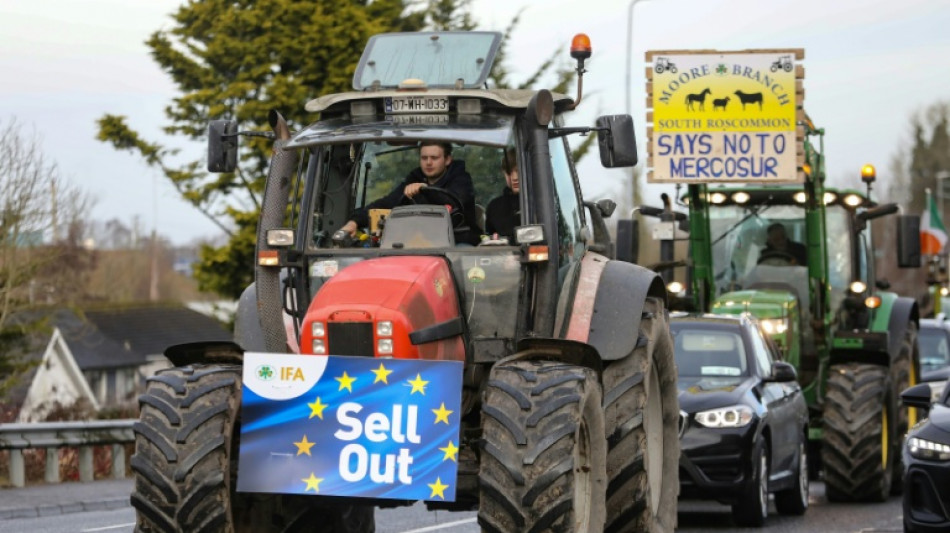
Thousands of Irish farmers protest EU-Mercosur trade deal / Photo: Gareth CHANEY - AFP
 Teatro Mayor Unveils 152-Performance 2027 Season Highlighting Beethoven and García Márquez

 Rutgers Defeats NJIT 101-64 Behind Francis and Mark Scores

 Thukukile Zuma Resigns from ANC Johannesburg Leadership Amid Disciplinary Dispute

 CM Mohan Yadav Meets Bohra Spiritual Leader to Discuss Simhastha 2028 and Development

 Eli Crane Defeats Jonathan Nez in Tight Arizona Congressional Race

 Sherilyn Smith Encourages Women to Embrace Scars as Symbols of Resilience
Thousands of Irish farmers protested Saturday against the European Union's trade deal with the South American bloc Mercosur, a day after EU states approved the treaty despite opposition from Ireland and France.
Tractors streamed into the roads of Athlone, in central Ireland, for the demonstration, displaying signs including "Stop EU-Mercosur" and ones with the European Union flag emblazoned with the words "sell out".
Farmers on Friday also marched in Poland and blocked roads in France and Belgium as the EU gave the green light to the trade deal, which has been welcomed by business groups but heavily criticised by European farmers.
The accord, more than 25 years in the making, would create one of the world's largest free-trade areas, boosting commerce between the 27-nation EU and the Mercosur bloc comprising Brazil, Paraguay, Argentina and Uruguay.
Major Mercosur exports to the EU include agricultural products and minerals, while the EU would export machinery, chemicals and pharmaceuticals with lowered tariffs applied.
But many European farmers fear their livelihoods will be undercut by a flow of cheaper goods from agricultural giant Brazil and its neighbours, prompting Ireland, France, Poland, Hungary and Austria to vote against the accord.
The agreement is widely opposed by Irish farmers for fear it will result in an influx of an extra 99,000 tonnes of cheap beef from South America, disrupting Irish agriculture.
The Irish Farmers' Association (IFA), Ireland's main farmers' lobby group, called the result "very disappointing".
It said it would "renew" focus on securing a majority against the deal in the European Parliament.
"We expect Irish MEPs to stand behind the farming community and reject the Mercosur deal," said IFA president Francie Gorman in a statement.
Earlier this week Irish prime minister Micheal Martin expressed concern that Mercosur beef may not be produced to the EU's strict environmental standards.
"We have to be confident" that standards and obligations set for Irish farmers won't be "undermined" by imports with less stringent regulations, said Martin.
At the Saturday protest, farmers carried signs calling for an "Irexit" and accusing the Latin American bloc's beef exports of not following the same standards.
The Mercosur deal will also need to be agreed by a majority of MEPs in the European assembly in the coming months, where voting coalitions have become more volatile and unpredictable.
D.Kaufman--AMWN