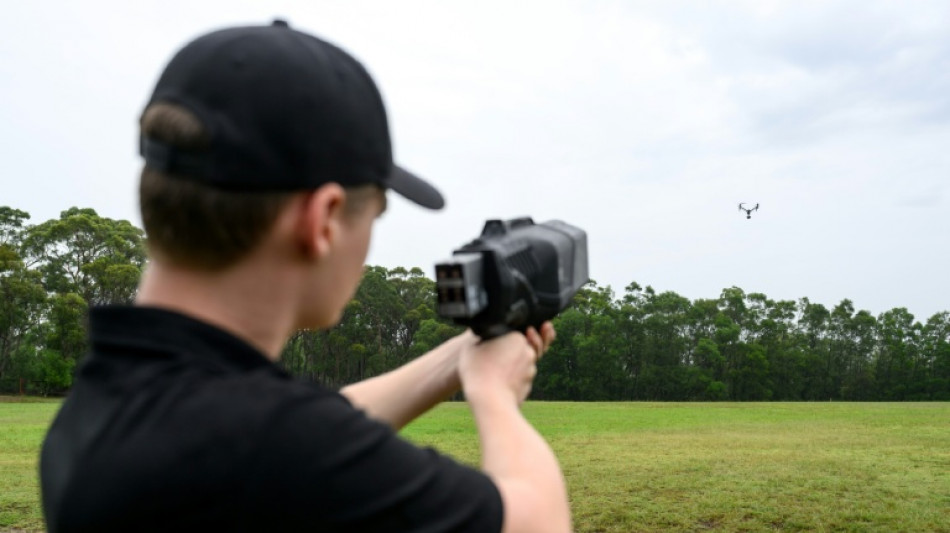
Australian defence firm helps Ukraine zap Russian drones / Photo: STEVEN MARKHAM - AFP
 Paris FC confirm Rosenior taking over as coach
 Thousands without power in US Pacific islands after super typhoon
 Prince Harry to discover outcome of UK tabloids case

 Messi v Salah in World Cup last-16 showdown
 Death toll from China storms rises to 15, hundreds injured

 Belgium boosted by Balogun furore: Tielemans

 Samsung expects 1,800% operating profit leap on AI boom

 Belgium thrash USA to end World Cup dream and set up Spain showdown

 France's Le Pen faces pivotal ruling in race for president
 NATO allies seek to win over Trump after Iran ire
 US leads international concern after China test-fires missile into Pacific

 Close to tears and on his own as Ronaldo's World Cup dream ends

 HM Exploration Expands Newly Discovered Blind Massive Sulphide Lens at Lewis Pilley's Project
 Great Western Mining Corporation PLC Announces Sampling Returns Positive Tungsten Assay Results
 Argentina's gruelling World Cup schedule a concern for Scaloni

 Race to recover bodies ahead of Venezuela quake cleanup
 Egypt coach Hassan says Palestinian suffering 'a shame on the world'

 NBA Kings waive six-time All-Star forward DeRozan

 Greaves and Hope centuries usher West Indies towards safety

 'I celebrated in bed' -- Norway's Solbakken stays grounded after beating Brazil

 Canada chooses Germany's TKMS to build new fleet of submarines
 Mbappe condemns racist abuse by Paraguayan senator after World Cup clash

 FIFA chief forced to defend Balogun World Cup reprieve
 Antetokounmpo says goodbye to Milwaukee in video
 Fairytale Fery sinks Dimitrov to make Grand Slam history at Wimbledon
One of Australia's most highly valued defence firms is helping Ukrainian soldiers knock Russian drones off the battlefield, riding a surge in military spending by Western governments with tech combating the weapon of the future.
From the trenches of Ukraine to the Red Sea and the cartel wars of South and Central America, unmanned aerial vehicles (UAVs) are an ubiquitous part of modern conflict -- conducting surveillance, taking airports offline, dropping deadly payloads, and carrying out so-called "kamikaze" strikes.
Shares in the Sydney-based DroneShield-- whose tech was originally conceived as a high-tech mosquito swatter -- soared over 300 percent in the last year on hopes that it is uniquely positioned to profit from the wars of the 21st century.
"Any future war will have all the normal things you expect like tanks and artillery and missiles but also to have drones, and with it, you need counter drone systems to cover that," CEO Oleg Vornik told AFP at the firm's headquarters in Sydney.
"You have to now assume the threat from the air is just as likely as the threat from the ground."
An hour's drive from DroneShield's headquarters, in a leafy Sydney suburb, the firm's technicians try to give a sense of what it looks like in the field.
A drone hovers over the trees as a technician wields DroneGun Tactical, its black veneer and size looking like something out of science fiction.
As the technician fixes the gun's sights on the drone, he pulls the trigger, and brings it down.
It is a very different scene from the battlefront of Ukraine, where if you see or hear the drone it's probably too late -- "you're very likely to die", said Vornik.
DroneShield's tech first allows the user to scan the area for enemy UAVs.
They then have a choice.
"You wait for the drone to move on and find something else to focus on," Vornik explained.
"Or alternatively, you want to take a drone gun out."
The DroneGun can then use directional concentrated radio wave energy to disrupt the control, navigation and video of multiple drones simultaneously.
"The drone says: 'Okay, I'm lost. I don't know where I am, so I'm just going to crash or gonna land'."
- 'Meme stock'? -
DroneShield is now Australia's highest-valued defence firm, with a market cap of AUD$3.01 billion ($2.13 billion).
But that rapid increase has raised questions over whether the firm's success is really a product of its long-term potential or whether it's simply a "meme stock" -- a share driven by retail investors and hype.
Last year, as the firm's share price soared to a record high, Vornik offloaded a $50 million stake.
That sent the share price plummeting and raised questions about DroneShield'slong-term future.
He told AFP he sold the shares to pay off a tax bill as well as secure his financial future.
But Vornick admitted DroneShield had become a "retail stock" and that like many defence firms there was "basically high risk, high reward type situation".
Beyond the battlefields of Ukraine, which he said constitutes just five percent of revenue, he sees growing civilian applications for counterdrone technology.
That includes security for airports, a number of which have been shut down by drone incursions in the past year, and for prisons in the UK, where UAVs are often used for smuggling contraband to inmates.
- Year of the drone -
And he points to the growing use of drones by drug cartels in South and Central America. Many, he said, are learning the lessons of the war in Ukraine.
Australian financial firm Bell Potter has declared 2026 to be the "Year of the Drone" in a bullish note backing DroneShield.
Drones have "become an integral part of how war is being fought", Steven Feldstein at the Carnegie Endowment for International Peace in Washington DC told AFP.
"They do things that otherwise are much more expensive and much harder to replicate using traditional munitions," he said.
"And then it's the cost, it's the ability to do things in a much cheaper way with much more maximal effect, and to do so at scale."
The real challenge for firms like DroneShieldis keeping up with this "moment of disruption" in warfare, he said.
"But that's true in any kind of weapon that comes about -- whether it's tanks and anti-tank systems or supersonic aircraft or stealth fighters," he said.
"That's the nature of war."
F.Dubois--AMWN