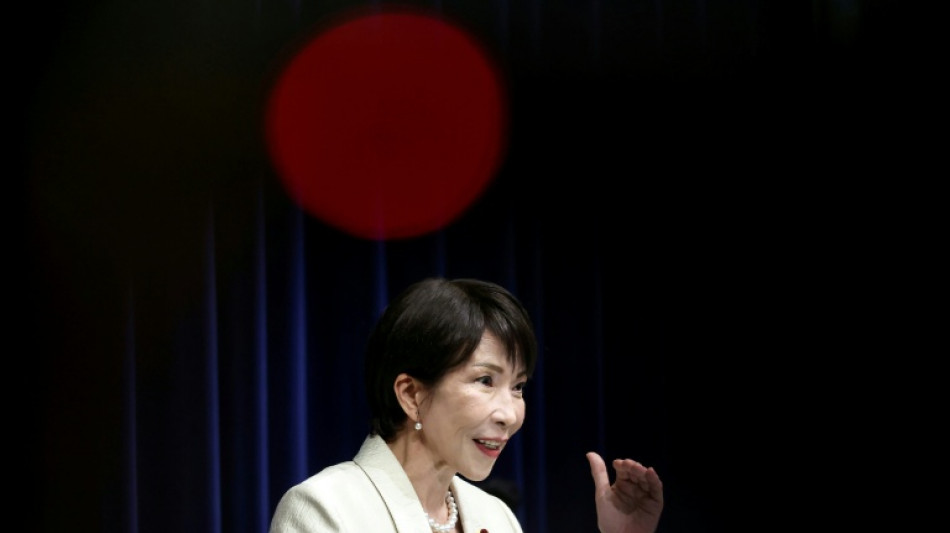
Japan inflation eases in welcome news for Takaichi / Photo: Kiyoshi Ota - POOL/AFP
 Brussels Education Unions Schedule Major November Protest Over Funding and Reforms

 Making Your Home Safer for Aging Parents: Accessibility Renovations That Add Value

 iPS Cell Research Accelerates Drug Discovery for ALS and Spinal Cord Injury

 Rene Eyre Revisits Autobiographical Performance 'Say A Little Prayer' in London

 UAE's HCT Holds Record Graduation and Announces Major Training Expansion

 NASA Awards $10B Lunar Contract Framework to SpaceX, Blue Origin

 Katy Perry Tells Fans Ex-Husband Russell Brand 'Should Be in Jail' During UK Concert

Japanese inflation slowed in January, government data showed Friday, in welcome news for Prime Minister Sanae Takaichi after her recent election landslide win.
Soaring prices in Asia's number-two economy contributed to the downfall of Takaichi's two predecessors and Japan's first woman premier has made fighting inflation a priority.
Excluding fresh food, "core" consumer prices rose 2.0 percent year-on-year, down from a 2.4 percent increase in December and in line with market expectations, the data showed.
Also stripping out energy prices, inflation mellowed by more than expected to 2.6 percent from 2.9 percent in January, compared to the median forecast of 2.7 percent.
Unadjusted, consumer prices rose 1.5 percent compared to 2.1 percent in December, also constituting a bigger drop than expected, with market consensus 1.6 percent.
Petrol prices fell 14.6 percent, thanks in part to government subsidies making fuel less expensive at the pump for motorists.
But the cost of food excluding fresh produce rose 6.2 percent, and the price of rice -- which doubled last year -- soared 27.9 percent.
- Policy address -
Takaichi was due to give a policy address in parliament later on Friday.
She was formally reappointed as prime minister on Wednesday, 10 days after her historic landslide election victory.
The 64-year-old won a two-thirds majority for her party in the snap lower house elections on February 8.
A poll by the Yomiuri newspaper published Friday put support for Takaichi's cabinet at 73 percent, up six percentage points and her highest yet.
In the address, Takaichi will likely repeat her campaign pledge to suspend consumption tax on food for two years to help households cope with inflation.
This promise has exacerbated market worries about Japan's Godzilla-sized debts, with yields on long-dated government bonds hitting record highs last month.
To ease such concerns, Takaichi again on Wednesday repeated her mantra of having a "responsible, proactive" fiscal policy and promised to reduce debt.
She will also announce in her policy speech the creation of a cross-party "national council" to discuss taxation and how to fund ageing Japan's ballooning social security bill, media reports said.
But Takaichi's first order of business will be obtaining approval for Japan's budget for the fiscal year beginning on April 1 after the process was delayed by the election.
She is also expected to announce that the government wants to update Japan's 10-year-old "Free and Open Indo-Pacific" (FOIP) strategic framework.
Ch.Kahalev--AMWN

