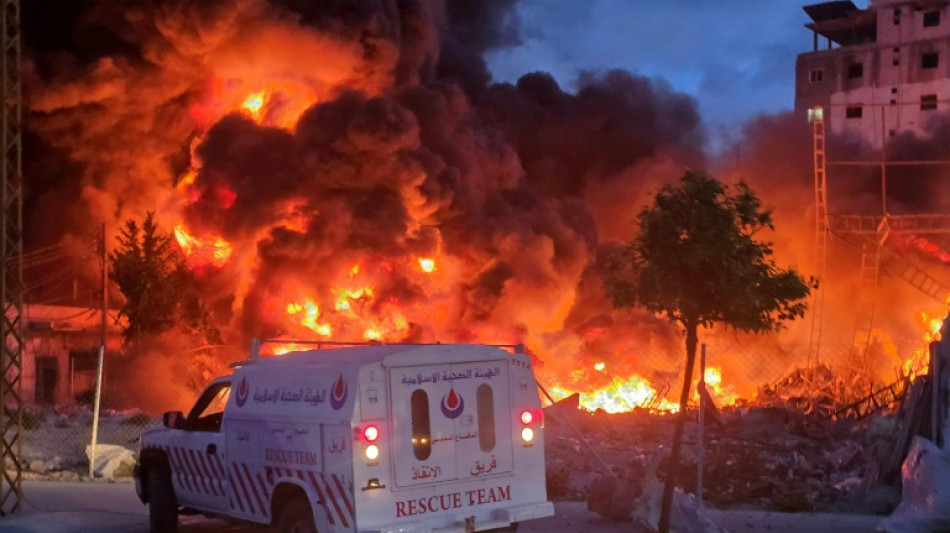
Israel keeps up Lebanon strikes as ground forces advance / Photo: Kawnat HAJU - AFP
 Rene Eyre Revisits Autobiographical Performance 'Say A Little Prayer' in London

 UAE's HCT Holds Record Graduation and Announces Major Training Expansion

 NASA Awards $10B Lunar Contract Framework to SpaceX, Blue Origin

 Katy Perry Tells Fans Ex-Husband Russell Brand 'Should Be in Jail' During UK Concert

 South African election results renew debate over identity-based voting

 South African voters report smoother local election but declining IEC trust

 Dolly Parton museum and Nashville hotel open after singer’s death

 George and Amal Clooney attend New York political-comedy reading

 British buyers pay substantial premiums for period-home appearance

 Thomas Markle released to house arrest after child-abuse-image charge
Israel's attacks on Lebanon entered a fourth day on Thursday, after Israeli forces pushed into several border towns and conducted air strikes targeting Iran-backed militant group Hezbollah.
AFPTV footage showed smoke rising after a strike hit the Hezbollah stronghold of south Beirut early Thursday.
Israel's military earlier told residents to leave the suburb where the strike hit, warning it was about to attack a target it said was linked to Hezbollah.
In Israel's north near the border, repeated air raid alerts sent residents to shelters in several locations, with no immediate reports of impact or casualties.
Lebanon was drawn into the Middle East war on Monday, when Hezbollah attacked Israel in response to the killing of Iranian supreme leader Ayatollah Ali Khamenei during US-Israeli strikes over the weekend.
Hezbollah's leader vowed Wednesday to keep up its fight against Israel and step up attacks, saying the group had targeted Israeli positions as far as Tel Aviv in at least 15 attacks.
"We are facing aggression... our choice is to confront it until the ultimate sacrifice, and we will not surrender," Hezbollah leader Naim Qassem declared in his first speech since the latest round of fighting broke out.
"For us this is an existential defence," he added.
Lebanese authorities announced at least 72 people killed, 437 wounded and 83,000 displaced from their homes since Monday.
The Israeli military told people living south of Lebanon's Litani river -- a large area stretching around 30 kilometres (20 miles) north of the border -- to evacuate, warning that the army was "compelled to take military action" against Hezbollah there.
- 'Direct' clashes -
Under a November 2024 truce, only UN peacekeepers and the Lebanese army may bear arms south of the Litani river. Israel was supposed to withdraw all of its forces, but has kept troops in areas it deems strategic and conducted regular air strikes, citing Hezbollah's refusal to surrender arms.
On Tuesday, Israel's military said it was creating a buffer zone inside Lebanon to protect Israeli residents.
Troops from three divisions, including infantry, armoured and engineering units were operating in southern Lebanon, Israel's army said late Wednesday.
AFP video footage showed what appeared to be two Israeli tanks amid residential buildings in Khiam, about six kilometres (3.7 miles) north of the border.
The UN peacekeeping mission, UNIFIL, reported Israeli "movements and military activities" on the Lebanese side, adding in a statement that they violate Lebanon's "sovereignty and territorial integrity".
Hezbollah said its fighters had engaged Israeli troops in "direct" clashes in Khiam, while Israel said two of its soldiers had been "moderately injured" by anti-tank fire.
Meanwhile, an air strike hit a hotel in Hazmieh -- the first reported Israeli attack on the predominantly Christian area in Beirut's suburbs, which is near the presidential palace and several foreign embassies.
Some rooms were gutted in the strike, and wounded people received treatment in the lobby, AFP images showed.
People fled through debris carrying suitcases past the Comfort Hotel's sign, which had fallen broken to the ground. It was not possible to determine who was targeted in the attack.
The upscale district overlooks the capital's southern suburbs, where Hezbollah holds sway.
Several people told AFP they had received recorded phone messages telling them to evacuate.
- Southern suburbs targeted -
A series of strikes on Wednesday hit Beirut's southern suburbs following evacuation warnings from Israel's military.
One of the strikes targeted a building near a major hospital, according to an AFP photographer.
AFP footage showed thick plumes of smoke rising above buildings in the densely populated suburb, which some residents fled when the violence erupted on Monday.
In Aramoun and Saadiyat south of Beirut -- two towns outside of Hezbollah's traditional sphere of influence -- the health ministry said Israeli strikes killed at least six people.
AFP footage from Aramoun showed damaged cars and rescue workers carrying a wounded person on a stretcher.
Strikes also targeted a four-storey building in the city of Baalbek, in Lebanon's east, far from the border where Hezbollah also has a strong presence.
Y.Aukaiv--AMWN