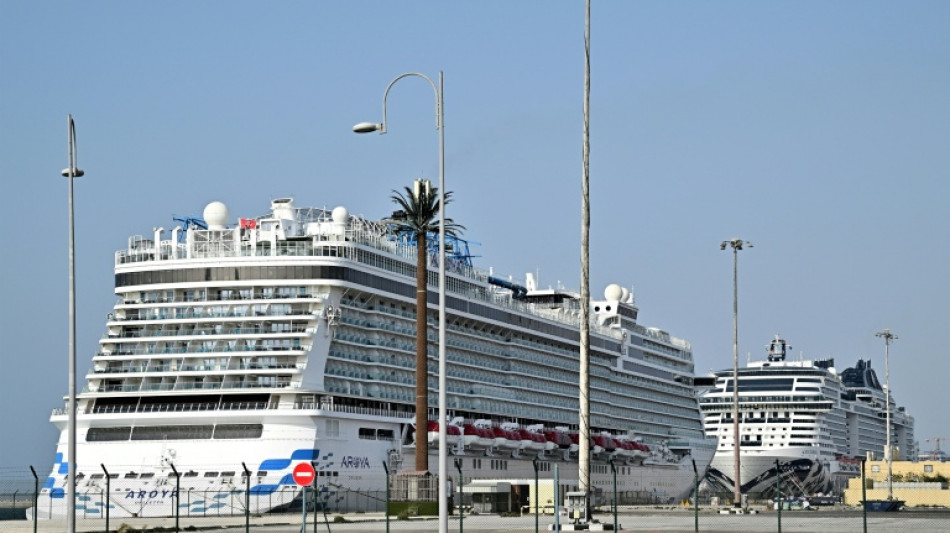
Mideast war traps 20,000 seafarers, 15,000 cruise passengers in Gulf / Photo: Giuseppe CACACE - AFP
 Rene Eyre Revisits Autobiographical Performance 'Say A Little Prayer' in London

 UAE's HCT Holds Record Graduation and Announces Major Training Expansion

 NASA Awards $10B Lunar Contract Framework to SpaceX, Blue Origin

 Katy Perry Tells Fans Ex-Husband Russell Brand 'Should Be in Jail' During UK Concert

 South African election results renew debate over identity-based voting

 South African voters report smoother local election but declining IEC trust

 Dolly Parton museum and Nashville hotel open after singer’s death

 George and Amal Clooney attend New York political-comedy reading

 British buyers pay substantial premiums for period-home appearance

 Thomas Markle released to house arrest after child-abuse-image charge
Around 20,000 seafarers and 15,000 cruise ship passengers are stuck in the Gulf because of the Middle East war, the UN's International Maritime Organization told AFP on Thursday.
The shipping regulator's secretary general Arsenio Dominguez said that the "IMO is ready to work with all stakeholders to help ensure the safety and well-being of the seafarers affected".
The maritime sector said it had designated the Strait of Hormuz, Gulf of Oman and Gulf as a "warlike operations area", granting seafarers additional protections as the Middle East war engulfs the crucial energy transit route.
Since war erupted on Saturday, the IMO has recorded seven incidents involving ships in the region that have resulted in two deaths and another seven people wounded.
- 'Alarming attacks' -
"Beyond the economic impact of these alarming attacks, it is a humanitarian issue. No attack on innocent seafarers is ever justified," Dominguez told AFP.
"I reiterate my call for all shipping companies to exercise maximum caution when operating in the affected region," he added.
Iran has effectively shut down the Strait of Hormuz, through which a fifth of the world's crude and considerable supplies of liquefied natural gas travel.
Several shipping groups, including Danish shipping giant Maersk, have suspended bookings in the Gulf.
Maritime employers and unions representing their workers on Thursday said their upgraded designation of the Strait of Hormuz, Gulf of Oman and Gulf from a "high risk area designation" three days ago "reflects the continuing and heightened threat to seafarers and vessels operating in the region".
"Hundreds of vessels are stranded in the Gulf following the halt of vessel movements through the Strait of Hormuz, highlighting the scale of disruption and risk facing civilian crews in the region," said a joint statement from the International Transport Workers' Federation (ITF) and the Joint Negotiating Group, which represents maritime employers.
ITF General Secretary Stephen Cotton told AFP that after 32 years involvement with the federation, "this is the worst" he has seen it, "because it's so unclear on the diplomatic level".
While seafarers can request to leave a ship and be repatriated, the reality is not so clear.
"You can't push a button and you immediately leave a vessel," said Cotton.
"If you've got a crew of 25, you probably need 16 to safely run the vessel."
Iran's Revolutionary Guards on Wednesday claimed "complete control" of the Strait, with reports of additional vessels coming under attack.
Energy intelligence firm Kpler said oil tanker transits through the Strait had dropped by 90 percent from last week.
- Oil price surge -
With energy prices already soaring, US President Donald Trump said Tuesday that the US Navy was ready to escort oil tankers through the crucial shipping route.
Benchmark US oil contract, West Texas Intermediate, soared more than five percent to $78.88 per barrel in trading Thursday, the highest level since January last year, as the Iran war threatens supplies.
International benchmark, Brent North Sea crude, jumped 3.6 percent to $84.34 per barrel.
Other regions are already classified as "Warlike Operations Area" by the maritime sector, such as parts of the Sea of Azov, the northern Black Sea, the southern Red Sea and the Gulf of Aden.
J.Williams--AMWN