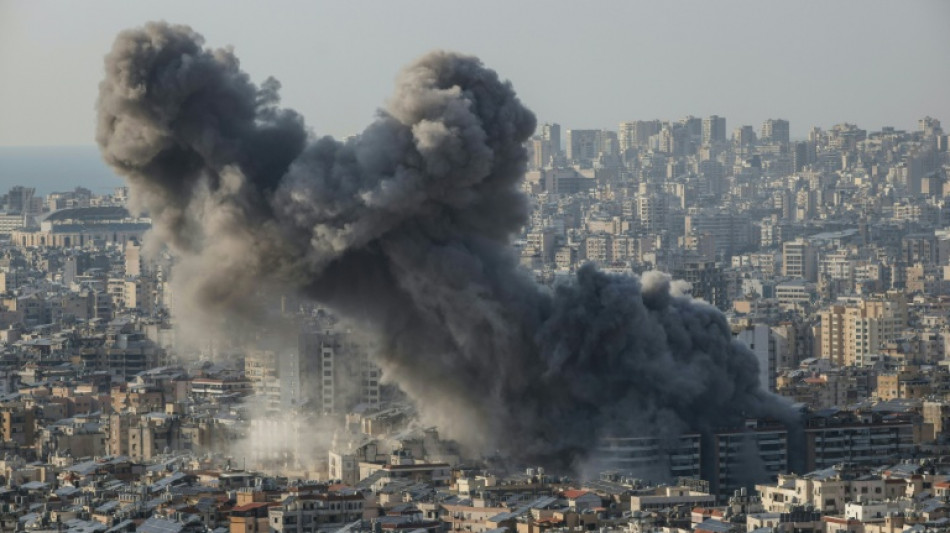
Blasts rock Tehran as US says strikes to intensify / Photo: Ibrahim AMRO - AFP
 Trump names Stephen Miller as White House chief of staff after midterm losses

 Restored Albanian tower houses anchor new rural tourism trail

 Sonia Gandhi reflects on family tragedy and reluctant political career

 Pope Leo begins three-country South American tour in Uruguay

 Khawaja says entire Australia camp knew of 2018 ball-tampering plan

 November Foraging Guide: Edible Mushrooms and Critical Safety Protocols

 Microsoft Updates Xbox PC App with 60% Faster Startup and Redesigned Interface

 Early Polar Vortex Disruption Creates Uncertain Winter Outlook for Pennsylvania

 How to Enjoy Luxury Experiences on a Budget

 Pakistan Demands Grant-Based Climate Finance at COP31 to Avoid Debt Trap
Explosions thundered out in Tehran on Tuesday after the Pentagon chief warned US strikes on Iran would reach their highest intensity since the start of the war in the Middle East.
The war has been a shock to energy markets, and Iran has vowed that no crude exports would leave the Gulf if the United States and Israel kept up their bombardment.
But the war has shown no sign of relenting, with AFP journalists reporting three explosions in Tehran on Tuesday evening, with no immediate information available about the intended targets.
US Defense Secretary Pete Hegseth had earlier told a news conference at the Pentagon that Tuesday would "be yet again our most intense day of strikes inside Iran -- the most fighters, the most bombers".
Volatile oil prices again veered sharply on Tuesday, sliding after a senior US official announced the navy had escorted a tanker through the strategic Strait of Hormuz.
However, US Energy Secretary Chris Wright deleted the social media post announcing the operation moments later, and the White House subsequently said no such escort mission had taken place.
Iran's Revolutionary Guards replied that no US navy vessel had "dared" approach the waterway, where a quarter of the world's seaborne oil and a fifth of all LNG pass.
Iran began attacking shipping in the strait following the February 28 US-Israeli strikes that killed its supreme leader and triggered the regional conflict.
The Israeli military announced a new wave of attacks on Tehran and Beirut, where AFPTV footage showed smoke rising from the southern stronghold of Iran's Lebanese ally Hezbollah.
And Iran's Revolutionary Guards announced a fresh salvo of missiles against Israeli cities and US targets in the region.
- 'Catastrophic consequences' -
Oil prices had surged following the Iranian attacks on shipping, strikes on oil depots in Iran and attacks on energy infrastructure in wealthy Gulf countries, previously seen as safe havens in a turbulent Middle East.
The UAE's biggest oil refinery at Ruwais was closed on Tuesday as a precaution after a drone attack on the industrial complex that houses it caused a fire, a source familiar with the situation told AFP.
A driver working at the complex, who requested not to be named, told AFP they saw "bursts of fire rising from the complex, with loud sounds like explosions".
Qatar, where a suspension of LNG exports has sent European energy prices sky-high, said Iranian attacks on its civilian infrastructure were ongoing, with AFP journalists reporting explosions in Doha.
Traders and energy policymakers are nervously following the hostilities.
"There would be catastrophic consequences for the world's oil markets the longer the disruption goes on, and the more drastic the consequences for the global economy," Saudi oil giant Aramco's president and CEO Amin H. Nasser told journalists.
"It's absolutely critical that shipping resumes in the Strait of Hormuz."
The UN trade and development agency warned the Hormuz closure could increase the cost of essentials such as fuel and food for the world's most vulnerable people.
In Egypt, which increased the cost of fuels by up to 30 percent, mother-of-six Om Mohamed fretted about the future.
"We were barely getting by as it is. I don't know how people will manage," she told AFP at a Cairo market.
- Rare volatility -
Tuesday's oil price slump came a day after US President Donald Trump's suggestion that the war could soon end, which steadied a spike that had neared $120 per barrel.
But Iran's Revolutionary Guards mocked Trump's apparent bid to lessen the economic impact of the war.
"The Iranian armed forces... will not allow the export of a single litre of oil from the region to the hostile side and its partners until further notice," a Guards spokesman said.
"It is we who will determine the end of the war," the Guards, seen as close to Iran's new supreme leader Ayatollah Mojtaba Khamenei, said in a separate statement carried by Iranian media.
Iran's parliamentary speaker Mohammad Bagher Ghalibaf warned on X that attacks on the Islamic republic's infrastructure would be met "with the rule of 'an eye for an eye', without compromise, without exception".
Experts warned the economic outlook remains extremely volatile.
"The conflict in the Middle East continues at full speed, political developments are not pointing to a near-term resolution, and there is little clarity about the US plans."
Iran's intelligence ministry announced that 30 people, including a foreigner whose nationality was unspecified, had been arrested for alleged spying for two Gulf countries "in the name of the American-Zionist enemy".
burs-imm/smw
L.Harper--AMWN