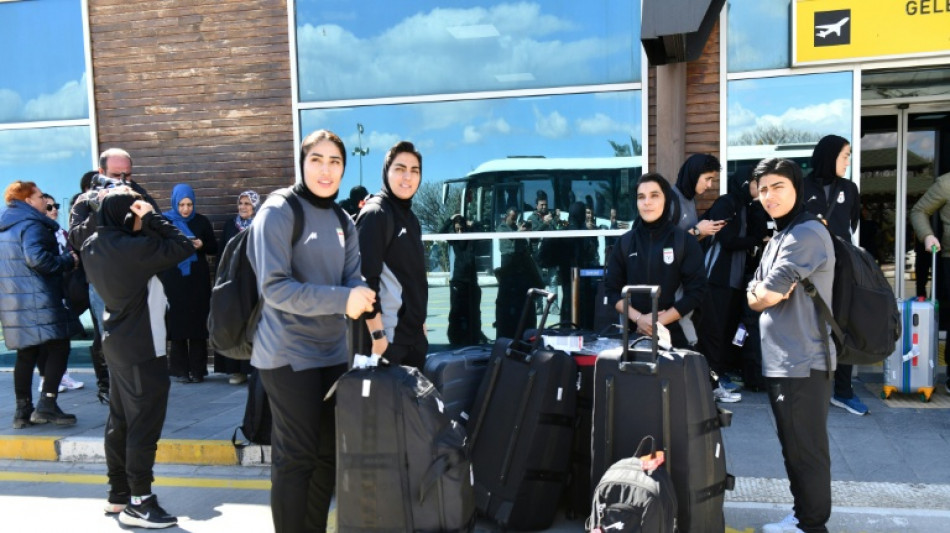
Iran women's football team cross Turkish border to head home: AFP / Photo: Ali IHSAN OZTURK - AFP
 November Foraging Guide: Edible Mushrooms and Critical Safety Protocols

 Microsoft Updates Xbox PC App with 60% Faster Startup and Redesigned Interface

 Early Polar Vortex Disruption Creates Uncertain Winter Outlook for Pennsylvania

 Edmund Richardson Wins Baillie Gifford Prize for 'Alexander' Biography

 BYD Drops Rotating Screens in New Models Due to Tech Limits

 Ryanair Flight from Rome Makes Emergency Landing in Lisbon After Bomb Threat

The Iranian women's national football team crossed the Turkish border into Iran on Wednesday, among them several players who withdrew an asylum bid in Australia.
Seven members of the delegation had sought sanctuary in Australia last week after being branded "traitors" in Iran for refusing to sing the national anthem before their opening game at the Women's Asian Cup.
But five later changed their minds, including captain Zahra Ghanbari.
The team arrived in Istanbul on Tuesday evening from Oman, then flew to the eastern city of Igdir before travelling home overland.
Wearing Iranian national team tracksuits, the women could be seen leaving the airport for the Gurbulak-Bazargan crossing about 100 kilometres (60 miles) to the southeast.
The players arrived in Turkey via Oman and Kuala Lumpur, having left Australia where they were competing in the Asian Cup.
"I am missing my family," one of them told AFP on Monday at Kuala Lumpur airport.
In a post on X, Iranian parliament speaker Mohammad Bagher Ghalibaf said the players and their support team were "children of the homeland, and the people of Iran embrace them".
He said by returning, they had "disappointed the enemies (of Iran) and did not surrender to deception and intimidation by anti-Iran elements".
In the end, only two of the players remained in Australia.
Rights groups have accused Tehran of pressuring athletes abroad by threatening relatives with the seizure of property if they defect or make statements against the Islamic republic.
Iranian authorities had in turn accused Australia of pressuring the players to stay.
G.Stevens--AMWN