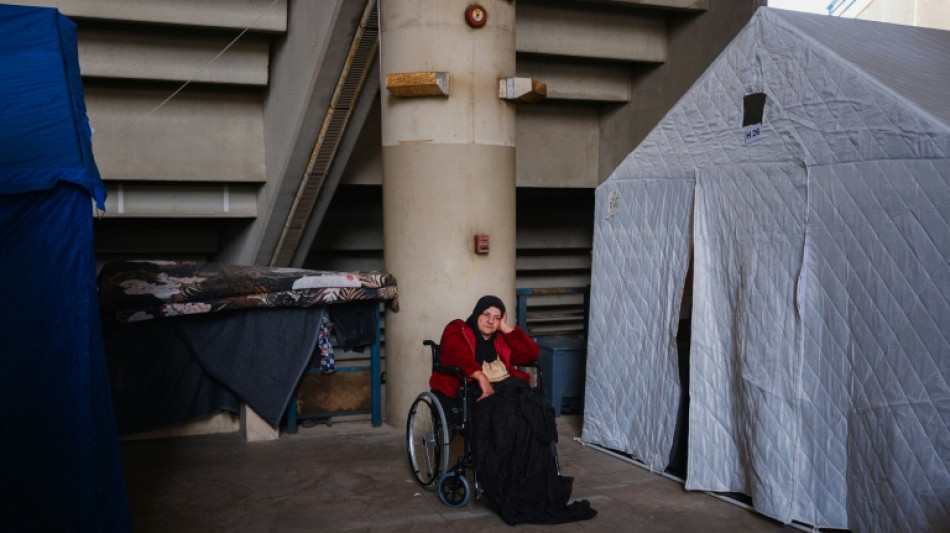
In Beirut's largest stadium, displaced people with disabilities face 'ordeal' / Photo: Dimitar DILKOFF - AFP
 Ireland pip Australia 33-31 in Nations Championship nailbiter

 Antonelli edges Hamilton in sprint to extend title lead
 Rennie 'relief' as All Blacks tenure begins with narrow win over France

 Europe's baked rice bowl seeks escape from drought

 Ukraine says still fighting for eastern stronghold

 Mali hit by new wave of coordinated attacks
 New Zealand edge France 34-32 in thriller to open Nations Championship
 Pope defends migrants at Mediterranean island frontier
 Pope to defend migrants at Mediterranean island frontier
 US turns 250 as Trump warns of 'attack' on American identity
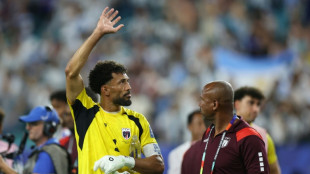
 Feels like 'victory': Cape Verde celebrates heroic World Cup defeat

 Haaland's stetson, Cape Verde's pride: World Cup last-32 moments
 Colombia overcome Ghana to reach World Cup last-16
 Cape Verde show anything is possible at World Cup with 'big hearts'

 Huge crowds gather as Khamenei funeral ceremonies open in Iran
 Mass protests expected as German far-right AfD meets

 Argentina survive Cape Verde scare to reach World Cup last 16
 England v Mexico World Cup game kickoff time unchanged: FIFA
 McDonald's, bus station convert into Venezuela quake clinics

 'Super typhoon' Bavi heads for US Pacific islands
 England seek end to Australia agony in Women's World Cup final
 President-elect Fujimori hails 'new chapter' for Peru
 Global celebrities pay court at Swift, Kelce "royal wedding"

 Dangerous heat wave roasts America's big birthday party
 Egypt edge Australia on penalties to reach World Cup last 16
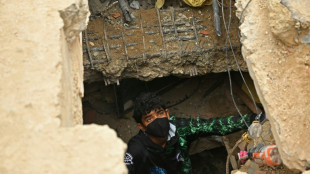
In the stands of Beirut's largest stadium, it is the shouts of children displaced by war that echo, not the songs of fans.
Beneath the concrete steps, more than a thousand people fleeing Israeli bombs on Lebanon sleep in tents, including around 50 wheelchair users and people with other mobility challenges.
The vast sports complex, which opened its doors to displaced people during the previous war in 2024, is one of the few shelters able to take in people with disabilities, despite being poorly adapted to their needs.
"If there's a strike, the people around me could run away and leave me behind; I can't get up and move if no one helps me," says 62-year-old Fatima Nazli, who uses a wheelchair.
The state has not put in place any strategy to evacuate people with disabilities, said Sylvana Lakkis, head of the Lebanese Union for People with Physical Disabilities.
"We submitted a policy and proposal" to the government, but "they never listened", she told AFP.
"Every time there is a crisis, we, people with disabilities pay the price."
Nazli and her husband had to leave their apartment in Beirut's southern suburbs, shelled by Israel since Lebanon was pulled into the Middle East war on March 2.
They are living in a tent in a section of the stadium where she is forced to ask Red Cross volunteers for help to get down the flight of steps leading to the only bathrooms she can access.
– 'Living in constant fear' –
The couple expects to move to another section of the stadium, where two access ramps and four accessible toilets were recently installed.
In the meantime, Nazli and her husband, Abu Ali, who did not wish to give his full name, go back to their apartment from time to time to take a shower and pick up clean clothes, gripped by fear because the neighbourhood "could be bombed at any moment" by the Israeli air force.
The Camille Chamoun Sports City, on the edge of Beirut's southern suburbs, has witnessed the twists and turns of Lebanon's troubled history.
Destroyed by bombing during the Israeli invasion in 1982 and rebuilt after the end of the civil war in 1990, it has fallen into disrepair due to a lack of funds for its upkeep.
Football legend Pele once trod its turf, and international sporting competitions have been held there.
But the stadium has also served as a warehouse for food supplies, and Hezbollah held the lavish funeral for its leader Hassan Nasrallah, killed by Israel, there in September 2024.
– 'An ordeal' –
"This place was not built to be lived in," says stadium director Naji Hammoud, who opened its doors "the next day" after the first evacuation warnings issued by the Israeli army in the southern suburbs in early March.
More than a million people have been displaced and Israeli strikes have killed more than 1,200 people, including 124 children, Lebanese authorities say.
Many displaced people are sleeping on the streets of the capital or in their cars, and Hammoud wants the facility to take in "as many as possible".
Around the tents, workers are busy renovating the unsanitary restrooms, installing showers and connecting them to the water supply, and hooking up electricity.
"I can't wash myself on my own, I need help," explains Khodr Salem, a shopkeeper from the south of the country, who has difficulty walking and uses a crutch because of an infection in his leg.
"We lived like kings in our homes. Our life has become an ordeal," the old man says through tears, sitting on a mattress in his tent.
For Lakkis, Lebanon doesn't have enough accessible shelters: the few schools able to receive people with disabilities fill up quickly.
Many displaced people therefore have to find relatives who can host them or pay exorbitant rents to landlords, explains Fadi Al-Halabi, executive director in Lebanon of the Ecumenical Disability Advocates Network.
"The international community must take into account the needs of people with disabilities" and allocate a share of the international aid budget to them, he said.
M.Fischer--AMWN