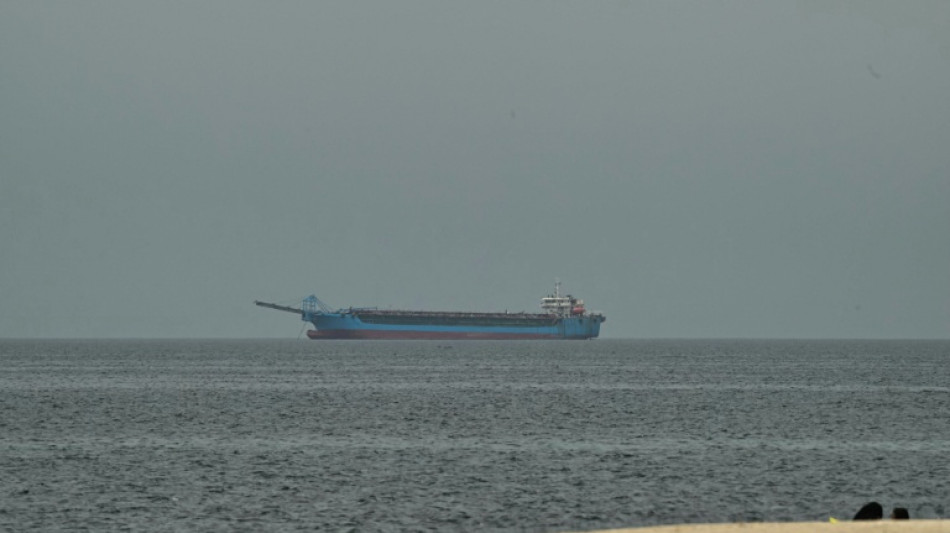
Stranded seafarers endure costly path home from Gulf / Photo: - - AFP
 England bowl against Pakistan in first Test of post-Bazball era

 Villa sign Japanese 'keeper Suzuki, Italian defender Ruggeri

 Injury-plagued Pogba released by Monaco

 Japanese 'keeper Suzuki signs for Aston Villa

 Paul Pogba to be released by Monaco: club

 Texas Counseling Center Highlights the Role of Counseling in Supporting Immigration Psychological Evaluations

 Pakistan govt to challenge court on moving ex-PM Khan to private hospital

 India four wickets away from victory in Sri Lanka Test

 Belgian wildfire 'encircled' but situation still 'complicated'

 Southern African mothers plead for sons lured to Russia's war

 Palestinian-American hoists US flag on home besieged by settlers

 Freedom Holding Marks New Türkiye Milestone as Freedom Yatırım Secures Brokerage License

 Humanoid resources: China's robots search for workforce breakthrough

 China goes rural with data centres in quest to power AI

 Trump pauses planned 50% tariffs on Canadian goods for three days

 Ikitau, Suaalii named in Australia squad for Argentina Tests

 'American Doctor' shows brutality of conflict in Gaza

 New Zealand blocks lawsuits against firms over climate harm

 Aussie Rules club suspends five players amid police probe

 No.1 Sabalenka slams Wang to power ahead in Cincinnati

 Israel blames Turkey after strike on Syria air base

 Who Does the Best Male Facelift Surgery in Sarasota?
 BioNxt Advances Cladribine Clinical Program with Completion of the Investigational Medicinal Product Dossier (IMPD) Ahead of Human Clinical Studies

 Elevate Acquires Lupl

 Caldwell Strengthens Life Sciences and Healthcare Practice with Addition of Olga Kozlova in Dubai

When seaman Rex Pereira saw missiles flying above his vessel in the Gulf, it sparked in him one desperate wish: to get back home to India.
Stranded by the Middle East war, like thousands of other seafarers, he feared for his life as he saw bombardments in the distance in Iran.
When he demanded to be repatriated from his supply vessel docked in Iraq, he did not expect the process would take him weeks and cost him hundreds of dollars.
Besides the perils of the US-Israeli war with Iran, he and many of the 20,000 other seafarers stuck in the region struggled with the shipping industry's poorly regulated working conditions.
"Whatever I have earned (on the ship), I think I paid the entire amount in travelling, so I didn't get anything in return. All of my savings are gone," the 28-year-old told AFP by phone from his home in Mumbai.
"The experience was really bad, so I don't think I will be going back to the sea."
- Passport struggle -
When the bombs started flying as the war broke out, Pereira contacted unions in India on March 3 for help to get home.
The owner of his vessel had his passport and was refusing to give it back.
The unions contacted the Indian embassy in Iraq, which made visa requests and pressed Iraqi immigration officers to force the owner to return Pereira's documents.
In the meantime, his ship was running out of food and water.
He and his crewmates had to boil water to drink, and collected water dripping from air conditioning units to shower and wash their clothes.
– Long journey home –
When he finally got his necessary visas a month later, on April 2, a long and expensive journey home began.
"An immigration officer came to pick me up on April 5 and dropped me at the Kuwait border. After that, I was alone," he said.
He took a bus and three taxis, travelling for 17 hours to reach Riyadh airport in Saudi Arabia, where he took a flight to Mumbai early on April 7 -- two full days after he had left his vessel in Iraq.
He spent $1,350 in total to get home: $200 for part of the plane ticket -- the rest was paid for by his company -- $450 for the taxis and $700 for visas.
He said he hoped to get reimbursed by the Indian recruitment agency that got him the job, but had not heard back from it since he got home.
– 'Logistical nightmare' –
"This type of situation is unfortunately very, very recurrent," says Mohamed Arrachedi, Network Coordinator for the Arab World and Iran at the International Transport Workers' Federation (ITF).
The off-duty captain of one vessel which was stuck off Qatar told AFP that replacing seafarers in the Gulf amid the war was a "logistical nightmare" and could cost up to twice as much as in non-war times.
Because of this, many ship owners were reluctant to let their crew sign off, said Manoj Yadav, the General Secretary of the Forward Seamen's Union of India.
Even when seafarers are authorised to leave, the process is "delayed because processing of visas taking longer than usual, and because very few flights are available", Yadav told AFP.
He said more than 200 Indian seafarers had asked his union for help with bringing them home.
Some of them had to travel "nearly 1,800 kilometres (1,100 miles) by road from Iran to Azerbaijan to catch a flight to India".
- Fear on board -
Shivendra Chaurasiya's journey home lasted three days. He reached his village in Uttar Pradesh, India on April 6.
After joining the crew of a bulk carrier in December, he was stuck while it was anchored at Bandar Abbas, Iran, from late February.
He described the fear he felt on board, seeing ships hit by strikes.
"My life was at risk. I used to think, which meal might be my last one? Maybe today's breakfast is my last."
Unlike Pereira's, his employer paid for his entire trip home.
Doing so is a legal requirement for companies whose ships are covered by the International Bargaining Forum (IBF)'s labour agreements -- around 15,000 vessels worldwide, according to the IBF.
– $300 salary –
Seafarers wishing to leave vessels with no such agreements in place either have to pay for their own way home or are left stranded.
One 21-year-old seafarer, who asked to be identified only as Manish, said he could not afford to get home.
"I have not received my salary of 300 dollars a month," he said.
He spoke on Monday to AFP from the cargo vessel he joined nine months ago, stuck in Iran since the start of the war.
His contract had ended but he said the vessel's owner was refusing to pay for his return home despite a clause in his contract -- seen by AFP –- that explicitly stated the owner had to.
"We have no provisions, no food, and too many problems", he told AFP. "Please, tell someone who can help with a ticket to go back to my homeland."
F.Dubois--AMWN