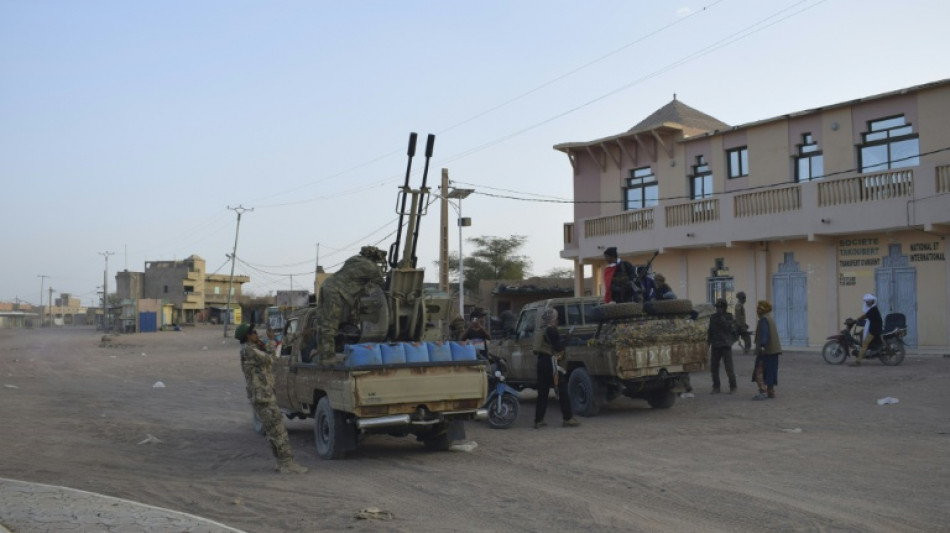
Separate goals, common enemy for Mali's jihadists and separatists / Photo: - - AFP
 New 'Insidious' reflects anxiety of being a new parent: director

 No.1 Sabalenka slams Wang to advance at Cincinnati

 Turkey rejects Israeli claims after strike on Syria air base
 Climate change main driver of European ocean warming: study

 Gauff finds a way into the Cincinnati fourth round

 ZZ Top drummer Frank Beard dies at age 77
 Bayern's Musiala reveals 'neurological disorder' after on-field collapse

 Angelique Kidjo immortalised on Hollywood Walk of Fame

 France to expel two Iranian diplomats: foreign minister

 Spain's Granada closes iconic Alhambra as new quake hits

 Venus, Stephens, Monfils named among US Open wild cards

 Rodri joins La Liga champions Barcelona from Manchester City

 Disney, ABC sue US regulator over threat to broadcast licenses

 Trump, Carney hold talks as new US tariffs on Canada loom

 Germany opens new drone research centre as security threats mount

 How only a few tree species drive Amazon forest recovery

 Ivonne A-Baki enters race to be next UN chief

 Ukraine says Russian strike kills 10 in northeast region

 Meta in court over child social media addiction

 Vieira appointed Senegal head coach after World Cup disappointment
 F1's Albon re-signs with Williams for 2027

 Borderless.xyz Deepens Africa Coverage as CrissCross Goes Live on Its Network

 Pakistan court orders ex-PM Khan moved from jail to hospital
 'Lonely place': Black UK academics slam racism after Arday's death
 UK PM says not embarrassed by hoax messages with fake Trump aide
Unprecedented attacks in Mali by Al-Qaeda-linked jihadists and Tuareg separatists who killed the defence minister and seized a key town are the dramatic result of a new alliance the two groups forged a year ago.
The separatists and the jihadists have divergent interests, but are united against a common enemy, experts say: the military junta that has ruled the west African country since 2020 and its Russian paramilitary backers.
Militants from Al-Qaeda's branch in the African Sahel region, the Group for the Support of Islam and Muslims (JNIM), claimed responsibility on Saturday for a series of brazen attacks carried out with the Azawad Liberation Front (FLA), an ethnic Tuareg separatist movement.
Attacking strategic positions held by Mali's ruling junta in several major towns and on the outskirts of the capital, Bamako, the militants took control of the northern town of Kidal and killed Defence Minister Sadio Camara.
JNIM attributed its "victory" to "hard work" and the "active participation of our brothers in the Azawad Liberation Front".
This predominantly Tuareg separatist group, created in 2024, wants independence for the territory of Azawad in northern Mali.
On Saturday, the rebels and jihadists launched a joint assault on Kidal, which they now control again after losing it in November 2023 to the Malian army and allied fighters from the Wagner Group, a Russian mercenary force now largely replaced by Moscow's Africa Corps paramilitary group.
Security sources said the JNIM and FLA also fought together in the northern town of Gao on Saturday. They were pushed back by the Malian army, but remain deployed in the area.
The attacks are reminiscent of a crisis that rocked Mali in 2012, when Tuareg rebels allied with jihadists to capture strategic hubs in the country's vast, remote north.
That was before the alliance disintegrated, the two erstwhile allies turned on each other and the jihadists drove the Tuareg separatists out.
- Different agendas -
Relations between the two were fraught for years, leading to direct clashes in April 2024 on the Mauritanian border.
But they forged a fresh alliance in 2025, according to Wassim Nasr, a researcher at the Soufan Center think tank who specialises in jihadist movements.
The Tuaregs, a historically nomadic people present across Mali, Niger, Algeria, Libya and Burkina Faso, have for decades taken up arms to protest at being marginalised, particularly around Kidal.
The new deal between the FLA and JNIM says the Tuareg rebels will accept the application of sharia law, that judges need to be accepted by both movements before they can be appointed, and that the two will share military expertise.
It also stipulates, Nasr said, that if towns are captured, the urban centres will be administered primarily by the FLA, while rural zones will be the purview of the jihadists.
The decision to cooperate, Nasr said, has been aided by the Islamists' willingness to share their expertise in the use of improvised explosive devices (IEDs) and mortars -- capabilities the FLA had previously struggled to master.
Saturday's coordinated attacks mark "the first time we have truly seen the terms of the agreement put into practice", he said.
A distinctive feature of this new alliance is that it unites two organisations with different agendas, said Jean-Herve Jezequel, the head of the Sahel project at the International Crisis Group.
"JNIM pursues a political-religious agenda, centred on the establishment of sharia law and the rejection of foreign forces, whilst the FLA champions a territorial and autonomist agenda, centred on Azawad," he said.
"This convergence is based above all on the existence of common adversaries, namely the Malian authorities and their Russian partners."
- 'Hasten the junta's fall' -
Nasr said the alliance's strategic goal was not to seize power in Bamako from the ruling junta, but to retake the northern regions.
"They pinned down the army in the centre, dealt a blow to the government in Bamako -- which paralysed the military response -- and achieved their aims in the north," he said of the capture of Kidal.
"They may subsequently try to press their advantage in the centre of the country... to hasten the fall of the junta and/or elicit regime change in Bamako," he said.
Junta leader Assimi Goita has not spoken or been seen publicly since the attacks began, and the head of the intelligence services, Modibo Kone, has been wounded by gunfire.
The groups' strategy "is to weaken and delegitimise the Malian authorities by increasing security pressure in the hope that the regime will collapse, rather than directly seizing power, which appears more complicated in the short term", Jezequel said.
Unlike the alliances of the early 2010s, which quickly fell apart, Jezequel said, the current cooperation deal could last longer, even if its medium-term future might be uncertain.
Nasr said the real test will be how cities such as Kidal are managed -- a phase that has not yet begun.
F.Schneider--AMWN