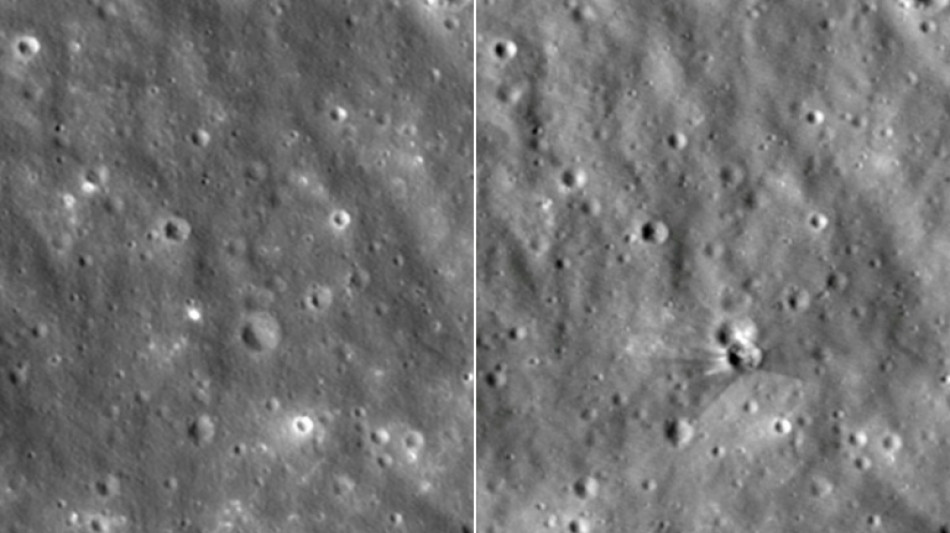
NASA images reveal crater left by SpaceX rocket's Moon crash / Photo: - - NASA Goddard/Intuitive Machines/AFP
 Gauff finds a way into the Cincinnati fourth round
 ZZ Top drummer Frank Beard dies at age 77

 Bayern's Musiala reveals 'neurological disorder' after on-field collapse

 Angelique Kidjo immortalised on Hollywood Walk of Fame

 France to expel two Iranian diplomats: foreign minister

 Spain's Granada closes iconic Alhambra as new quake hits

 Venus, Stephens, Monfils named among US Open wild cards

 Rodri joins La Liga champions Barcelona from Manchester City

 Disney, ABC sue US regulator over threat to broadcast licenses

 Trump, Carney hold talks as new US tariffs on Canada loom

 Germany opens new drone research centre as security threats mount

 How only a few tree species drive Amazon forest recovery

 Ivonne A-Baki enters race to be next UN chief

 Ukraine says Russian strike kills 10 in northeast region

 Meta in court over child social media addiction

 Vieira appointed Senegal head coach after World Cup disappointment

 F1's Albon re-signs with Williams for 2027

 Borderless.xyz Deepens Africa Coverage as CrissCross Goes Live on Its Network

 Pakistan court orders ex-PM Khan moved from jail to hospital

 'Lonely place': Black UK academics slam racism after Arday's death

 UK PM says not embarrassed by hoax messages with fake Trump aide

 West Bank siege exposes Israel army inaction on settler violence

 Four-time champion Roglic to ride Vuelta after training crash

 Ukrainian convicted in Germany over Russian sabotage plot

 Beleaguered FIFA chief Infantino rids himself of critic Lamour

NASA on Tuesday released new images of the crater caused by a SpaceX rocket slamming into the Moon earlier this month.
The photographs were captured by the Lunar Reconnaissance Orbiter (LRO) between August 11 and 12, and show the impact formed by a SpaceX Falcon 9 upper stage striking the Moon's surface on August 5.
Scientists from the US space agency determined the crater was 60-feet-wide (18 meters), and less than 10 feet deep, based on the length of its shadow.
The Falcon 9 launched in January 2025 carrying Firefly Aerospace's Blue Ghost 1 lunar lander, a private mission that made a soft landing on the Moon.
These weren't the first images of the crash site. The Korean space agency published pictures on August 6 that were taken a day earlier by Korea Pathfinder Lunar Orbiter (KPLO), also known as Danuri.
The LRO, in service since 2009, circles the Moon from pole to pole every two hours while the Moon rotates underneath it.
A NASA statement said it was challenging to capture the image. To photograph a specific spot on the Moon, the spacecraft must wait until that location turns into view, which took six days in this case -- and the spacecraft had to be tilted just right so that its camera pointed to the crater while it passed 60 miles overhead.
Timing was the other challenge, NASA said: "If the camera snapped even 10 seconds too early or too late, the target would drift off-center by 10 miles."
The images they captured from different viewing angles brought out different features, including brighter and darker streaks fanning out around the crater.
NASA explained the darker streaks "are made of surface dust and rocks altered over a long time by solar wind, galactic cosmic rays, and micrometeorite impacts" that was thrown up by the collision from 1.5 feet below the surface.
The brighter streaks that hug the crater's rim were fresh material excavated from deeper underground.
Finding the crater site was a global endeavor that brought together leading experts and hobbyists.
NASA said its Center for Near Earth Object Studies incrementally refined the trajectory until identifying the location of impact, which it then provided to Korea.
The Danuri team in turn sent their coordinates to NASA's LRO team to help refine their follow-up imaging sequence.
P.Santos--AMWN