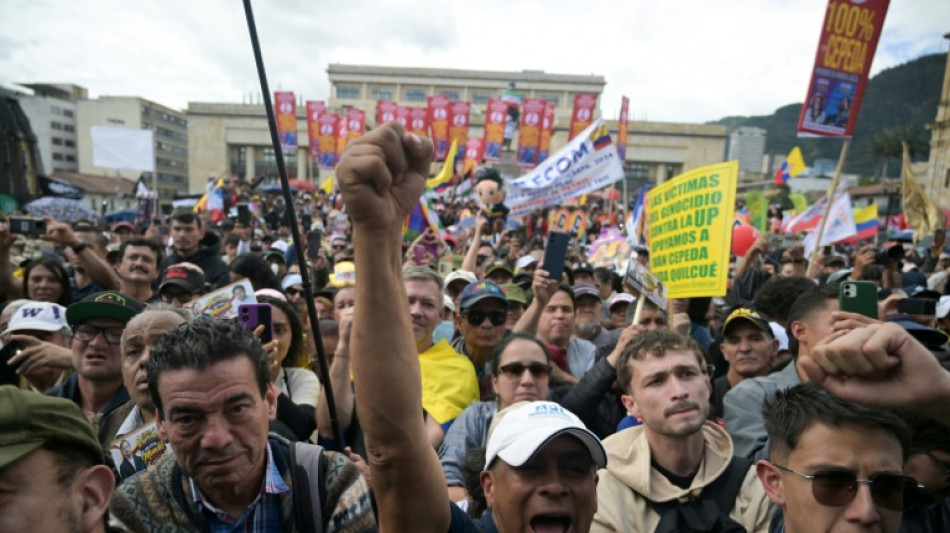
'No going back' for Colombia's workers as the right eyes return / Photo: Raul ARBOLEDA - AFP
 Gauff finds a way into the Cincinnati fourth round

 ZZ Top drummer Frank Beard dies at age 77
 Bayern's Musiala reveals 'neurological disorder' after on-field collapse
 Angelique Kidjo immortalised on Hollywood Walk of Fame
 France to expel two Iranian diplomats: foreign minister

 Spain's Granada closes iconic Alhambra as new quake hits
 Venus, Stephens, Monfils named among US Open wild cards

 Rodri joins La Liga champions Barcelona from Manchester City
 Disney, ABC sue US regulator over threat to broadcast licenses

 Trump, Carney hold talks as new US tariffs on Canada loom

 Germany opens new drone research centre as security threats mount
 How only a few tree species drive Amazon forest recovery
 Ivonne A-Baki enters race to be next UN chief
 Ukraine says Russian strike kills 10 in northeast region

 Meta in court over child social media addiction

 Vieira appointed Senegal head coach after World Cup disappointment
 F1's Albon re-signs with Williams for 2027

 Borderless.xyz Deepens Africa Coverage as CrissCross Goes Live on Its Network

 Pakistan court orders ex-PM Khan moved from jail to hospital
 'Lonely place': Black UK academics slam racism after Arday's death
 UK PM says not embarrassed by hoax messages with fake Trump aide
 West Bank siege exposes Israel army inaction on settler violence
 Four-time champion Roglic to ride Vuelta after training crash
 Ukrainian convicted in Germany over Russian sabotage plot

 Beleaguered FIFA chief Infantino rids himself of critic Lamour

Colombian workers on Friday had a message for the two right-wing candidates trying to flip the presidency four years after the country elected its first leftist leader: "We're not going back."
The South American country goes to the polls on May 31 to choose a successor to firebrand President Gustavo Petro, famous for his skirmishes on X with President Donald Trump.
Polls show Petro's political heir, Senator Ivan Cepeda, winning the first round of voting with a program of continued social support for the poor in one of the world's most unequal countries.
But it is unclear whether he can triumph in a run-off against ultra-right lawyer Abelardo de la Espriella or conservative senator Paloma Valencia in an election shadowed by a surge in guerrilla violence, which the right has laid at Petro's feet.
Addressing a May Day rally in Bogota on Friday, Cepeda warned that workers' rights, including an unprecedented increase in the minimum wage, would be rolled back if the right came to power.
His rivals, he declared, represented the "neoliberal model of opulence for a narrow, unscrupulous and unproductive elite" that dominated Colombia's history until Petro, a former leftist guerrilla, came to power in 2022.
"Comrades, don't allow them to take away what we have achieved!" Cepeda, a professorial figure in a collarless white shirt and rimless glasses, told thousands of supporters gathered outside Congress under a hot Andean sun.
"The people have awoken. There's no going back," former health minister Carolina Corcho roared from the stage.
- 'Peace of mind' -
A few months ago, the odds appeared to be stacked against the left.
From Argentina to Bolivia to Chile, Latin American voters were tossing out left-wing governments, accusing them of corruption, shambolic economic management and/or failing to halt crime and illegal migration.
Petro was in the crosshairs of US President Donald Trump, who in January told him to "watch his ass" after overthrowing fellow left-winger Nicolas Maduro of Venezuela.
But after patching up relations with Trump during a White House visit, and implementing a 23-percent minimum wage hike, Petro's popularity soared, and with it that of Cepeda.
For Alejandro Guayara, a 38-year-old father of two struggling to make ends meet as a doorman in a Bogota apartment building, the wage hike represented "peace of mind."
While only 2.4 million Colombians are paid the minimum wage, many others have benefitted from increases to night-time and weekend pay pushed through by Petro last year as part of a major labor reform.
"People have experienced new-found hope with this president because ordinary people are being taken into account," Guayara said.
"Today the power is in our hands, that of the people," Jose Cruz, a 60-year-old former member of the M-19 urban guerrilla group to which Petro belonged in his youth, told AFP.
Petro's past within M-19, which disbanded in 1990, has been used by critics to suggest he is cozy with the myriad armed groups that still rule large parts of Colombia's northeast and south.
Yann Basset, a professor of political science at the University of Rosario in Bogota, said the Colombian left was long dogged by its association with left-wing guerrillas.
But now "a large part of the population associate it with something else, with the social reforms of the Petro government in particular, and much less with violence."
Petro's failure to broker peace with the country's various cocaine-trafficking armed groups has however tainted his legacy for some left-wing voters.
It has also soured them on Cepeda, a key architect of the peace talks strategy.
Last year was the most violent in the decade since the Marxist rebel army FARC signed a historic peace deal ending half a century of war with the state.
Last weekend, a dissident FARC faction opposed to the peace deal bombed a highway in southern Colombia, killing 21 people, in what it later said was an "error."
The situation has boosted calls for a "mano dura" approach of the kind promoted by de la Espriella and Valencia.
"Security has been terrible in recent years," 18-year-old engineering student Juan Manuel Cespedes said, calling for harsher prison sentences.
Y.Nakamura--AMWN