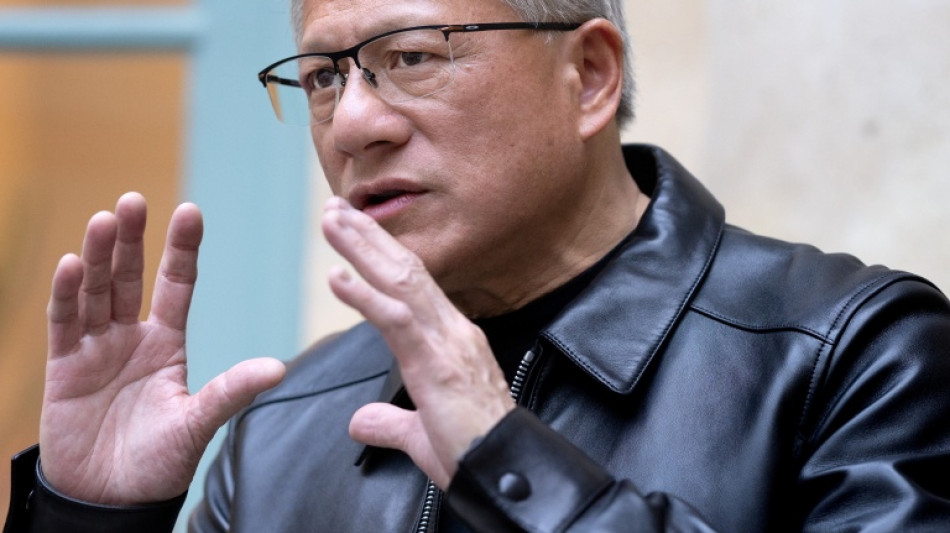
Asian stocks rise as tech bounces from rout, Warsh upbeat on AI / Photo: Joel Saget - AFP
 Search Underway for 'Dooars Rani' Tigress After Second Escape from Buxa Tiger Reserve

 The Dilemma of Recording Live Music: Preserving Memories vs. Being Present

 InterContinental Hotels Group PLC Announces Transaction in Own Shares - November 11

 Fulcrum Metals PLC Announces New Critical Mineral Recoveries Expand Potential
 Fulcrum Metals PLC Announces Publication of Updated Investor Presentation

 Christmas Day Shifts More than Double as Americans Return to In-Person Holiday Celebrations

 Thukukile Zuma Resigns from ANC Johannesburg Leadership Amid Disciplinary Dispute

 CM Mohan Yadav Meets Bohra Spiritual Leader to Discuss Simhastha 2028 and Development

 Eli Crane Defeats Jonathan Nez in Tight Arizona Congressional Race

Most Asian markets bounced Friday after the previous day's tech rout fuelled by concerns over the AI boom, which Federal Reserve boss Kevin Warsh said offered huge benefits to the global economy.
Seoul and Tokyo enjoyed healthy gains in early exchanges boosted by chipmakers SK hynix and Kioxia, after having been pummelled Thursday as investors bailed out of the once-dominant AI sector.
The selling had been fuelled by forecast-beating US inflation data that ramped up bets on Fed interest rate hikes, as well as concerns about the financial health of data centre operator CoreWeave owing to its huge debt pile.
The New Jersey firm -- which has borrowed heavily to finance hefty purchases of pricey semiconductor chips from Nvidia -- tanked 15.5 percent Wednesday in the US as yields on some of its bonds soared, reflecting heightened angst over its future.
That added to concerns about the whole AI-tech complex, but Nvidia chief Jensen Huang on Thursday lifted spirits by defending the company and its health.
"CoreWeave's strength is improving every day," he told Bloomberg. "I'm optimistic. Their cost of capital is actually decreasing."
CoreWeave's shares climbed almost six percent.
Huang's "defence of CoreWeave's financial position was enough to pull the NeoCloud complex off the floor, drag AI equities higher and give the broader market something resembling a pulse", wrote SPI Asset Management's Stephen Innes.
"One moment the market was pricing the possibility that the AI financing machine had started eating its own tail, the next it was listening to the high priest of the boom explain that the patient was getting stronger.
"AI Jesus had entered the trading room and, for a while at least, the machines found religion again."
Seoul jumped more than two percent and Tokyo around 1.8 percent, though they slumped 7.6 percent and 4.9 percent respectively Thursday.
Hong Kong, Shanghai, Singapore, Taipei, Mumbai, Bangkok and Manila were also up.
Paris and Frankfurt opened higher but London fell.
Fed chief Warsh said Friday that AI was the "most consequential change" to the global economy in his lifetime, predicting its effects would be positive but the path forward "bumpy".
At an event at the IMF-World Bank Annual Meetings in Bangkok he said the AI investment boom would drive prices up in the short term, but "there really is, I think, a huge benefit to the global economy, to the US economy over the horizon".
He also reiterated his previously stated belief that the technology would "make economies and countries that put it to good use more productive".
But he added: "The path from where we are to there is likely to be a very bumpy one, bumpy in our understanding of the technology, bumpy because we really don't know what the market structure is going to be of these new technologies."
Shares in Jakarta tanked more than 11 percent -- its heaviest loss since 1998 -- after index compiler MSCI said it was "no longer appropriate" to maintain Indonesia's emerging-market status, fuelling fears of an exodus of foreign investment.
The US firm said earlier this year that investors had raised concerns about "ongoing opacity in shareholding structures" as well as co-ordinated trading behaviour that affected price information.
Authorities said they had carried out changes but MSCI said Friday that investors had indicated the "sufficient progress has not been observed consistently across the Indonesian equity market", adding "it considers Indonesia's continued classification as an Emerging Market no longer appropriate".
- Key figures at around 0715 GMT -
Tokyo - Nikkei 225: UP 1.4 percent to 65,324.29 (close)
Seoul - Kospi: UP 2.1 percent to 5,668.05 (close)
Hong Kong - Hang Seng Index: UP 0.3 percent to 24,136.88
Shanghai - Composite: UP 0.2 percent to 3,716.28 (close)
London - FTSE 100: DOWN 0.3 percent at 10,810.91
West Texas Intermediate: DOWN 0.7 percent at $97.27 per barrel
Brent North Sea crude: DOWN 0.7 percent at $105.17 per barrel
Euro/dollar: UP at $1.1235 from $1.1213 on Thursday
Pound/dollar: UP at $1.3310 from $1.3274
Dollar/yen: DOWN at 157.94 yen from 158.12 yen
Euro/pound: DOWN at 84.41 pence from 84.47 pence
New York - Dow: UP 1.1 percent at 52,177.69 (close)
P.Silva--AMWN