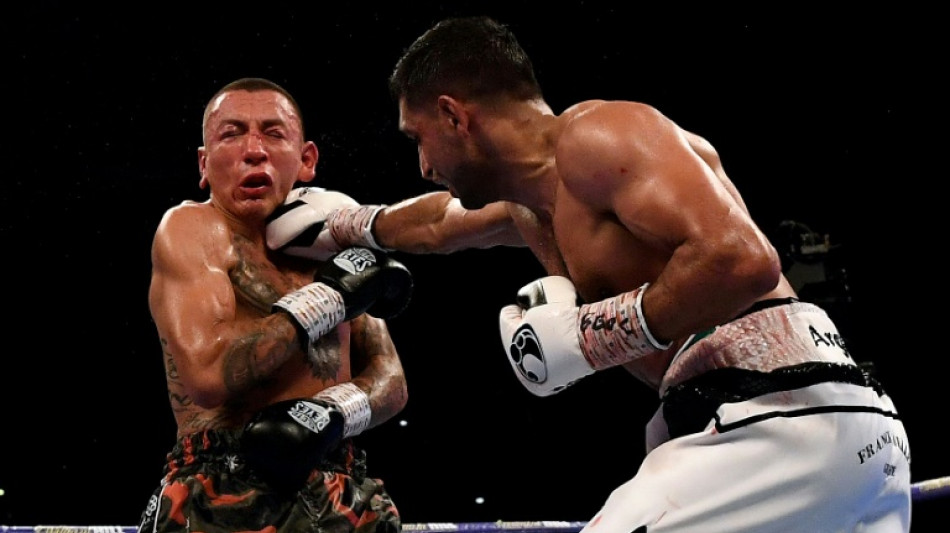
Ex-world champion Khan handed two-year doping ban / Photo: Paul ELLIS - AFP
 Pope Leo begins three-country South American tour in Uruguay

 Khawaja says entire Australia camp knew of 2018 ball-tampering plan

 November Foraging Guide: Edible Mushrooms and Critical Safety Protocols

 Microsoft Updates Xbox PC App with 60% Faster Startup and Redesigned Interface

 Early Polar Vortex Disruption Creates Uncertain Winter Outlook for Pennsylvania

 Edmund Richardson Wins Baillie Gifford Prize for 'Alexander' Biography

Former light-welterweight world champion Amir Khan said he would "never cheat" after being handed a two-year ban from all sport for testing positive for a prohibited substance.
UK Anti-Doping said on Tuesday that Khan, 36, returned a positive result for the anabolic agent ostarine following his loss to Kell Brook in Manchester in February 2022.
Khan, who announced his retirement in May last year, accepted a violation of anti-doping rules but said he had not intentionally ingested the substance, an argument accepted by an independent panel.
"I would never cheat. I'm a retired fighter. I've got a two-year ban now which is quite strange and funny that they banned me. I've already retired. I've no comeback plans at all," Khan told Sky News.
Khan was first notified of his own positive result in April 2022 and given a provisional suspension, with charges following in July after he had announced his retirement with a 34-6 professional record.
Following the hearing in January this year, the National Anti-Doping Panel accepted Khan's submission he had not taken the substance intentionally but imposed the ban on the basis of strict liability.
Ostarine is a drug designed to have similar effects to testosterone.
"You can see by my performance against Kell Brook wasn't the best. I lost the fight. If I went in there and knocked Kell Brook out it's different," added Khan.
"I've never cheated in my life. I'm the one that wanted testing on that fight. Also, the amount that was in my system could have been by shaking people's hands. I don't know the drug that was in my system."
The ban is deemed to have commenced on 6 April 2022, when his provisional suspension was imposed, and will expire on 5 April 2024.
UKAD chief executive Jane Rumble said: "This case serves as a reminder that UKAD will diligently pursue anti-doping rule violations in order to protect clean sport."
Khan became a household name in Britain after claiming a silver medal at the 2004 Athens Olympics, aged just 17.
He made his professional debut in July 2005 and four years later won the WBA light-welterweight title with victory over Andreas Kotelnik in Manchester.
Khan unified the WBA and IBF titles with a win over Zab Judah in 2011 but controversially lost his next fight to Lamont Peterson, who would subsequently test positive for synthetic testosterone.
O.Karlsson--AMWN