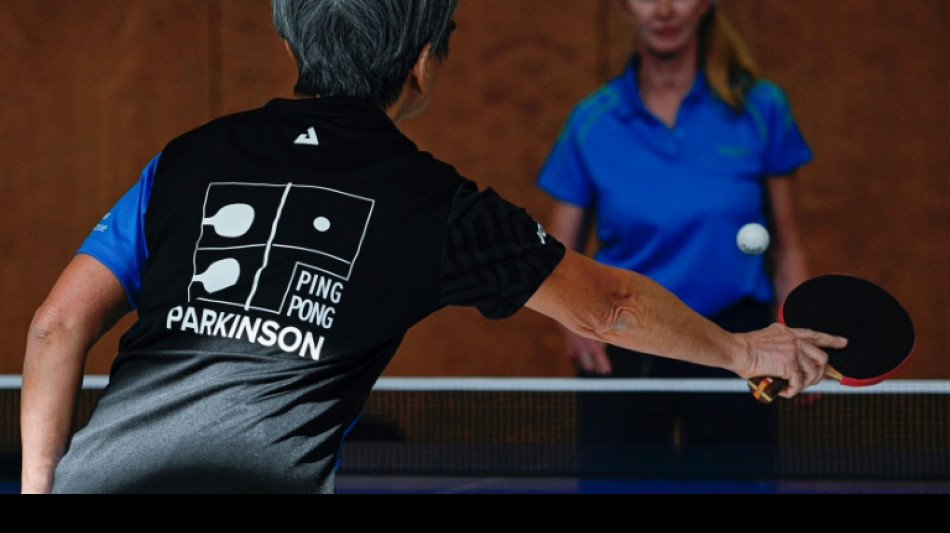
Berlin patients use ping-pong to ease Parkinson's pain / Photo: Tobias SCHWARZ - AFP
 Anna Miltina Confronted with Racism Allegations on ProSieben Show

 German Auto Giants Face Existential Crisis as China Sales Plummet

 Cause of Death Revealed for 'Ellen' Producer Matthew Wright

 How to Enjoy Luxury Experiences on a Budget

 Pakistan Demands Grant-Based Climate Finance at COP31 to Avoid Debt Trap

 E Pellicci Pop-Up at Selfridges Brings Back Nostalgic School Cake

 Coronation Street's Debbie Webster Steps Down as Dementia Storyline Intensifies
Luci Krippner's eyes never leave the little white ball as her arms loosen up. When she plays ping-pong like today in Berlin, she can forget for a while that she has Parkinson's disease.
"I train sometimes for three hours without realising I'm tired. It's great," said the 69-year-old pensioner. She has lived since 2015 with the neurodegenerative illness that impacts her ability to move.
Krippner said playing table tennis reduces tremors and eases her pain. "And at night I sleep better," she added over the din of bouncing plastic balls.
Since last year, Krippner has been training twice a week with a dozen members of the "Ping Pong Parkinson" association, which promotes what it calls the therapeutic virtues of the discipline.
On April 11, World Parkinson's Day, the players were all in, relentlessly pounding the ball across the short net.
"I need less of my medication when I play regularly," said coach Andreas Moroff, 54.
Wearing a "Team Germany" shirt, he checked from time to time that everyone was feeling well.
"When you're playing table tennis, you don't think about your Parkinson's," Moroff said.
"Everyone can stop whenever they need to and when their medication begins to wear off, they can take a break and drink something."
- World Cup -
Between matches or after training, the table-tennis players sometimes talk about their journey with the disease.
"Here we know better than anyone what we experience on a daily basis, the sorrows and anxieties," Moroff said.
"It's really nice to play with people who have the same lot," agreed Michael Siegert, 65.
The graduate school professor erupted in joy after winning a point. "It's not just fun, it's also a form of therapy," he said.
Several members of the team, including Moroff and Krippner, will participate in Ping Pong Parkinson's next World Championship in September in Austria.
Moroff spends about 10 hours a week with a paddle in his hand but said the aim is not to take playing too seriously.
Established in Germany in 2020, Ping Pong Parkinson has 170 clubs across the country and around 1,000 members.
On its website, the association cites a Japanese study from 2021 according to which regular practice of ping-pong for six months can reduce the physical symptoms of Parkinson's, such as tremors or stiffness.
Some 400,000 people live with Parkinson's disease in Germany, according to the association.
The incurable illness causes uncontrollable movements such as shaking, as well as sleep and mental health disorders. The symptoms get worse over time, and eventually patients can struggle to walk or talk.
P.Silva--AMWN