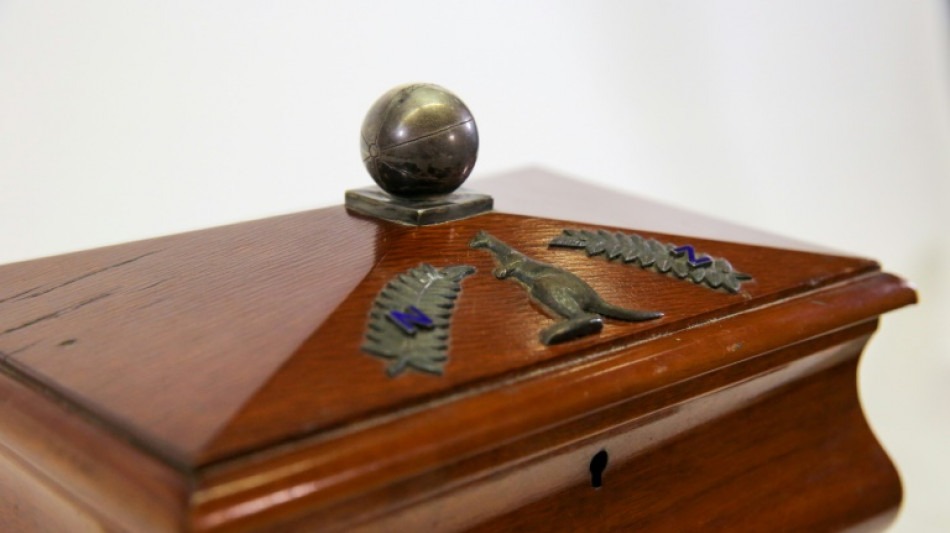
Australia rediscovers 'football's Ashes' after 69 years / Photo: Handout - FOOTBALL AUSTRALIA/AFP
 Anna Miltina Confronted with Racism Allegations on ProSieben Show

 German Auto Giants Face Existential Crisis as China Sales Plummet

 Cause of Death Revealed for 'Ellen' Producer Matthew Wright

 How to Enjoy Luxury Experiences on a Budget

 Pakistan Demands Grant-Based Climate Finance at COP31 to Avoid Debt Trap

 E Pellicci Pop-Up at Selfridges Brings Back Nostalgic School Cake

 Coronation Street's Debbie Webster Steps Down as Dementia Storyline Intensifies
A long-lost trophy crafted to celebrate matches between Australia and New Zealand has resurfaced, football officials said Tuesday, solving a sporting mystery that has puzzled historians for almost 70 years.
Inside the ornate wooden trophy is a small silver razor case containing the ashes of cigars smoked by the Australian and New Zealand captains after the sides met in 1923.
The case had belonged to a soldier during the treacherous Gallipoli landing of World War I.
Reminiscent of the celebrated Ashes urn contested between the Australian and English cricket teams, the Anzac Soccer Trophy was last seen in 1954.
Football Australia announced the discovery as tens of thousands of people gathered at Anzac Day dawn services there and in New Zealand to honour their armed forces.
"This is quite possibly the greatest domestic treasure there is in the game," football historian Trevor Thompson said.
"It's packed with so much imagery about the unity of the two countries, and the razor case that had been to Gallipoli referenced the recent experience of fighting shoulder to shoulder during the First World War."
The trophy was found by the family of former Australian football chairman Sydney Storey.
"This is not just a trophy, it's a symbol of Australia and New Zealand working together, playing together and looking after each other -- it's really, really powerful," the family said in a statement.
"Of course, how it is used again is up to Australia and New Zealand, but at least now it's available to them football organisations as a first step."
The wooden trophy, or casket, was built from a mix of Australian maple wood and New Zealand honeysuckle, while the silver razor case was carried during the Gallipoli landing in 1915 by Private William Fisher -- a football administrator.
J.Oliveira--AMWN