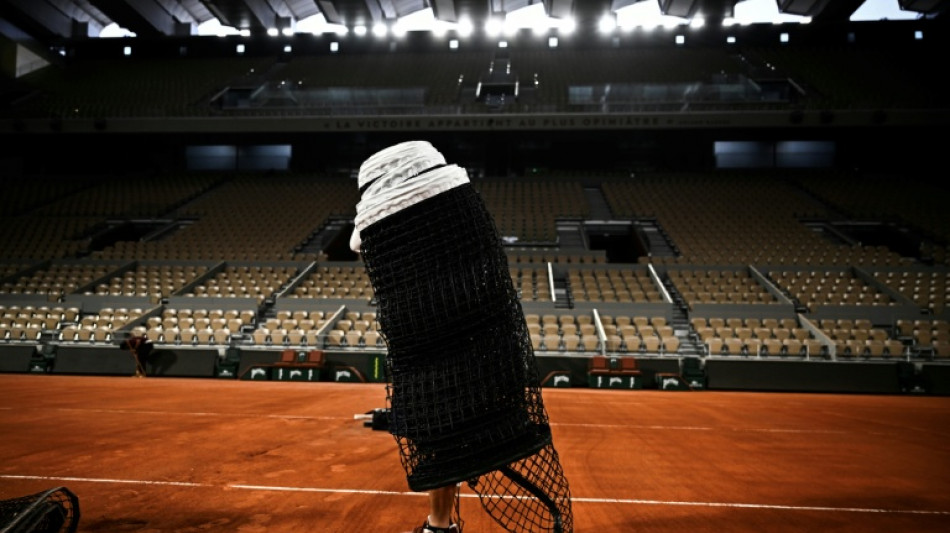
At Roland Garros, the 'other' clay specialists have their work cut out / Photo: JULIEN DE ROSA - AFP
 Student Activism Shifts Underground After University Crackdown on Gaza Encampments

 Surge in Early Social Security Claims Linked to Agency Turmoil

 Panthers Seek NFC South Lead Against Ravens as Baltimore Ends Skid

 Tosca's 2026 Sustainability Report Makes the Case for Packaging as Critical Supply Chain Infrastructure

 5 Fun Date Night Ideas That Don't Cost a Fortune

 GIRLBAND! Headline Show at Rough Trade Marks National Breakthrough

 Samsung Galaxy Buds Active Leak Reveals ANC, Ear-Hook Design and One UI 9.5 Integration

 Egypt and Syria Sign Agreement to Restore Direct Flights After 14-Year Hiatus

 Van Gogh’s ‘Châtaigniers en Fleurs’ Sets $285m Record at Sotheby’s

The almost cathedral-like silence of Court Philippe Chatrier is broken only by the thrumming of large squeegees scraping the clay: it's 6.30am and the groundstaff team quietly enters the arena to tend to the soon-to-be centuries-old ochre of Roland Garros.
With the aid of shovels, brooms and wheelbarrows -- and a dose of elbow grease -- the 180 or so specialised staff, most of whom are temporary workers, toil from dawn till dusk to whip the 18 courts into pristine condition for the year's second Grand Slam.
"It's a real craftsman's job," Philippe Vaillant, head of the groundskeeping department, insists of maintaining a surface that has been used at Roland Garros since 1928.
The clay, the product of 40 tonnes of red bricks from northern France which are then crushed in Belgium, is fickle in nature.
"It reacts very quickly to weather conditions, so you really have to pay close attention. It's almost like gardening," says Vaillant, who arrived at Roland Garros in 1995.
A blast of heat or wind and all bets are off: the clay dries and bakes, the surface becomes too fast and too slippery. A few drops of rain and the court can become too slow and greasy.
To make matters worse, small white granules from the thick layer of limestone beneath the clay - just a few millimetres thick - regularly rise to the surface.
- Relying on instinct -
Morning and evening, and sometimes between sets in the afternoon, the courts are watered heavily to counter the effects of the sun.
"We use around a cubic metre of water per day and per court, half as much as the toilet facilities and 10 times less than the kitchens," asserts Vaillant, aware of the environmental concerns and the need for reduced consumption.
Calcium chloride, which captures and retains water, is also added.
But there are no humidity sensors or other bits of technology to help.
"It's all down to the naked eye and the feel of the shoe," smiles Aurelien, who joined the crew in 2008.
The demands of the players must be factored in as well, which often increase as they scale the rankings.
Last year, Novak Djokovic attributed his injury during his last-16 victory over Argentina's Francisco Cerundolo to the lack of clay on Court Philippe Chatrier, which had become too slippery for his liking.
"There are players with whom it's a little more complicated. He's one of them. It's all good, all good or all bad," said a philosophical Vaillant.
"It's a hose pipe, there's no meter on it. Human error is possible," he admits, while pointing to players who ask to "only water their part of the court, or behind the baseline".
- Memories to savour -
For the temporary workers, the enemy is not so much the sun as the intermittent rain.
"The days of rolling out the tarp and removing it can be a bit tough" physically, points out Laurence, but that hasn't stopped her coming back for an eighth Roland Garros.
"It's very friendly, we come from all over France, that's what makes the adventure so charming."
"Coming to Roland Garros is the ultimate thing, it's a mythical place. We're like kids, we keep the flame burning," laughs Vincent, in his fifties.
For Aurelien, he cherishes the connection that will forever link him to record 14-time champion Rafael Nadal.
"I've prepared courts for Nadal," he says, "It's still a privilege. Tennis fans would write a huge check to be in my shoes."
L.Mason--AMWN