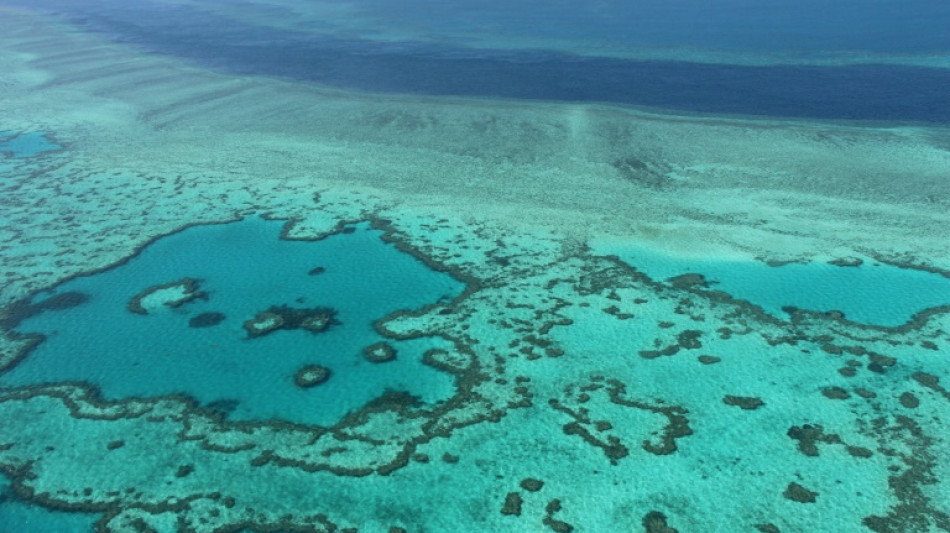
Australia falls short in Great Barrier Reef efforts: experts / Photo: SARAH LAI, SARAH LAI - AFP/File
 'No' camp seen winning Iceland's EU referendum

 Nepal flood survivors return to ruins to salvage memories

 Killing of Palestinian children and teens by Israel surges in West Bank

 Educators keep 9/11 memory alive for next generation, 25 years on

 Venezuelans view US oil deal with doubt, hope

 Gobena and Jepchirchir power to Sydney Marathon victories

 Iceland in suspense after close EU vote

 Wallabies hold on for victory in Argentina

 Juve notch second straight win, Fiorentina's centenary party falls flat

 Rybakina eases injury fears ahead of US Open
 Djokovic kicks off latest Grand Slam quest under US Open lights

 'Sorry' De Zerbi won't panic after Spurs shambles

 UN, Nepal warn of climate threat after deadly floods

 USTA boss says structure of new player council not yet set

 Tiny Elversberg stun Leverkusen on Bundesliga debut, Dortmund beat Hamburg

 James Cleverly leaves shadow cabinet to seek London mayoralty

 Baladi Map app turns Lebanon’s local problems into a public record

 Thirty-seven Mumbai pilgrims return after Nepal flood disruption

 Ankle ligament tear ends Neeraj Chopra’s 2026 season

 Chinchpoklicha Chintamani begins 2026 arrival procession in Parel

 Cyberabad civic body demolishes 19 unauthorised structures

 About 50 Karnataka travellers return from Nepal as 24 remain missing

 French campaign sharpens as far right accuses left over civil disobedience calls

 Court orders JIPMER assessment of Durai Dayanidhi before money-laundering trial

 Chennai councillors unite across parties to demand ward development funds

Despite warnings, Australia's efforts to save the Great Barrier Reef still fall short of protecting the world's largest coral reef system from pollution and climate change, experts said Monday.
Australia had taken unprecedented steps towards the protection of the Great Barrier Reef, which the United Nations has designated a world heritage site, but more was needed to avoid the site being declared "in danger" by UNESCO, the UN agency which compiles and manages a list of heritage sites.
Such a designation puts a government on notice that a site could be removed from the World Heritage list altogether, a very rare event.
"Despite the unparalleled science and management efforts" made by Australia over recent years, the Great Barrier Reef is "significantly impacted by climate change factors", Eleanor Carter at the International Union for Conservation of Nature (IUCN) and UNESCO representative Hans Thulstrup said in a report based on a mission to the Reef.
"The resilience of the property to recover from climate change impacts is substantially compromised," they said.
Carter and Thulstrup recommended that the reef should be added to the "World Heritage in Danger" list.
The Australian government in January announced a billion-dollar package to protect the reef, seven years after its "Reef 2050" plan, already a response to a UN downgrade threat.
The Climate Council pressure group said this latest package of funding was like putting "a Band-Aid on a broken leg".
Monday's report echoed that assessment, saying the reef's ability to recover from climate change impacts was "substantially compromised".
In particular, Australian strategies were "lacking clear climate change targets", while some measures were not fully implemented, especially concerning "water quality and fisheries activities", it said.
Australia reported in May that 91 percent of the reef's coral had been damaged by bleaching after a prolonged summer heatwave, a process that increases the mortality rates of the affected corals.
After intense lobbying, Australia narrowly avoided the Reef being placed on UNESCO's "in danger" list in the summer of 2021.
The then-government of conservative prime minister Scott Morrison was voted out this year in favour of a centre-left government under Anthony Albanese who has promised greener policies.
A UNESCO spokesperson told AFP that "a constructive dialogue is ongoing with the current government".
A source close to the matter called Monday's report "a roadmap submitted to the Australian government which should say what it intends to do with it and produce results".
The source added: "The path to saving the Great Barrier Reef is narrow, but it exists. Strong and rapid action can produce results.".
To be included on UNESCO's world heritage list, a site must have "outstanding universal value".
An spot on the list usually means boosted tourism, and improved access to funds and to scientific expertise.
Those benefits are threatened when a site is declared "in danger" -- which is currently the case of about 50 sites worldwide.
Only three sites have ever been dropped from the heritage list completely.
X.Karnes--AMWN